← JOURNAL29 Sep 2026
Onigiri at Home: Rice That Holds Together, Fillings That Work and Crisp Nori
 By SoJapan
The rice triangle looks effortless in a drawing: white grains, a dark strip of seaweed and perhaps a filling hidden in the middle. At home, it can become a different puzzle. The rice falls apart when lifted, the centre escapes through a crack, or the whole thing holds together so firmly that it eats like a compressed block.
Those problems do not all have the same solution. More squeezing may close a gap, but it cannot make every rice variety behave alike. More seaweed may hide the seam, but it cannot correct an overfilled centre. And keeping cooked rice warm on the counter to preserve its texture is not a safe storage plan.
This guide is for Indian anime fans who want to understand and try onigiri, not merely recognise it in a lunchbox. It follows the decisions involved in making one: the rice, the centre, the shape, the wrapper and the time before eating. The practical suggestions are editorial guidance based on the linked sources, not a claim that we have kitchen-tested a new recipe.
Onigiri are shaped portions of rice. They may contain a centre, have ingredients mixed through them, or be enjoyed quite simply. The triangle is familiar, but it is not the definition. Zojirushi’s onigiri introduction shows filled, mixed and grilled approaches, as well as round and barrel-like shapes. Nori is common, not compulsory. Explore the manufacturer’s onigiri overview.
The useful distinction from sushi is the rice preparation. A basic onigiri can use plain or lightly salted cooked rice. Sushi rice is seasoned with a vinegar mixture; Kikkoman’s preparation combines rice vinegar, sugar and salt. A rice triangle does not need that mixture merely because the uncooked grain was sold as “sushi rice.” See Kikkoman’s explanation of prepared sushi rice.
That phrase causes two different shopping questions to collapse into one. On an uncooked bag, it can describe rice intended for sushi-making. In a recipe, it can mean rice that has already been cooked and seasoned. Read which meaning is intended before adding anything.
You can choose a recipe that uses vinegar or another seasoning. The point is not to police your lunch. It is to understand that seasoning changes taste and is not an automatic structural requirement. If your first attempt crumbles, pouring sushi vinegar into it is not a diagnosis of the problem.
For the broader food context, our guide to bento boxes in anime explains how rice balls fit into a meal. Here, the focus is the bite itself.
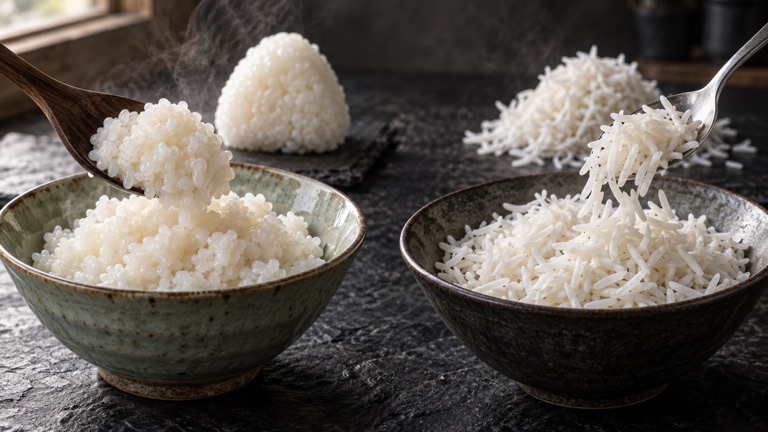
For an uncomplicated starting point, look for a short- or suitable medium-grain white rice intended for Japanese-style cooking. Zojirushi specifies these types in its basic filled-onigiri recipe. This is a practical starting specification, not a requirement to buy the most expensive imported brand. Read the basic filled-onigiri recipe.
USA Rice, the rice-industry organisation, describes cooked long-grain rice as relatively separate and fluffy, while short and medium grains tend to be moister and cling more. These are broad cooking tendencies, not a promise that every bag within a grain-length category behaves identically. Read its grain-type comparison.
If the rice you normally cook is selected to produce separate grains, do not assume it will form the same handheld shape under the same treatment. That is especially relevant when comparing the desired result with a fluffy biryani or a loose rice accompaniment. Neither texture is superior: they are solving different eating problems.
For a first attempt, changing the rice is a clearer experiment than adding several binders to a recipe that did not call for them. If the only rice available to you stays separate, serving the same filling and nori over a bowl of rice is a perfectly useful alternative. It lets you explore the flavours without pretending the structure is identical.
Ordinary Japanese table rice and mochigome, or glutinous rice used for foods such as mochi, are distinct. MAFF separates everyday uruchimai from mochigome in its explanation of rice uses. Do not select a bag only because an English label contains the word “sticky.” Read MAFF’s distinction between the rice types.
There are preparations using glutinous rice, brown rice and mixtures. They deserve recipes designed for them. They are not evidence that an unplanned one-for-one substitution will reproduce a basic white-rice onigiri.
When checking an unfamiliar bag, find the grain description, whether it is ordinary or glutinous rice, and its cooking instructions. A photograph of sushi is less informative than those details. Country of cultivation and culinary suitability are also different questions; a Japanese-style rice need not have been grown in Japan.
Taste a small amount of the freshly cooked rice with a clean utensil before shaping. If it is already unpleasantly hard or excessively wet, the filling is not going to resolve that. You have a cooking question before you have an onigiri question.
Use the directions for your actual rice and cooking equipment. Zojirushi’s white-rice instructions pair its supplied measuring cup with the matching cooker water line; they also distinguish preparation and resting instructions for different cooker types. Those details should not be flattened into a universal water ratio for every pot, pressure cooker or rice cooker. Check the manufacturer’s white-rice procedure.
In particular, “two cups of rice” followed by “water to line two” is an equipment-specific instruction. It does not mean two arbitrary mugs of rice plus two mugs of water. If you use a stovetop recipe, follow that recipe’s measurement system rather than borrowing only the rice quantity from a cooker recipe.
For troubleshooting, write down the rice used, its measured amount, the water and the cooking method. A note such as “a little extra water” is difficult to reproduce next time. The goal is not to turn lunch into a laboratory project; it is to avoid changing the rice, water and cooking programme simultaneously and then having no idea what helped.
Once cooked, handle the grains gently. Think of separating and lifting rice with a paddle, not beating a mixture into a uniform mass. Stop and look: can you still distinguish grains? A neat outer shape is not worth losing the texture you wanted to eat.
Suppose you have 360 g of cooked rice available for an immediate meal. Dividing it into four portions gives 90 g of rice per piece; dividing it into six gives 60 g. With an illustrative 10 g filling in each piece, those become approximately 100 g and 70 g respectively, before nori or other additions.
This is arithmetic, not a tested filling ratio or a recommended serving size. It also shows why “one onigiri” is an unreliable quantity when comparing recipes. Six smaller pieces are not automatically six larger meals, and a recipe’s stated yield does not tell you the size you personally want.
Keep cooked and uncooked weights separate. The 360 g in this example is rice after cooking; it is not an instruction to measure 360 g of dry grain. Water uptake means you cannot transfer the number from one stage to the other unchanged.
For a first learning batch, similar-sized portions make comparison easier. If one piece is much larger and contains twice the filling, a difference in how it holds together will not tell you much about your shaping technique.
Before choosing a flavour, ask three practical questions: how large are the pieces, how much free liquid is present, and can the rice close around the centre? A delicious dish is not automatically a convenient enclosed filling in its original form.
MAFF’s example identifies grilled salmon, umeboshi and okaka. Umeboshi is a salted plum preparation, with its pit removed before use. Okaka is bonito-based: the ministry’s version includes bonito flakes and seasonings. It is not a vegetarian seasoning simply because it looks like a small brown garnish. See MAFF’s onigiri ingredients.
The centre need not be elaborate. For a first attempt, choosing one filling you understand makes it easier to judge both flavour and structure. A list of ten competing additions may look generous on paper, but it gives you ten more variables before you have learned whether the rice covering closes properly.
A vegetable-named centre can still include seasonings that do not match your diet. Ask about the complete preparation, not just the vegetable named on the menu. Furikake is a category of rice seasoning, not a universal vegetarian ingredient; Zojirushi’s introduction lists varieties including salmon and bonito as well as vegetables. See its vegetable-furikake onigiri example.
The same recipe cooks its vegetable mixture until most of the liquid has evaporated, then folds it through the rice. That gives a useful preparation principle: distributed seasoning need not mean pouring a wet sauce through every grain. Follow the full recipe if using it; note that its seasonings include mirin, which may matter to readers avoiding alcohol-containing ingredients.
Its carrot, daikon and kale are cut into small pieces before cooking; they are not large chunks enclosed in a thin rice shell. That is a concrete option for readers who prefer distributed vegetables to a hidden centre. If the listed ingredients do not suit your diet, choose a different complete recipe rather than assuming that removing one seasoning leaves every other question settled.
For your own adaptation, a finely chopped cooked vegetable mixture could be a starting idea, provided you check all ingredients and manage the liquid. This is an adaptation suggestion, not a tested claim that any sabzi will work. A gravy-heavy preparation and a relatively dry preparation ask different things of the surrounding rice.
You also do not have to make familiar Indian food imitate a Japanese filling name. Calling an experiment an onigiri-inspired adaptation is clearer than claiming it reproduces a regional speciality. Our Japanese vegetarian food guide offers a wider ingredient-checking vocabulary.
A practical sign of overfilling is that you cannot bring rice over the centre without leaving a thin patch or an opening. Remove some filling rather than applying more pressure to force the same volume inside. The aim is a covering that remains intact when handled, not a contest to hide the largest possible centre.
Treat excess sauce separately. If you want more of it at the meal, serving a small amount alongside is an editorially simpler choice than discovering how much liquid your rice can absorb. Do not confuse a dry-looking filling with a preservation method: the whole assembled food still needs appropriate handling.
Have a clean small bowl, a rice paddle and food-contact wrap suitable for the food’s temperature ready before you begin. Wash your hands even if you are using wrap or utensils. Do not handle rice while it is hot enough to burn you, and do not leave the entire batch sitting out while you spend a long time perfecting one shape.
The basic Zojirushi method uses a wrap-lined bowl, places the centre into a portion of rice and gathers the wrap to shape it with light pressure. Its important condition is that the result should hold together without crushing the grains. Follow the linked recipe for its complete preparation rather than treating this explanation as a replacement ingredient list.
For a first practice piece, a rounded shape is useful because it removes the extra task of producing three sharp-looking corners. Once it holds, you can work on the outline. A triangle with slightly rounded corners still communicates “onigiri” without demanding that you compact it into a hard geometric object.
Look at the first piece before repeating the process. Is filling visible through a crack? Do grains fall away as soon as you release the wrap? Does the whole surface look smeared? Each observation points to a different next question.
If a piece falls apart but the food has been handled safely, serve it in a bowl. That is a sensible change of format, not a reason to keep kneading or reheating it repeatedly. It also leaves you free to diagnose the next batch without letting the current meal become an exercise in frustration.
| What you notice | Check first | A useful next adjustment |
|---|---|---|
| Grains scatter before a filling is added | Rice type and cooking result | Establish a cohesive plain portion before changing the centre |
| A crack exposes the filling | Centre size and thin patches in the rice | Reduce the filling and close the covering evenly |
| The piece holds but feels dense | Pressure and handling | Shape the next piece more gently; do not chase sharp corners |
| Rice feels wet near the centre | Free liquid in the filling | Use a suitably prepared filling or serve the sauce separately |
| Nori is soft but the rice is otherwise pleasant | Time in contact with rice | Add the next strip nearer eating time if crispness is the goal |
These are diagnostic prompts, not guaranteed diagnoses. A rice ball can have more than one problem. Change the most obvious variable first instead of treating every failure as evidence that you need a mould, a premium cooker or a different seaweed brand.
One particularly useful comparison is the unshaped rice against the shaped piece from the same batch. If both are hard immediately after cooking, investigate the cooking result. If the loose rice is pleasant but the shaped piece is dense, handling deserves attention. If both were pleasant initially and became firmer only after refrigeration, you have identified a storage-related change instead. This comparison does not measure a perfect pressure or prove a single cause; it stops three different meanings of “hard rice” from leading to the same unhelpful instruction to squeeze harder.
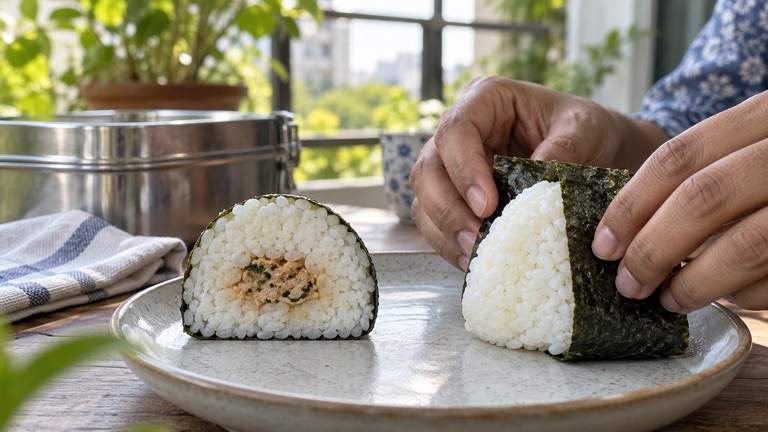
Nori is the seaweed sheet often wrapped around part or all of an onigiri. If you want a crisp bite, keeping it apart from the rice until eating is the straightforward choice. Zojirushi’s overview explains that separately packaged seaweed is used to avoid it becoming soggy against the rice.
There is no need to interpret every softened wrapper as a ruined meal. Crisp and softened nori give different eating experiences; choose the result you want. What you should not do is expect a sheet wrapped around moist rice well in advance to behave exactly like a dry sheet taken from its packet.
Keep the remaining dry sheets protected too. Nori Japan, the industry’s educational site, advises sealed storage away from humidity, heat and direct sunlight. Follow your pack’s storage instructions and reseal it promptly. Leaving the entire packet open beside your preparation area works against the crispness you are trying to preserve. Read Nori Japan’s storage and sizing guide.
That guide gives a standard full-sheet size of approximately 21 × 19 cm and notes that pre-cut formats vary. A serving suggestion that says “one sheet” may therefore mean something quite different from the small strips in your packet. Check the actual dimensions instead of wrapping an unexpectedly large quantity around a small rice portion.
You can also skip nori during the first shaping attempt and add it when eating. This lets you see whether the rice holds independently. Seaweed can be part of the finished experience without becoming a bandage over a structural problem.
The centre-filled version gives a contrast between outer rice and a concentrated filling. A mixed version distributes smaller ingredients through the portion. Neither is inherently more advanced; they simply organise the same bite differently.
MAFF’s NIPPON FOOD SHIFT onigiri material presents wrapping, mixing and seasoning as different routes, with examples spanning seaweed, vegetables and other ingredients. That range is useful permission to think beyond one white triangle with a hidden centre, without pretending every adaptation is the same preparation. Explore MAFF’s onigiri combinations.
For an editorially simple progression, establish a plain portion first, then choose either a modest centre or a small mixed-in seasoning. Learning both at once makes it harder to identify what changed the texture. Once you know which format you enjoy, variation becomes more purposeful.
Yaki-onigiri adds a different surface: grilled rice with a browned exterior. Zojirushi’s recipe uses a soy- or miso-based basting sauce and offers grill and frying-pan instructions. It is a cooking method with its own sequence, not merely an already-wrapped onigiri placed on high heat. Remove any plastic wrap before heating, and follow the recipe for the pan, sauce and timing. See the yaki-onigiri method.
Try that as a deliberate variation, not as a way to rescue rice that has been stored unsafely. Browning the outside is a texture goal; it is not evidence that the food’s previous handling no longer matters.
Freshly shaped and refrigerated onigiri need not feel identical. Zojirushi’s Japanese explanation describes starch retrogradation as a reason chilled rice becomes firmer and less pleasant in texture. Covering it helps limit drying but does not eliminate that change. Its discussion of freezing is about preserving quality, not an instruction to ignore safe cooling. Read the manufacturer’s texture explanation.
Do not turn “the refrigerator changes the texture” into “leave cooked rice on the counter.” Plan an immediate meal or an appropriate cooling-and-storage process before you start. A small freshly eaten batch is the easiest first learning session because it separates the shaping lesson from the additional problem of transport.
The UK Food Standards Agency’s rice guidance says cooked rice should be cooled quickly, ideally within one hour, using smaller portions rather than leaving it in a cooker or pan to cool. Refrigerated rice should be consumed within 24 hours; if reheated, it should be steaming hot throughout and reheated only once. Bacillus cereus spores can survive cooking, and prolonged room-temperature storage allows bacteria or toxins to make rice unsafe. These are UK household guidelines, not a statement of Indian law. Read the FSA’s current rice guidance.
If carrying onigiri, arrange cold transport rather than relying on the container’s appearance. Zojirushi’s handling guidance recommends an insulated bag with cold packs and cautions that even salty fillings do not make the whole rice ball safe. A plum, a seaweed strip or tight wrapping is not a substitute for temperature control.
If you cannot establish safe storage, do not use taste or smell as the deciding test. Likewise, “I will grill it later” is not a repair plan for neglected cooked rice. Choose a different meal rather than gamble on the texture looking normal.
Choose a suitable rice and a recipe compatible with your equipment. Make an amount you can handle and eat safely, with one clearly understood filling or no filling at all. Keep the nori separate if crispness matters to you. Those decisions are more useful than starting with a large assortment intended to look like an anime picnic.
After tasting, describe what happened precisely. “It failed” gives you little to work with. “The plain rice held, but the filled piece split at the top” tells you where to look. “The rice was pleasant but the nori was soft” points towards timing rather than buying a different grain.
For the next attempt, keep the successful parts. Change the centre quantity, the shaping pressure or the wrapper timing—not everything together. Your first goal is a rice portion you enjoy eating and understand well enough to repeat. The photogenic triangle can come after that.
AUTHOR OF THIS ARTICLE
SoJapan
SoJapan India Pvt. Ltd. is a Japanese-founded company based in Gurugram. We bring Japanese food, anime goods and apparel materials to Indian businesses, with a sister company in Kyoto that works directly with makers in Japan.