← JOURNAL29 Sep 2026
Ninja Hattori Explained: The Characters, the Comedy and the India Connection
 By SoJapan
A ninja with extraordinary skills moves into an ordinary family home. The surprising part is how quickly the problems become familiar: homework, showing off, a younger brother’s emotions, a rival’s interference and the wish to impress a classmate.
That is the pleasure of Ninja Hattori. The ninja action is visible, but the embarrassment underneath it does much of the comic work. You do not need a background in Japanese history to understand someone wanting to look brave when they are frightened.
For Indian viewers returning to the series, there is another story worth discovering. India belongs to its documented broadcasting and later production history—not merely to a nostalgic claim that “everyone watched it”. There is even an official episode synopsis in which an Indian boy introduces the characters to cricket.
This guide looks at the people behind the familiar faces, the way their relationships generate jokes, and the difference between fictional ninja tricks and real cultural references. It contains a few spoiler-light story premises, but no detailed episode endings. Character facts come from official studio profiles; explanations of why a joke works are editorial readings, not claims about the creator’s private intentions.
Three useful starting points:
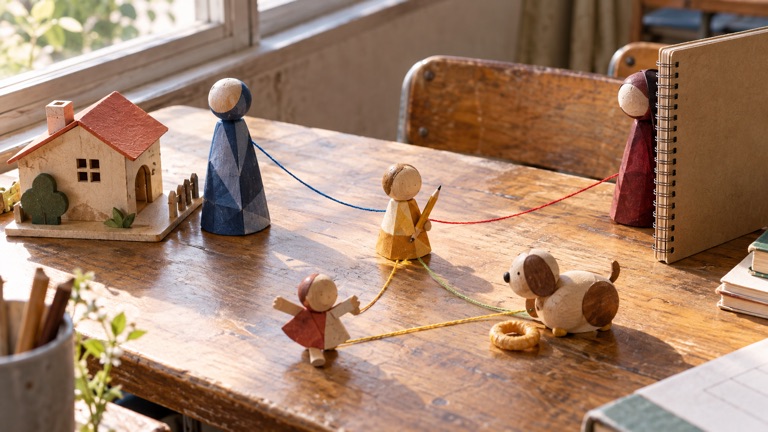
Created by Fujiko Fujio A, the story begins with Hattori coming from Iga and staying with the Mitsuba family. Kenichi is the boy at the centre of that household, while the ninja’s skills enter a modern domestic setting. The official Fujiko Fujio A digital selection, published with Shogakukan and Fujiko Studio involvement, presents the work as a comedy about that encounter.
This is a useful distinction if your idea of ninja anime comes mainly from battles, training arcs and increasingly powerful enemies. Here, extraordinary ability is brought close to ordinary inconvenience. A problem can matter enormously to a child without threatening an entire village or world.
The home also gives the premise warmth. Hattori is not only someone Kenichi consults when danger arrives. His presence belongs to the family’s daily life. A helper who shares your environment can become involved in your mistakes, rivalries and small achievements in a way that a distant superhero cannot.
There is an affectionate contradiction at the centre of that arrangement. The ninja appears equipped for situations far more demanding than a schoolboy’s trouble, yet solving the practical problem does not necessarily solve the human one. Being able to intervene is different from knowing when an intervention will help.
Read the series through that contradiction and the scale begins to make sense. A minor disappointment is not a distraction from the “real” ninja story. Very often, ordinary life is exactly where the ninja story belongs.
Shin-Ei Animation’s Hattori character profile identifies him as an Iga ninja who has mastered many techniques, lives at Kenichi’s home, and is afraid of frogs. That last detail is more revealing than another list of powers would be.
A highly competent character can become remote if nothing ever unsettles him. A specific fear brings the capable helper back within reach of everyone else. You can admire his skill while recognising the uncomfortable experience of being frightened by something another person finds harmless.
It also creates a comic change of status. The person normally expected to cope can suddenly need patience himself. My reading is that this makes his helpfulness more engaging: confidence in one area does not mean confidence everywhere.
When revisiting Hattori, notice whether you are laughing at a spectacular technique or at the gap between the composed figure and the situation confronting him. Those are different pleasures. The first showcases what a ninja can do; the second makes this particular ninja a character rather than a collection of tricks.
That is why a small, recognisable weakness can stay in memory longer than an elaborate move. It tells you something about how to watch him, not merely what to expect him to win.
The studio’s Kenichi profile places him in the Mitsuba family and notes two forms of address: the familiar Ken-chan and Hattori’s distinctive Kenichi-uji. TV Asahi’s international programme description introduces him as a schoolboy who struggles with homework and studies.
That description makes it tempting to reduce him to “the weak boy who gets rescued”. It is a less interesting way to watch. Kenichi supplies the ordinary stakes that give Hattori’s abilities a purpose: the wish to keep up, avoid humiliation or handle a situation that feels too large.
A useful question is not simply whether Kenichi succeeds. It is what he wants the success to prove. Doing something because it needs doing is different from doing it so that somebody else will think well of you. The same apparent obstacle can produce a different joke depending on that motive.
This also helps explain why a powerful friend does not remove every difficulty from the premise. Assistance can change what happens externally without instantly changing how a person feels. Confidence, honesty and the wish for approval cannot all be handed over like borrowed equipment.
For a returning viewer, Kenichi can therefore become more interesting rather than less. The ninja trick may be the image you remember, but the feeling behind asking for help is easier to recognise once you have more experience of your own expectations.
Kemumaki is a Koga-style ninja and Hattori’s rival. Unlike Hattori’s conspicuous place in the household, he conceals his ninja identity while attending Kenichi’s school. Those details come from Shin-Ei’s Kemumaki profile.
The school connection matters. He is not an opponent who appears only for a distant confrontation. The rival belongs to the same social environment in which Kenichi wants to do well. That puts impressive abilities within reach of small acts of competition and interference.
As a viewer, you can separate two contests. One concerns who has the cleverer technique. The other concerns who controls the situation: who knows a secret, notices a weakness or decides when to expose it. A character can gain an advantage in the second contest without becoming physically stronger.
That distinction is a good reason not to turn every Hattori discussion into a power ranking. The comic result often depends on timing and information. A technique is only part of the arrangement around it.
Kagechiyo extends this rival side of the cast. The studio identifies him as a Koga ninja cat and Kemumaki’s subordinate. He is not simply an unrelated cat added to make the picture busier.
His role also gives the rivalry another scale. A disagreement need not always be carried by the two principal ninja boys; the animals can bring their own ambitions and loyalties into it. That allows a familiar opposition to feel different without requiring the story to introduce a new grand enemy each time.
When a scheme goes wrong, watch who was responsible for the idea and who was expected to carry it out. The relationship between a planner and an accomplice can be as entertaining as the rivalry with the intended target.
Shinzo is Hattori’s younger brother and a ninja in his own right. His official studio profile singles out the overwhelming effect of his crying. It is a wonderfully direct comic idea: an emotion that might make a child appear vulnerable becomes difficult for everyone around him to handle.
That is different from giving a younger character a smaller version of the hero’s competence. Shinzo brings a younger sibling’s place in the group. The point is not only what he can perform, but what happens when older characters must respond to him.
There is a useful contrast with Hattori’s composure. One figure can be approached as the organised helper; the other makes emotion hard to ignore. Reading them as brothers, rather than merely as two ninja costumes of different sizes, gives their shared scenes more texture.
Shishimaru belongs to another category again: he is an Iga ninja dog, and the studio makes his love of chikuwa explicit. Shin-Ei’s Shishimaru profile.
That food preference is not an advanced piece of mythology you need to memorise. It is an immediately understandable desire. Even before you know what chikuwa tastes like, you understand a character who is strongly motivated by a favourite snack.
The distinction between Shinzo and Shishimaru is helpful when introducing the series to someone new. One adds a family relationship; the other adds an animal personality with recognisable appetites. Both broaden the household beyond a simple partnership between helper and schoolboy.
Yumeko is a classmate admired by both Kenichi and Kemumaki. The official character description also identifies her as academically strong. That places her within the school world, not outside it as an occasional visitor.
Her presence is important because an audience changes behaviour. There is a difference between being frightened in private and being frightened in front of somebody whose opinion matters to you. The same incident can become a performance of bravery, confidence or competence.
This is a reading of the relationships, not a reason to treat Yumeko only as a prize for the boys to win. It is more revealing to notice the pressure they place on themselves around her. Their attempts to manage an impression tell you about them.
For example, ask what would change if nobody were watching. Would the character admit the problem sooner? Would the rival still have the same leverage? That simple question often makes the social mechanism of a comedy clearer than a long list of ninja techniques.
It is also a familiar feeling across cultures. You need not have attended a Japanese school to understand why someone becomes less sensible when trying especially hard to look impressive.
TV Asahi’s 2014 announcement for Ninja Hattori Returns supplies three revealing examples. In one, Kenichi fears a museum mummy but wants to look brave before Yumeko, while Kemumaki exploits the situation. Another puts Shishimaru’s dog team against Kagechiyo’s cat team in football. A third has an Indian boy, Anand, teach the group cricket before Kemumaki interferes with ninja tricks.
Those premises place fear, sporting fairness and learning something unfamiliar beside one another. The techniques change, but social pressure supplies the reason to use them. The question is not simply “Who is strongest?” It is also “Who is embarrassed?”, “Who is cheating?” and “Who understands the situation?”
The cricket example is especially relevant to Indian viewers because the cultural exchange is concrete. Hattori is learning a game from an Indian character, rather than being placed beside a vague reference to India. These are descriptions of story setups, not claims that every international version uses the same translated episode titles or numbering.
If Shishimaru made you curious about his favourite food, the answer is not a Japanese biscuit or a sweet roll. Ordinary chikuwa belongs to the family of fish-paste products often grouped under kamaboko. Japan’s Ministry of Agriculture, Forestry and Fisheries explains that this broader category includes fish paste prepared by steaming, grilling or frying, with chikuwa among the examples. MAFF’s introduction to regional fish-paste foods.
For an Indian vegetarian viewer, that is an important distinction: a pale, rounded cartoon food is not necessarily bread, paneer or a plant-based snack. Identify the food and read a real product’s ingredients before deciding whether it fits your diet. The illustration alone cannot settle the question.
You can enjoy the reference without needing to eat it. Understanding what the character wants is already a small cultural discovery. It turns an indistinct prop into a recognisable food and helps explain why a simple preference can become part of a character’s identity.
If food details are what you notice most in anime, our guide to Japanese foods seen in animation follows that interest across different dishes. Keep the same habit there: separate what a food looks like, what it is called and what it contains.
In Japanese material, Hattori’s manner of speaking is part of the characterisation. The studio’s Kenichi profile specifically records Kenichi-uji, while official story titles repeatedly use de gozaru. You do not need to copy this speech to appreciate the contrast it creates.
The helpful listening question is whether the speaker sounds like another classmate or like someone bringing a stylised, old-fashioned manner into the same room. A familiar domestic problem can become funnier when approached with conspicuous formality.
The -kun in Ninja Hattori-kun is also a form of address, not a secret ninja rank. Such suffixes carry relationship information, but they do not map perfectly onto a single English or Indian-language equivalent. Our anime honorifics guide explains that distinction in more detail.
If you know the programme through a dub, your recognition may be tied to vocal rhythm, a particular pronunciation or a repeated expression. That is a real part of encountering the work, but it should not be used as proof that every language version says the same thing.
When comparing versions, choose a short exchange rather than declaring an entire dub “more accurate” from one remembered line. Notice pauses, levels of politeness and the way a character’s confidence is heard. Translation has to carry those effects as well as the literal information.
TV Asahi lists India among the countries in which Ninja Hattori has been broadcast. Its 2014 Japanese announcement also describes new India-produced material returning to Japan in a Japanese-language version. These are stronger foundations for the India connection than an unsourced ranking or an assertion that an entire generation watched exactly the same episodes.
The distinction matters: a Japanese-origin series can travel through dubbing and broadcasting, while later production can involve work beyond Japan. Country of origin, production location and language version describe different parts of that journey. One label cannot replace the others.
TV Asahi’s Ninja Hattori HD page describes an India-produced series and notes modern details such as mobile phones, the internet and email. These are changes to the world around the characters, not merely a sharper display of an older image.
That offers an interesting way to revisit the comedy. New communication tools can change how characters learn something, hide something or misunderstand one another. The household-and-rivalry premise can remain recognisable even when the objects in that household belong to a later period.
It would be too broad, however, to call every newer story “Indianised”, or to assume that a cricket episode explains the entire international production. The more useful approach is to identify the particular connection a source actually documents: an Indian character, a production location, a language version or a broadcast territory.
That leaves room for both affection and precision. Indian viewers do not need an invented popularity statistic to have a meaningful place in the series’ history.
Shin-Ei’s anniversary archive dates the original television animation to September 1981–December 1987. Later programme catalogues include both remastered material and newer animation. Treat these as edition clues, not as a demand to complete decades of viewing before enjoying a short story.
| Label or clue | What to establish before comparing |
|---|---|
| Original television animation | Which original story or broadcast package the listing contains |
| HD remaster | Whether the underlying animation is older material presented in a revised edition |
| Newer or Returns material | Which production and story set it belongs to, rather than assuming it is only a remaster |
| Hindi or another dubbed version | The audio language and edition; a language label alone does not identify the production |
Episode numbers can be less useful than you expect. TV Asahi’s HD listing groups two named stories within numbered entries. A short story, a combined television programme and a platform’s season entry therefore need not be identical counting units.
If you want to find a remembered moment, record the premise, characters and any available story title before relying on a number. “The cricket story with Anand” gives a different kind of search clue from “episode 26”, which only makes sense within a particular listing.
This guide does not present a Japanese television schedule or an old distribution announcement as proof of present Indian streaming access. Check the service available to your Indian account, its current licence information and its listed audio languages. For broader help with that process, see our legal anime-viewing guide for India.
The names behind the rival ninja traditions are not invented places. The Ninja Museum of Igaryu connects Iga with Mie Prefecture and Koka with Shiga Prefecture. You may encounter Koka in geographical and historical material where the character discussion uses the familiar Koga form. The museum’s introduction.
That connection gives the fiction a cultural starting point, but it does not turn Hattori’s abilities into evidence about historical practice. The Japan Ninja Council’s historical overview distinguishes information-gathering and survival duties from the supernatural ninja imagery developed through fiction and performance.
Keep three layers separate: actual places, historical people and practices, and entertainment built from their imagery. A work can borrow the first layer freely while exaggerating the third. That does not make the comedy defective; it tells you what kind of work you are enjoying.
Nor should the rivalry between individual fictional characters become a lesson that one historical region was inherently good and another inherently bad. Hattori and Kemumaki are characters arranged for comedy, not representatives authorised to explain whole communities.
If the series sparks an interest in ninja history, follow it into museum or research material with a new set of questions. For the cartoon itself, you can leave the impossible feats where they belong: in imaginative entertainment, not in instructions to imitate dangerous stunts.
You can return to Ninja Hattori without converting a familiar comedy into homework. Pick an episode that is legally available to you and notice one relationship rather than trying to catalogue every technique.
For Hattori and Kenichi, watch the difference between solving a problem and helping someone feel capable. For Kemumaki and Kagechiyo, watch the information shared between a schemer and an accomplice. For Shinzo and Shishimaru, notice how a younger sibling’s feelings and a dog’s appetite give the household different kinds of energy.
Then look at the ordinary object or activity around which the story turns: food, a school task, a visit, a game. The setting does not need to become enormous for the characters to care about it.
That is a satisfying reason to revisit Hattori. Not to prove that a childhood favourite was secretly a different kind of anime, but to see how carefully an extraordinary visitor can be fitted into the embarrassments and affections of everyday life.
AUTHOR OF THIS ARTICLE
SoJapan
SoJapan India Pvt. Ltd. is a Japanese-founded company based in Gurugram. We bring Japanese food, anime goods and apparel materials to Indian businesses, with a sister company in Kyoto that works directly with makers in Japan.