A spike is easy to celebrate. The harder part of watching Haikyu!! is recognising who made that spike possible. A receive that travels to the right place, a setter who still has several options, or a middle attacker who draws a block can change the rally before the ball reaches the player who scores.
If you know Hinata and Kageyama but lose track when players rotate, Nishinoya leaves the court or someone celebrates a touch that did not score, this guide is for you. You do not need a volleyball background. You need a way to follow the chain of decisions.
For an Indian viewer who follows cricket, the familiar starting point is that the scorecard does not contain every useful contribution. But volleyball is not cricket with a net. Possession is brief, defensive work can become an attack almost immediately, and a player’s legal front-row or back-row status matters even after they move.
Read with four questions in mind: Where did the first pass go? What choices did it leave the setter? Which attacker occupied the block? Who was ready when the ball came back?
This is a spoiler-light viewing guide, not a refereeing course. It discusses the early Hinata–Kageyama combination without revealing tournament winners or later character outcomes. Rules were checked on 29 September 2026; current international rules and event-specific tests are identified separately rather than imposed on every Japanese school match in the anime.
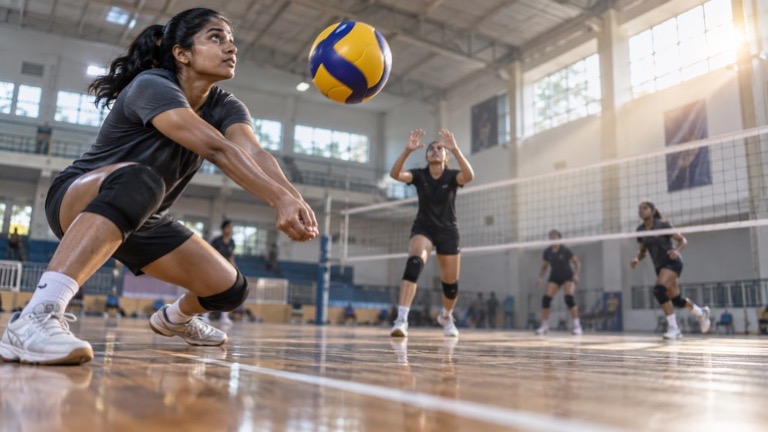
Indoor volleyball permits up to three team contacts to return the ball, with a block touch outside that allowance. A common sequence is receive, set, attack. It is a useful pattern, not a requirement to use exactly three contacts every time. The FIVB basic introduction is a good reference for that foundation.
The first contact is often the least glamorous and the most revealing. After a serve, watch where the receiver sends the ball. Does the setter move comfortably towards it, or sprint away from the intended attacking area? The difference is not merely neatness. It changes what can happen next.
Imagine two versions of the same opportunity. In the first, the ball arrives where the setter can prepare without an emergency chase. In the second, the setter must run towards a sideline and reach awkwardly. Both receives kept the ball alive. They did not give the attack the same starting conditions.
That is why “they got it up” and “that was a good receive” are not identical judgements. Survival is valuable; control can be more valuable still. Neither automatically guarantees a point, because the opponent is also reading the situation.
The next contact usually turns that possibility into a choice. A set prepares an attacker to play the ball; a spike is the conspicuous attacking hit. A dig usually refers to defending an opponent’s attack, while serve reception is receiving the serve. Subtitles sometimes use broader words such as “receive,” so pay attention to the action as well as the label.
A useful first rewatch exercise is to ignore the final hitter for one rally. Follow only the receiver and setter. When the hitter eventually appears to have a clear opportunity, ask whether the opportunity began with a particularly good first contact. You will often have a more interesting question than “who hit hardest?”
There are two meanings of “position” to keep apart. One is a player’s usual job: setter, middle blocker, wing spiker or libero. The other is a numbered place in the rotation. A setter does not stop being the team’s setter simply because that player rotates to the back row.
The anime’s official character lineup identifies Kageyama as a setter, Hinata and Tsukishima as middle blockers, Nishinoya as a libero, and Tanaka, Daichi and Asahi as wing spikers. The page contains material connected to a later film; you do not need to browse its other sections to use these basic role labels.
| Character to follow | Role anchor | A useful viewing question |
|---|---|---|
| Kageyama | Setter | What options are still available when he reaches the ball? |
| Hinata | Middle blocker | Is he receiving the set, or making the opponent respect that possibility? |
| Tsukishima | Middle blocker | What information is he waiting for before committing? |
| Nishinoya | Libero | Does his contact merely rescue the ball, or help organise the next attack? |
| Tanaka, Daichi and Asahi | Wing spikers | What work happens before and after the visible attacking hit? |
These questions are our viewing framework, not official performance ratings. “Middle blocker” does not mean a character only blocks. Calling one player an ace does not make the rest of the court a supporting cast with no tactical agency.
Try following Daichi through a passage instead of watching only whoever is about to jump. The purpose is not to award a new secret “best player” title. It is to notice that a team needs continuity between spectacular moments. Someone has to make the next playable ball possible.
The early Hinata–Kageyama combination connects a fast approach and jump with a precisely delivered set. Broadcaster MBS’s episode-four feature describes Kageyama adjusting to Hinata’s movement and the famous eyes-closed contact. That is a verified early-series example, not a claim that beginners should copy the action.
For viewing purposes, separate two ideas: hitting force and the time the defence has to organise. A ball does not need to be described as the hardest spike in the match for an attack to create a difficult decision. An opponent who must respect a fast middle option has something else to monitor while the setter considers another attacker.
Here is the important distinction: the quick attacker can matter even when the set goes elsewhere. That is the logic of a decoy. The threat has to look credible enough to influence a defender’s decision; merely running in a direction does not magically remove a blocker.
Consider a hypothetical two-choice situation, not a reconstruction of an episode. A setter could send the ball to a middle attacker or a wing attacker. If the opposing middle blocker commits towards the middle threat, the wing may have a more favourable situation. If the blocker ignores the middle, the setter may have reason to use it. The interest lies in the defender having to choose, not in either outcome being guaranteed.
This gives you a way to judge the play without relying on whether Hinata gets the final touch. Watch the opponent’s first movement. Did someone hesitate? Did a blocker move towards one threat before the actual set became clear? If the camera does not show enough, leave the question open rather than inventing a perfect tactical explanation.
The show’s own Nekoma character feature recalls an early practice-match response in which Inuoka closely tracks Hinata. You do not need the result of that match to understand the point: a threat can be studied and assigned attention. A successful combination is an invitation for the other side to adapt.
Our interpretation is that the early quick is compelling because it makes cooperation visible. Hinata’s movement and Kageyama’s delivery become one attacking opportunity. The eyes-closed detail is heightened fiction, not a sensible instruction for an unsupervised attempt on a real court. Enjoy the trust the scene dramatises without treating it as a training prescription.
A team rotates when it wins the right to serve from the receiving side; winning another rally while already serving does not trigger another rotation. That distinction, also explained in the FIVB’s basic rules, accounts for many apparently confusing changes between points.
Facing the net, the numbered front row is 4–3–2 from left to right, and the back row is 5–6–1. The clockwise sequence is 2 → 1 → 6 → 5 → 4 → 3 → 2. These are rotation positions, not shirt numbers. The current FIVB rulebook, rules 7.4–7.6, supplies the numbering.
For a simple paper exercise, place six letters in that order. Start A at position 2. Each time the team regains serve, advance every letter once. A moves to 1, then 6, then 5, then 4, then 3 and eventually back to 2. Six gains of service complete that cycle; six consecutive points scored while already serving do not.
That last comparison matters when a server puts a team under pressure. The scoreboard can move several times while the receiving side remains in the same rotation. You are watching that lineup solve repeated problems, not six entirely new arrangements.
Players’ actual movement during a rally is a different layer. The setter may travel towards a useful setting location; defenders organise around the attack they expect. Movement does not convert a rotational back-row player into a front-row player. Think of the numbered order as the legal identity underneath the moving formation.
The 2025–2028 FIVB baseline checks the receiving team’s relative order at service contact; the serving side has positional freedom. FIVB’s 2026 test announcement goes further for named competitions: receivers are ordered at the whistle but can move when the serving action begins. Those tests cover the 2026 VNL, U17 World Championships and Continental Championships, not every match everywhere.
This is why a modern highlight is not enough evidence to call an older anime scene wrong. First establish the event and applicable rules. For a first viewing, the more useful skill is recognising who is front row, who is back row and which player serves next. Exact overlap adjudication can wait.
Nishinoya is not an extra seventh player, and leaving the court does not necessarily mean he has been benched for poor play. The libero is a defensive specialist with distinct replacement rules and a contrasting uniform. When the occupied rotational slot advances into the front row, the libero cannot simply stay in it: the regular player returns. The FIVB game overview explains the role’s backcourt focus.
Under the FIVB baseline, a libero replaces back-row players; those replacements are not ordinary substitutions. The libero cannot serve or block, including attempting a block, or complete an attack with the ball entirely above the net. An overhand finger pass from the libero’s front zone also restricts a teammate’s subsequent above-net attack. These are specific restrictions, not a ban on every pass made near the net. See rule 19.
A helpful example is a broken play in which the usual setter makes the first contact. Someone else must deal with the next ball. If that person is the libero, the method and location of the pass can matter to what the attacker may then do. You need not memorise every replacement procedure to notice why the team’s emergency solution requires thought.
Do not reduce this to “liberos cannot set.” A forearm pass and an overhand finger pass are not interchangeable for that particular restriction; nor is being in the front zone the same as being anywhere on the court. The point for a viewer is to watch how the rescue becomes an attacking ball, not just whether it reaches a teammate.
The role changes the emotional reading too. A clean defensive contact can look less dramatic than a diving rescue, yet be more useful to the next player. That does not make a desperate save unimportant. It means effort, difficulty and the quality of the resulting opportunity are three different things.
If a clip from a different competition appears to contradict the serving rule, check its code before arguing about it. USA Volleyball, for example, has its own indoor rules, including libero service in one rotation position. A rule used in an American competition is not automatically the rule for Karasuno or a current FIVB event.
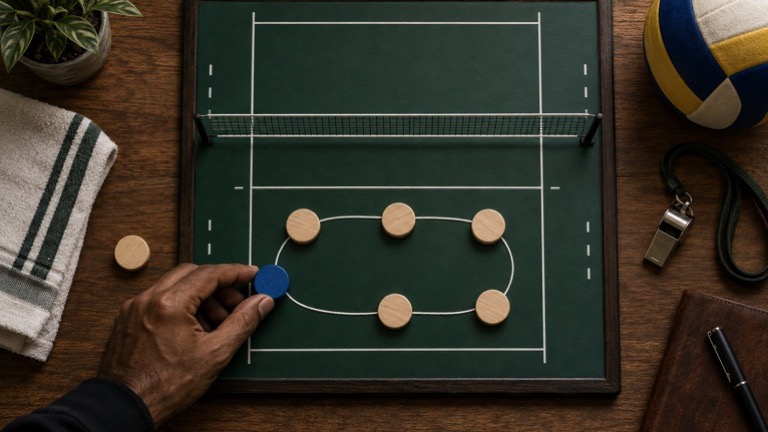
The simplest picture of blocking is a wall that sends the ball straight back down. That is only one outcome. FIVB’s skills overview also describes the block as a way to direct an attack towards defenders and distinguishes reacting to the set from committing to a quick threat.
This makes the relationship between the net and backcourt more interesting. A blocker does not have to make the final scoring touch for the defensive plan to work. The question is whether the attack became easier for the rest of the team to handle.
Imagine a fictional opponent with two plausible hitting directions. Suppose a block makes one direction difficult, and a defender is prepared for the other. If that defender digs the ball, the save belongs to a coordinated arrangement, not necessarily a miraculous reaction in isolation. This is an explanatory scenario, not a claim about a particular episode’s unseen positioning.
Now change one assumption: the defender expects the opposite lane from the one the blocker is protecting. Two individually energetic actions may leave a gap between them. That is a more precise way to think about “teamwork” than simply saying everyone tried hard.
When the anime celebrates a small touch at the net, therefore, look at the ball’s next destination. Did the contact make it playable? Did the players behind the block appear prepared? If the attack still scores, was the idea poor, the execution late, or the opponent’s solution simply better? The result alone cannot answer all three.
In ordinary FIVB play, sets before the fifth are won at 25 with a two-point margin; a deciding fifth uses 15, also with a two-point margin. The FIVB scoring introduction is describing that international format, not establishing the format of every school tournament.
For a concrete comparison, the JVA’s January 2026 national high-school championship regulations specify best-of-five semifinals and finals, with other rounds best of three. That is a real contemporary example of format varying by round, not proof of the exact regulations for every fictional qualifier in Haikyu!!.
When the commentators explain a match, first ask how many sets are needed to win. Then distinguish the small point totals inside a set from the match’s set count. Losing one set need not mean losing the match; winning a long rally still adds only one point under rally scoring.
Here is a labelled arithmetic example for a set played to 25, win by two. At 24–24, winning the next rally makes it 25–24, not a completed set. Losing the following rally makes it 25–25. Winning the next two makes it 27–25 and ends that set. Those four rallies matter because they produce a two-point separation, not because 27 is a special target.
Likewise, being behind 20–24 does not mean merely finding four spectacular attacks. Four unanswered points bring the score level at 24–24; the team would still need a two-point lead to finish. The minimum uninterrupted run from that starting deficit to a win is six points, ending 26–24.
These are calculations, not predicted comeback probabilities. They help you understand the pressure without inventing win-rate statistics. A commentator’s “one more” may refer to set point or match point, so check which layer of the scoreboard is at stake.
The following is an invented teaching sequence involving Team A and Team B, not an unshown Karasuno match. Assume ordinary indoor play, legal contacts and no other fault. Its purpose is to identify decisions rather than to predict the best tactic for every team.
1. Team B serves at Team A. Do not evaluate the serve only by whether it becomes an ace. Watch the receiver’s resulting pass. A serve that stays in play may still change the attack by pulling its organiser away from a preferred location.
2. Team A controls the first pass. In this example, the setter can reach it in balance. We will assume both a middle option and a wing option are realistically available. That assumption is essential: a diagram showing two attackers does not prove the setter can use both from any ball.
3. The middle attacker makes a credible approach. Team B’s middle blocker gives that threat attention. This does not automatically defeat the block. It creates a decision that may affect how quickly the defender can help elsewhere.
4. Team A sets the wing. The wing attacker now has an opportunity shaped by the receive, the setter and the other attacker’s movement. If the attack scores, crediting the hitter makes sense. Saying the hitter created the entire chance would miss part of the sequence.
5. Team B gets a block touch but the ball remains on its own side. The ball has not automatically become a point for either side. In this example, the touch makes it reachable for a defender. Team B can organise its permitted contacts after the block rather than treating the touch as an ordinary first team hit.
6. A defender controls the ball and a teammate prepares an attack. The rally changes direction. Players who were preparing to score now have to defend. Anyone who stops watching because their team’s spike did not immediately win would miss half the problem.
Now rerun the sequence with a poor Team A receive. Perhaps the setter can only provide an obvious high ball. The wing attacker may face a more prepared defence, even though that attacker has not suddenly become less talented. Changing the first contact altered the later decision tree.
Rerun it once more with Team B’s defender in the wrong place after the block touch. The net contact no longer leads to the same recovery. That is why one useful contact must connect to the next; a collection of impressive individual moments is not automatically a functional rally.
A regular back-row player can make an above-net attack after taking off behind the attack line without touching it, and can land in front afterwards. A libero has separate restrictions. The distinction is set out in FIVB rule 13.
For a replay, watch the take-off rather than treating the landing spot as the whole story. More broadly, never assume that a player’s physical location at one instant tells you their rotational status. This is one reason a quick highlight can be confusing when detached from the preceding serve and lineup.
That question overlooks the condition of the ball and the opponent’s attention. A player may be a convincing option without being the sensible recipient of this particular set. The more revealing question is: what did choosing that attacker ask the defence to solve?
You do not need to declare the setter a genius every time the point is won. A favourable outcome can follow an ordinary choice; a thoughtful choice can still lose to good defence. Keeping decision and result separate makes both teams more interesting.
Slow motion, reaction shots and internal narration let viewers understand a decision. Their screen duration is not a measurement of how long a real ball remains airborne. Do not calculate attack speed from an edited dramatic sequence or treat an eyes-closed fictional quick as a beginner drill.
The useful lesson is observational: look earlier, follow other players and ask which options remain. If the show encourages you to try volleyball, use supervised instruction appropriate to your ability rather than attempting dives and jumps because an animated scene made them look effortless.
Pick one rally, not an entire match, and give yourself a small assignment. First follow the opening pass. On a second look, track the setter’s options. On a third, watch a player who never touches the ball. If the framing hides something, mark it as unknown rather than filling the gap with certainty.
For friends watching together, each person can follow a different job and compare observations afterwards. One viewer might notice the first pass; another the middle attacker; another the backcourt after a block. The discussion becomes about visible decisions rather than arguing that one favourite character deserves every point.
If you are deciding whether the series suits you at all, our sports anime guide for Indian viewers compares its team-focused appeal with other shows. For the school-club relationships surrounding the matches, read Japanese school life in anime. Check the exact season and language on a licensed service in India; our legal anime viewing guide explains that process without assuming every season has identical availability.
The reward for learning these distinctions is not becoming the person who interrupts every episode with a rule correction. It is noticing more of what the characters contribute. The final spike remains exciting. Now the receive, the movement without the ball and the next defensive position can be exciting too.

AUTHOR OF THIS ARTICLE
SoJapan
SoJapan India Pvt. Ltd. is a Japanese-founded company based in Gurugram. We bring Japanese food, anime goods and apparel materials to Indian businesses, with a sister company in Kyoto that works directly with makers in Japan.