← JOURNAL29 Sep 2026
Anime Sub vs Dub: A Guide to Voices, Translation and Language Choices in India
 By SoJapan
You watch a scene in Japanese with English subtitles, then switch to an English or Hindi dub. The character seems more sarcastic. A joke lands later. The sentence on screen does not match the words you hear. Has something gone wrong, or are you listening to two different approaches to the same moment?
The answer depends on the scene. Subtitles, dub scripts and accessibility captions do different jobs. Voice actors make interpretive choices, and those choices work inside timing, direction and recording constraints. Some differences are reasonable adaptations; others deserve criticism. Calling every change a mistake is as unhelpful as pretending that every change works.
For viewers in India, the decision is also more varied than “Japanese or English.” You might prefer Hindi for a family watch, English for a familiar cast, or Japanese for a particular actor’s performance. Your preferred language may differ from the language in which you read fastest. There is no single setting that represents every Indian anime fan.
This guide explains the choices, offers concrete ways to listen and helps you check the exact version before subscribing or starting a long series. It is not a ranking of languages or a claim that every anime is available in every dub.
A subtitled version usually keeps the source-language performance while providing translated written dialogue. A dubbed version supplies a new spoken performance in another language. You can also encounter subtitles in the same language as the audio, but their purpose and content may differ from a translation track.
Accessibility captions or SDH—subtitles for the deaf and hard of hearing—can include speaker identification and meaningful sound information. Audio description is different again: it provides spoken descriptions of important visual information where available. Selecting one does not automatically activate the others.
| Option | What it gives you | What to check |
|---|---|---|
| Japanese audio with translated subtitles | The Japanese performance plus written translation | Can you comfortably follow both the image and text? |
| Dubbed audio | Spoken dialogue in another available language | Does this exact season have the dub you want? |
| Dub plus matching captions or SDH | Spoken dialogue with text and, depending on the track, sound cues | Does the caption track correspond to the selected dub? |
| Translated subtitles alongside a dub | Two adaptations that may use different wording | Is the difference distracting or useful to you? |
| Audio description, where offered | Additional spoken access to visual information | Is it available for this title and language? |
These are viewing options, not levels of fandom. A person who relies on captions is not failing to appreciate voice acting. A person who chooses a dub is not avoiding the “real” story. The meaningful question is whether the version gives you access to the work and whether its particular creative choices succeed.
Imagine a character has a short window in which to speak before the shot cuts away. A subtitle must be readable in that window. A dub line must also be speakable, fit the performance and work with the character’s visible mouth movement. Those are related but different demands.
Crunchyroll’s explanation of its localisation process distinguishes subtitle work from adapting a translated script for dubbing. It describes separate contributions from translators, timing and editorial staff, dub writers, directors, actors and engineers. It is an account of a production workflow, not a promise that every studio follows identical steps. Read Crunchyroll’s localisation overview.
The practical result is that a subtitle can be a good translation without being the sentence an actor should perform. Written phrasing that looks concise may sound stiff aloud. A natural spoken sentence may need different word order, emphasis or length.
Consider these invented English lines: “You finally decided to come” and “So, you made it.” They are not quoted from an anime and are not presented as translations of a Japanese sentence. They simply demonstrate that two short lines can describe a similar arrival while carrying different shades of reproach or relief.
Now imagine the speaker smiling warmly in one scene and standing rigidly in another. The more suitable line may change because the relationship and performance change. Sentence meaning cannot be judged independently of delivery and context.
That does not give an adaptation unlimited freedom. If the scene establishes a threat and the new line turns it into an unrelated joke, the change needs to be assessed on its actual effect. Timing explains a constraint; it does not automatically defend every solution.
Netflix’s published UK English timed-text guide includes a limit of 42 characters per line and a maximum of two lines. It also lists reading-speed limits of up to 20 characters per second for adult programmes and 17 for children’s programmes. These are platform-and-language-specific delivery rules, not universal rules for all anime or all viewers. See Netflix’s UK English timed-text guide.
For illustration, a hypothetical 60-character subtitle displayed for three seconds has a rate of 20 characters per second: 60 divided by 3. The same text displayed for two seconds reaches 30. This calculation does not tell you whether the translation is accurate, but it shows why timing changes the reading task.
A longer explanation might preserve additional nuance and still be a poor subtitle if a viewer cannot finish it before the next shot. Conversely, cutting a line until it is easy to read can lose an important relationship or plot detail. Good subtitling has to solve both problems together.
A still image lets you inspect spelling and wording. It cannot show how long the text stayed up, what preceded it or how the actor delivered the line. Before deciding that a subtitle is incomprehensible or misleading, watch the surrounding exchange at normal speed.
If you are comparing versions, keep the episode, timestamp and track name together. Otherwise, you can end up comparing a subtitle from one release with a dub from another without realising it. A precise observation is much more useful than a cropped screenshot captioned “they changed everything.”
Fans often describe a voice as too high, too deep or too old. Pitch matters, but it is only part of a performance. Speed, breath, emphasis, pauses and the way one line responds to another can change how a character feels.
A confident-sounding line can hide hesitation in its opening breath. A quiet reply can challenge someone more effectively than a shout. A rapid stream of words can suggest excitement, panic or an effort to avoid answering. The distinction comes from the scene and delivery, not speed alone.
For a first comparison, listen to an ordinary conversation rather than the most famous battle scream. Everyday dialogue gives you repeated opportunities to hear relationships: who interrupts, who waits, who shifts into formality and who relaxes around a friend.
First, listen for intention. Is the character trying to reassure, conceal, persuade, intimidate or entertain? Next, listen for rhythm: where does the line accelerate or stop? Third, notice the transition into the next person’s response. Finally, ask whether the voice feels consistent with this character’s behaviour in the surrounding scene.
None of this requires you to declare one actor the winner. One version may make a character sound openly warm; another may emphasise guardedness. You can prefer one while explaining the difference in terms more specific than “it has no emotion.”
If you do not understand a language, you can still hear many vocal features, but be modest about what they prove. You may notice tension or energy without reliably identifying a linguistic register, regional accent or wordplay. The limits of your language knowledge should remain part of the comparison.
The following examples are grounded in published interviews or casting announcements. They illustrate different questions rather than claiming that one actor’s method explains an entire national industry.
In a 2020 interview about So I’m a Spider, So What?, Aoi Yuuki discusses the lead character’s resilience and the challenge of moving between comic reactions and more serious battle moments. She also describes developing a shared sense of timing with the director. Read the first-hand interview.
The useful listening question is not simply how much energy a performer can generate. It is how the energy changes. A comic outburst can be funnier after a calm thought; a serious moment can become clearer because the surrounding performance has established a different baseline.
Try applying that question to any talkative protagonist. Does the voice give you contrasting states, or does every emotion sit at the same intensity? The answer may explain your response more accurately than a general preference for loud or quiet characters.
In a 2024 interview, members of the English Kaiju No. 8 cast discuss the series’ movement between humour and seriousness, the support of director Shawn Gann and the value of seeing the animation during performance. Read the English cast interview.
That is a reminder that the result is collaborative. A line you like may reflect the actor, the script, a director’s note, the visual edit or several of those at once. A line you dislike cannot responsibly be attributed to one person from listening alone.
When comparing tonal changes, watch the cut as well as listening to the voice. A close-up, reaction shot or sudden shift in character drawing can help establish the intended change. The performance is part of an audiovisual scene, not a detached voice sample.
Crunchyroll’s December 2023 Hindi-dub announcement for Solo Leveling named Rajesh Shukla as Sung Jinwoo and Ali Fazal as Song Chiyul, alongside the rest of that announced cast. This is a dated casting record, not a guarantee about every future season or release. See the official Hindi cast announcement.
The useful habit is crediting the person and role instead of referring vaguely to “the Hindi voice.” Check the credits for the version you actually watched. That becomes especially important when a title has different distributors, releases or later cast changes.
Celebrity casting can attract attention, but it does not answer whether a whole dub works. Listen to interactions across the cast, including smaller roles. A scene depends on the exchange between performances rather than the reputation of one name in an announcement.
A Japanese line can communicate a relationship through the way a person is addressed. A translation may retain an honorific, use a title, change the phrasing or convey the relationship elsewhere in the exchange. There is no single choice that works equally well in every scene.
For Indian viewers, familiarity with different forms of address can make the underlying problem easy to recognise: a name alone may not carry all the politeness, intimacy or status that a speaker intends. But the solutions available in English, Hindi or another language are not identical.
An important moment may occur when a character stops using a title or begins using a given name. If you are following subtitles, notice whether the scene marks that change through dialogue or reaction. If you are watching a dub, listen for the surrounding exchange rather than assuming the significance has vanished because the Japanese suffix is absent.
You can reasonably criticise a version that loses a plot-relevant shift. You need the scene’s evidence to make that criticism. The mere presence or absence of an honorific is not enough to establish the quality of the whole translation.
Our guide to Japanese honorifics in anime explains the vocabulary in more detail. Use it to notice relationships, not to assume that every suffix can be converted into one fixed English or Indian-language equivalent.
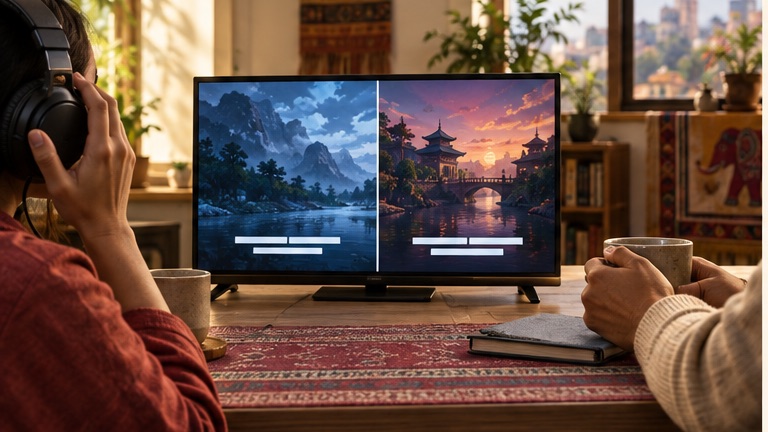
A joke can depend on sound, spelling, a cultural reference or the timing of a reaction. These mechanisms do not travel in the same way. If a misunderstanding depends on two similar-sounding words, a literal translation might preserve the dictionary meanings while making the misunderstanding impossible to follow.
A translation can respond in different ways: preserve the unfamiliar reference, build a different verbal link, provide a concise explanation where the format permits, or rely on the visual reaction to carry part of the humour. Each solution has costs.
A detailed translator’s note can be interesting after the episode. During a rapid exchange, it may compete with the next joke and the character acting. A short adapted line may land more naturally but give you less access to the original wordplay.
Neither observation should end the discussion. Ask which part of the scene matters most: the specific reference, the misunderstanding, the speaker’s personality or the rhythm of the exchange. Then describe what the chosen solution preserves and what it loses.
Avoid reproducing an entire scene’s dialogue just to compare it online. A brief description, a timestamp and a short necessary excerpt can usually make your point. Keep spoilers labelled, and distinguish your own back-translation from an official script or a verified translation.
If you select a dub and then turn on a general subtitle track, you may be seeing a translation prepared independently from the dub script. The mismatch can be distracting even when both tracks broadly communicate the scene.
An SDH or caption track intended for that dub is a different resource. Netflix’s UK English guide explicitly directs SDH work for dubbed material to use the dub script or audio as its basis, within timing and reading constraints. That does not mean every title on every service has such a track.
Look for the exact language and any CC or SDH designation. Then sample a short exchange. If the captions do not match what you need, check whether a different track is offered rather than repeatedly toggling the same one.
Do not assume that captions are unnecessary just because the audio is in a familiar language. Viewers may need them for hearing access, processing, sound conditions or personal preference. A dub can improve spoken-language access and still be incomplete for a viewer if appropriate captions are missing.
Crunchyroll’s support information notes that caption and subtitle availability can differ across titles and regions. Use the actual player’s options as the practical check. Read Crunchyroll’s subtitle-availability guidance.
Check the series, season and episode—not only the platform’s marketing page. A service offering Hindi somewhere in its catalogue does not establish that the particular show you want has Hindi audio, Hindi subtitles or both.
Crunchyroll’s Hindi-language help page recommends checking the available audio and subtitle options in the player. Netflix’s help page notes that language availability can differ between seasons and that rolling releases may receive tracks when those versions are ready. See Crunchyroll’s Hindi guidance and Netflix’s language-availability explanation.
First, open the exact title and season. Second, inspect the audio choices and subtitle choices separately. Third, test an episode if access permits. Fourth, look at the later episodes you expect to reach, especially for an ongoing release. Finally, confirm that the options work on the device you will actually use.
Do not mistake the interface language for the show’s audio language. Menus, subtitles and spoken dialogue are separate settings. Changing one does not create a track that has not been supplied for the title.
If information is missing before purchase, consult official support or a current title announcement. An old social-media post can establish that a dub was announced; it does not prove that every episode remains available in your region today. Our legal anime streaming guide for India covers the broader access decision.
Your best choice can change from one evening to the next. A subtitled mystery on a small phone demands a different kind of attention from a familiar dubbed episode on a television. Neither situation defines your taste permanently.
| If your priority is… | A useful starting choice | What could change the decision |
|---|---|---|
| Hearing a particular Japanese performer | Japanese audio with a subtitle language you read comfortably | Caption access, reading load or availability |
| Watching with family | An available language the group follows easily | Individual hearing, language and content needs |
| Studying character animation | A familiar-language dub or a scene you already know | Whether reading actually distracts you |
| Following dense dialogue | The clearest accessible combination of audio and captions | Translation clarity and the pace of that show |
| Comparing performances | A short scene in two official versions | The versions must be the same scene and release context |
For a group watch, ask about language and accessibility before starting. Do not make someone defend a practical preference as if it were a judgment on Japanese culture. The goal is a shared experience, not a test of endurance.
For solo viewing, give a version enough time to establish a character. A deliberately awkward introduction may not represent the actor’s entire performance. At the same time, you do not owe a version a full season if it prevents you from following or enjoying the story.
Choose a short, spoiler-safe scene you have already watched. A conversation with a clear emotional turn works better than a montage with little dialogue. Keep the device and listening volume reasonably consistent so that a louder playback does not become your main impression of stronger acting.
Watch the first version without stopping. Write one sentence about what the character wants in the scene. Watch the second version, then note a specific difference: a pause, a change in emphasis, a more formal address or a joke placed earlier in the line.
Now rewatch the surrounding exchange. Does the difference change a relationship, a plot fact or mainly the flavour of the performance? Which version works better for you, and why? An answer such as “the shorter pause makes the response feel defensive” is more useful than “all dubs are bad” or “subtitles are pointless.”
Keep the exercise bounded. You are comparing a scene, not proving a universal law about two languages. A strong result in one episode does not certify every later adaptation, just as one awkward sentence should not erase the work of an entire cast.
The most rewarding outcome of the sub-versus-dub question is not winning an argument. It is hearing how a character is built: a breath before an answer, a sudden shift in politeness, a joke that barely conceals fear or a silence that matters more than the sentence after it.
If that curiosity grows, our guide to how anime is made connects sound with the rest of production. The anime opening and ending songs guide offers another way to listen beyond the dialogue.
Choose the version that brings you into the story. Compare another when the comparison is enjoyable or useful. Understanding adaptation should give you more ways to appreciate anime, not one more reason to feel that you are watching it incorrectly.
AUTHOR OF THIS ARTICLE
SoJapan
SoJapan India Pvt. Ltd. is a Japanese-founded company based in Gurugram. We bring Japanese food, anime goods and apparel materials to Indian businesses, with a sister company in Kyoto that works directly with makers in Japan.