A bowl of edamame can raise an unexpectedly practical question: is the whole green pod food, or are you supposed to get something out of it? A freezer packet adds another: if the beans already look like the ones served in a restaurant, do they still need cooking?
Start with two separate answers. You eat the beans inside the pod, not the pod itself. The preparation needed before eating depends on whether you have fresh edamame or a particular packaged product. A shelled bean is easier to put into a salad, but being shelled does not establish that it is ready to eat.
This is where a generic instruction such as “microwave the bag” becomes unhelpful. Below, two real manufacturers’ products require opposite bag-handling decisions. Their instructions are examples of what to check, not interchangeable recipes or a claim that either product is available in India.
Before you start
Edamame are young green soybeans. Kikkoman’s account of this Japanese snack describes eating the beans by pressing them out of their pods and discarding the pod. It also distinguishes frozen edamame sold in pods from the already-shelled form. These are different presentations of the food, not instructions for the same preparation method. Kikkoman: Edamame
At the table, let a hot pod cool enough to handle. Press the beans out into your mouth, or open the pod with your fingers and take the beans out. You do not have to copy a restaurant gesture to eat it correctly. If you would rather see what you are eating, opening a pod over your plate is perfectly workable.
The important contrast is with a vegetable you might eat whole. Do not bite through an edamame pod expecting the entire thing to be the serving. Conversely, a bowl of empty pods is not evidence that somebody has wasted most of the snack: that is the part left after eating the beans.
For a shared bowl, put an empty bowl beside it before serving. That small arrangement solves two problems: newcomers can see where discarded pods go, and nobody has to balance them on the rim of a plate. Keep discarded pods separate from the serving bowl. If you are introducing edamame to someone, “eat the beans inside” is more useful than simply calling it a Japanese starter.
There is no need to turn the serving into an etiquette test. A pod-on bowl invites people to eat a few beans at a time; a bowl of shelled beans asks for a spoon or chopsticks. Choose the presentation that suits the meal and the people eating it.
Remember that this is soy, not a soy-free alternative to tofu. Identifying the edible part and checking whether the food suits someone’s dietary requirements are separate jobs. A plain-looking serving also does not tell you what has been added to its seasoning or dressing.
The most useful comparison is not “Japanese brand versus another brand.” It is what the manufacturer has prepared, and how that exact package is intended to be used. Both products below contain edamame and salt, yet their preparation instructions cannot be exchanged.
Specific products checked on 19 October 2026. Read the directions on your own pack; the table is not a substitute. On a narrow screen, scroll the comparison sideways.
| Decision | Nichirei 香り枝豆(塩味付), 250 g | Pictsweet Farms shelled edamame snack packs |
|---|---|---|
| Presentation | Salt-flavoured beans in pods | Shelled beans with sea salt |
| Thawing | The maker provides thaw-and-eat options. | The maker says not to thaw before cooking. |
| Microwave container | Remove the food from the bag and use a plate with wrap. The bag contains aluminium and must not be microwaved. | Cook one frozen, unopened snack pack as directed; do not open or pierce it beforehand. |
The sources are the current product pages for Nichirei’s salt-flavoured edamame and Pictsweet Farms’ shelled edamame snack packs.
Nichirei includes an overnight refrigerator-thaw option. Its room-temperature option specifies 20°C, so do not silently reinterpret that as any warm kitchen in India. The maker says to consume the beans promptly after thawing. Its microwave times vary with the amount and the appliance’s wattage.
Pictsweet’s instructions specify one pack, with a cooking time based on a 1,000-watt microwave, followed by a standing period. Its food-safety directions require heating to 165°F before use. “Snack pack” describes the portion and presentation; it does not remove that cooking instruction.
Neither package is a useful model for guessing what an unlabelled bag will do. If your own pack is different, follow its directions, even if the photograph looks identical. These examples demonstrate a real difference, not a ranking of the products.
A serving photograph may show the beans cold, beside a salad or ready for snacking. That tells you the intended finished result. Look elsewhere on the pack for the actions that get you there: cook from frozen, thaw, remove from packaging, leave unopened, pierce, stand, drain.
Read those actions in their printed order. Opening a bag is an ordinary first step for many ingredients, so it is easy to do it before looking at the cooking panel. With an unopened-pack method, that has already changed the setup. Read first and open second is the better habit here.
Next, find the amount covered by the instructions. A method for one small pack is not automatically a method for several packs together. Similarly, a timing printed beside a particular microwave wattage is not a universal “edamame time.” If your appliance does not match, use the manufacturer’s alternative instructions or ask for clarification rather than inventing a conversion.
If an imported packet is hard to read, identify the cooking panel and bag warnings before preparing it. Translation can help you understand the printed directions, but an online recipe for a different brand cannot supply missing product information. If you cannot establish whether cooking is required or what can go into the microwave, do not guess from the colour of the beans.
Freezing tells you about the food’s state in the freezer, not every process it went through beforehand. Kikkoman’s ingredient glossary even includes freezing fresh edamame without boiling as one home-storage option. That alone is enough to show why “it was frozen” cannot prove “it was cooked.” Kikkoman’s edamame glossary
Keep the two decisions separate on a shopping list as well. “Shelled” answers whether you will have pods to remove. The preparation panel answers what needs to happen before you can eat the beans. Buying the convenient form is sensible, but convenience is not the same thing as permission to skip a required step.
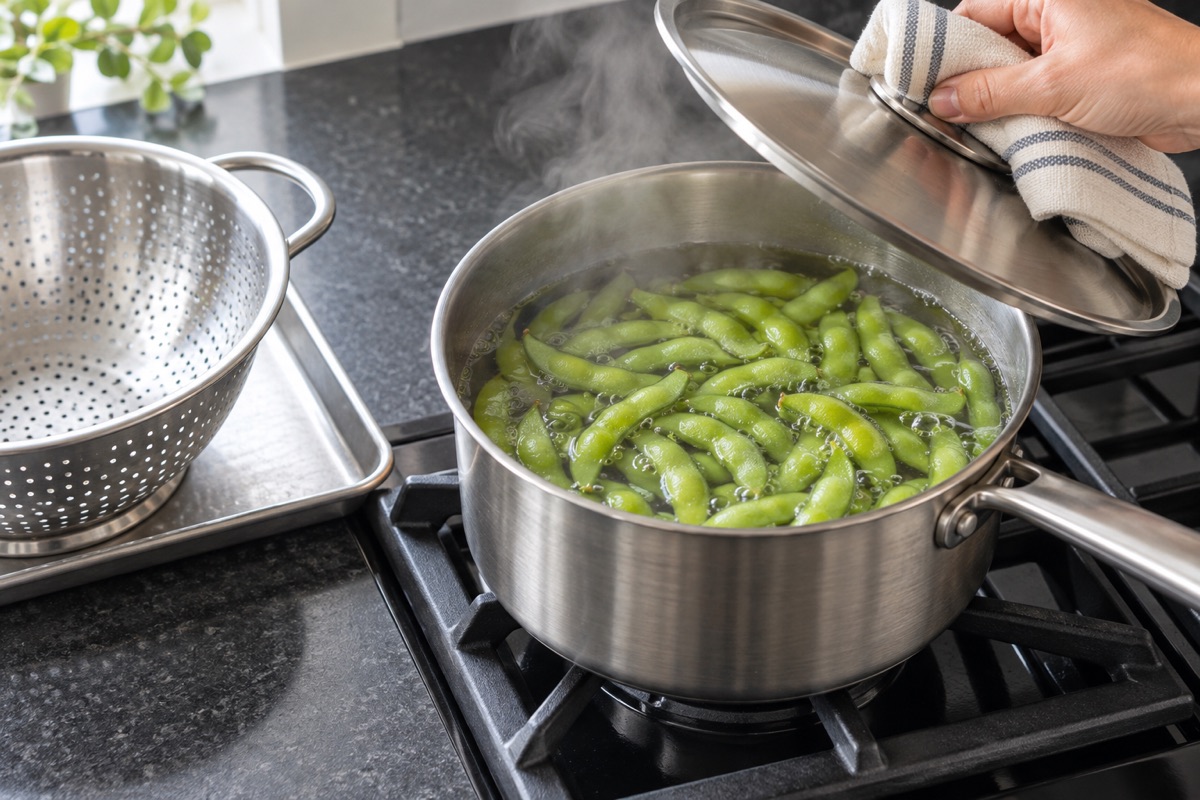
Fresh edamame is a different starting point. A frozen product’s short reheating instruction, or permission to thaw and eat, does not apply to fresh pods simply because they look similar. Choose a recipe that explicitly starts with fresh edamame.
Kikkoman’s Japanese lesson on boiled edamame is a useful example. It trims the ends of fresh pods and rubs them with salt before cooking in a small quantity of water. The lesson explains that trimming helps the beans come out and lets heat and seasoning reach them more readily; rubbing addresses the fine surface hairs as well as seasoning. Its covered, shallow-water method treats the salt and water amounts as part of one recipe. Kikkoman: boiled edamame lesson
Those details explain why “just boil it” is incomplete guidance for somebody trying fresh pods for the first time. The preparation before the pot and the amount of water in the pot affect how that recipe works. Taking the cooking time from one method, the salt from another and the water level from a third does not preserve the original instructions.
Follow one complete method for your first batch. Have the sieve or colander ready before cooking, and decide whether the beans will be served in their pods or removed for a dish afterwards. You want to be making the serving decision before you are holding a hot pan, not while the food sits in it.
A salt rub is a preparation step, but the salt may or may not remain part of the cooking medium. In the boiled-edamame lesson above, the rubbed pods go into the specified water without rinsing off that salt. Do not add another recipe’s full measure of salt on top without checking what the method already includes.
Kikkoman’s separate peperoncino-style recipe starts with fresh pods, rubs and rinses them, then uses oil, garlic and chilli, followed by a covered steam-frying stage with water. Soy sauce comes later. The rinse and the later seasoning belong to that particular method. Kikkoman: peperoncino-style edamame
The point is not that you need several edamame techniques before you can make a snack. It is that an instruction such as “rinse after rubbing” cannot be judged without the rest of the recipe. In one method the salt stays in the pot; in another, it is rinsed away before a different seasoning sequence.
Do not repeat all of this fresh-pod preparation on a pre-seasoned frozen product as an automatic ritual. Once the starting ingredient changes, return to the appropriate instructions. The extra work is not evidence of extra care if it solves a problem that the product no longer has.
Choose a documented method that fits the ingredient and equipment you have. If it calls for covered cooking, do not switch to an uncovered pan while assuming the stated timing still applies unchanged.
Choosing the final form before cooking makes the rest of the meal easier to organise. Ask a simple question: will the person eating this expect to put down their spoon and shell a pod? If the answer is no, remove the pods before combining the beans with the dish.
Pod-on edamame makes sense as a separate snack when you want the beans to be eaten a few at a time. Serve the prepared pods with a discard bowl and a brief explanation for anyone unfamiliar with them. Keep the bowl separate from a dish intended to be eaten by the spoonful.
If you are offering seasonings, make it clear whether they go with the whole snack or with shelled beans. A heavily coated pod is still a pod to discard, not an edible wrapper. More coating does not change which part is eaten.
For a mixed group, plain prepared beans with an optional accompaniment can make the serving easier to understand. That is an editorial serving suggestion, not a claim that a particular Japanese household or restaurant always presents them that way. Check the ingredients of both the beans and anything added for the people at your table.
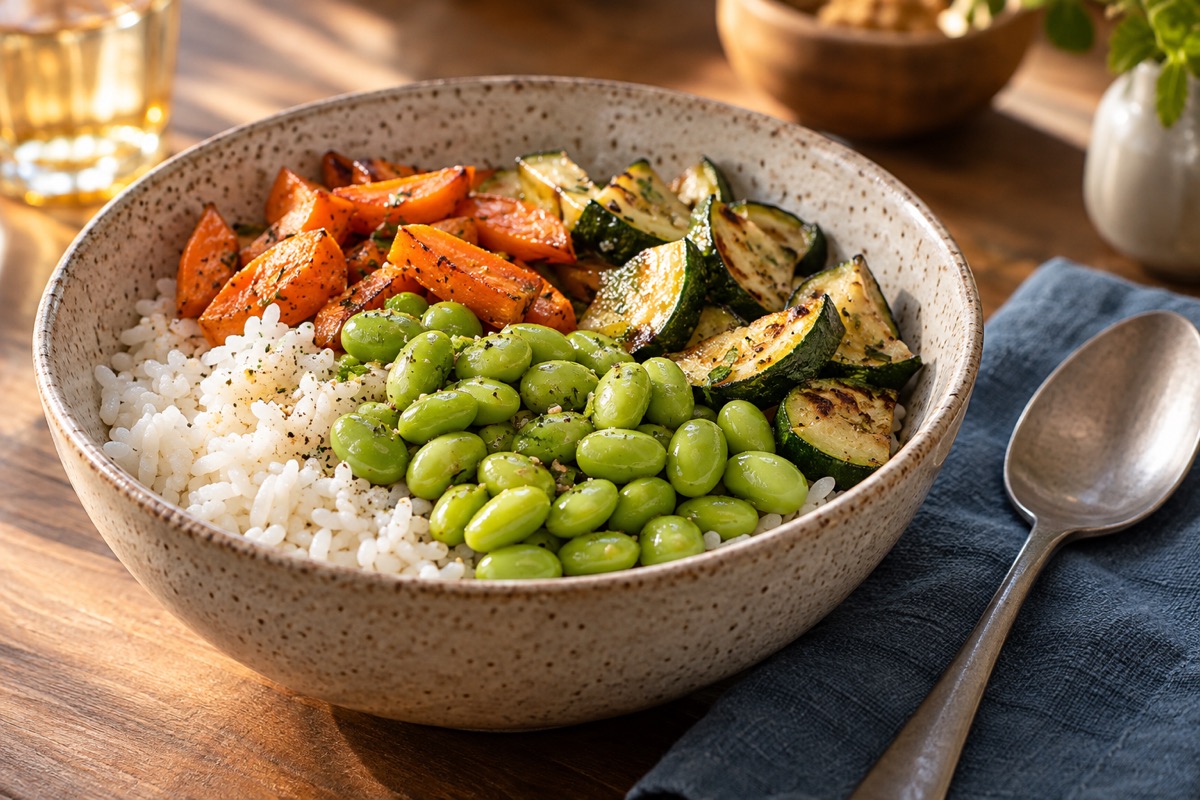
For a spoon-ready bowl, shell the prepared edamame separately and add the beans. Do not tuck whole pods among rice and toppings and expect diners to discover the distinction halfway through a bite.
As a meal-planning example, imagine rice, cooked vegetables and edamame as separate components. Prepare each as appropriate, then assemble the bowl using the edible beans. This is an assembly suggestion, not a tested one-pot recipe: it does not establish that a rice cooker’s cycle will cook any arbitrary fresh or frozen edamame product correctly.
That boundary matters when adapting something seen on screen or in a photograph. A finished bowl shows where the ingredients ended up; it rarely shows every preparation step. It is fine to borrow the visual arrangement while using a verified preparation method for each ingredient.
Kikkoman’s edamame salad recipe boils the edamame, drains it and removes the pods before the beans are combined with the other ingredients. It provides a clear example of shelling as part of preparation rather than asking the diner to extract beans from a dressed salad. Kikkoman: edamame salad
If your chosen product is already shelled, you have saved the pod-removal step, not necessarily the cooking step. The cold-dish section below deals with that distinction. Once your beans are appropriately prepared, choose a dressing for the dish you want rather than treating edamame as requiring one special bottled sauce.
For the separate question of whether whole seeds, ground sesame or sesame paste will give you the coating you want, see our guide to sesame forms for vegetables. That choice comes after deciding how to prepare the beans.
A recipe can be clear about the ingredient name but less clear about when it is weighed. “Edamame, 200 g” might mean pods before shelling or beans after shelling. Read the method, ingredient notes and any photograph before deciding what to measure.
Do not assume that buying 200 g of pod-on edamame supplies 200 g of shelled beans. The pods contribute to the weight and are then discarded. There is no single yield percentage established in this guide, and substituting an invented ratio would make the advice look more precise while making your shopping less reliable.
For a recipe that explicitly asks for shelled beans, weigh the beans at the stage the recipe specifies. If you are preparing pods first, shell them and measure the edible portion. If you are buying shelled beans, check whether the recipe asks for frozen, cooked or drained weight; those words are part of the measurement, not optional decoration.
For a flexible rice bowl or a small side salad, a modest difference in the bean quantity may simply change the balance of the dish. That is an editorial judgement about an assembly-style meal, not a licence to disregard the quantities in a tested recipe. Where an exact quantity matters, resolve the ingredient’s state before you begin.
The same distinction helps when comparing two packs in a shop. A larger pod-on bag and a smaller bag of shelled beans are not directly comparable by net weight alone. Consider the form you need and the preparation still required. For a snack, the pods are part of the serving experience; for a measured salad ingredient, you will be removing them before the beans reach the bowl.
“I am making a salad” is a decision about the finished meal, not proof that frozen vegetables can go straight into it. The UK Food Standards Agency specifically advises checking the pack and cooking frozen vegetables before eating them cold when the instructions require cooking. Its guidance notes that frozen vegetables can contain bacteria. Food Standards Agency: cooking your food
The practical sequence is therefore: establish the required preparation, complete it, then handle the beans appropriately for a cold dish. Do not use thawing as a replacement for a required cooking step. Equally, do not describe every frozen product as requiring the same treatment when a manufacturer explicitly permits a different preparation for its own product.
Plan the cold meal early enough that you are not trying to solve the entire process at the last minute. Have the rest of the salad ingredients ready separately, along with a clean container for the prepared beans. The FSA’s general guidance is to cool cooked leftovers and put them in the fridge within two hours, then eat them within 48 hours. Follow any stricter directions on the product; these general limits are not an instruction to leave food out for the full two hours. FSA leftover guidance
Keep a clean portion aside before serving if you expect to use some beans later. This is much more straightforward than trying to turn a communal bowl of handled pods into tomorrow’s salad ingredient. It also lets you measure the beans for the next dish without sorting through discarded pods.
The most confident first serving is not the most elaborate one. It is a bowl where you know which part to eat, what preparation the ingredient required, and whether the diner is meant to shell it. Once those decisions are clear, edamame can remain pleasantly simple: beans from a pod for a snack, or prepared beans ready to join a meal.

AUTHOR OF THIS ARTICLE
SoJapan
SoJapan India Pvt. Ltd. is a Japanese-founded company based in Gurugram. We bring Japanese food, anime goods and apparel materials to Indian businesses, with a sister company in Kyoto that works directly with makers in Japan.