A bowl of green beans can have sesame scattered over it, a rough sesame coating clinging to it, or a smooth dressing spooned across it. Those are three different finishes. Adding more whole seeds will not, by itself, produce the third.
This is the useful starting point for Japanese sesame cooking: decide what the sesame needs to do before deciding how much to add. A recipe’s small word—roasted, ground or paste—can matter as much as the quantity beside it.
For an Indian home cook who already knows sesame as til, the ingredient need not be exotic. The unfamiliar part may be the Japanese preparation name, or the expectation that an apparently simple vegetable side should have a particular coating. You do not need to buy every form to begin. You need to recognise which one your chosen recipe actually uses.
This guide follows the sesame from packet to mixing bowl, then looks at vegetables whose preparation changes the result. The examples come from sesame makers and Kikkoman’s own recipes; the comparisons and suggested choices are editorial guidance, not claims from a kitchen test.
Japanese names make this distinction unusually practical. Irigoma means roasted sesame seeds; surigoma is roasted sesame that has been ground; nerigoma is sesame worked into a paste. Kadoya also distinguishes these from washed, dried raw sesame. “Sesame seeds” on an English label therefore does not automatically mean the ready-roasted ingredient in a Japanese recipe. Kadoya’s product definitions explain the processing differences.
Here is how to read those forms at the bowl. The last column is a cooking decision, not a universal substitution rule.
| Form | Starting point | Cooking decision |
|---|---|---|
| Irigoma — いりごま | Whole roasted seeds | Keep individual seeds, or grind as directed. |
| Surigoma — すりごま | Ground roasted sesame | Check the requested coarseness. |
| Nerigoma — ねりごま | Smooth sesame paste | Combine with the dressing’s other ingredients. |
The table is not a ranking. Paste is not “better sesame,” and whole seeds are not an unfinished version of every dish. Each can be the intended finish.
It is also worth separating plain sesame from a prepared sesame seasoning. Kuki’s current white Pure Sesame Paste stand pack lists hulled roasted sesame as its ingredient; the black version lists roasted black sesame. Neither ingredient list turns it into a soy-and-vinegar dressing. Kuki’s stand-pack specifications are a useful concrete example of what plain paste means.
If you squeeze that paste over beans and find the result different from a restaurant’s sesame sauce, the missing step may be the rest of the dressing—not a more expensive brand of sesame. Read the complete seasoning list before judging the ingredient.
Colour does not tell you whether sesame is whole, ground or pasted. Make those two decisions separately: first the form required by the method, then the sesame colour or flavour requested by the recipe.
Kuki describes its white paste as milder and creamy, while its black paste has a stronger character and may bring some bitterness. These are the maker’s flavour descriptions, not a promise that every white or black sesame product tastes identical. Kuki’s guide to nerigoma is useful when you want to explore beyond the recipe’s starting point.
For a first attempt, keeping the specified colour removes one variable. Try changing it once you know how the original dressing tastes.
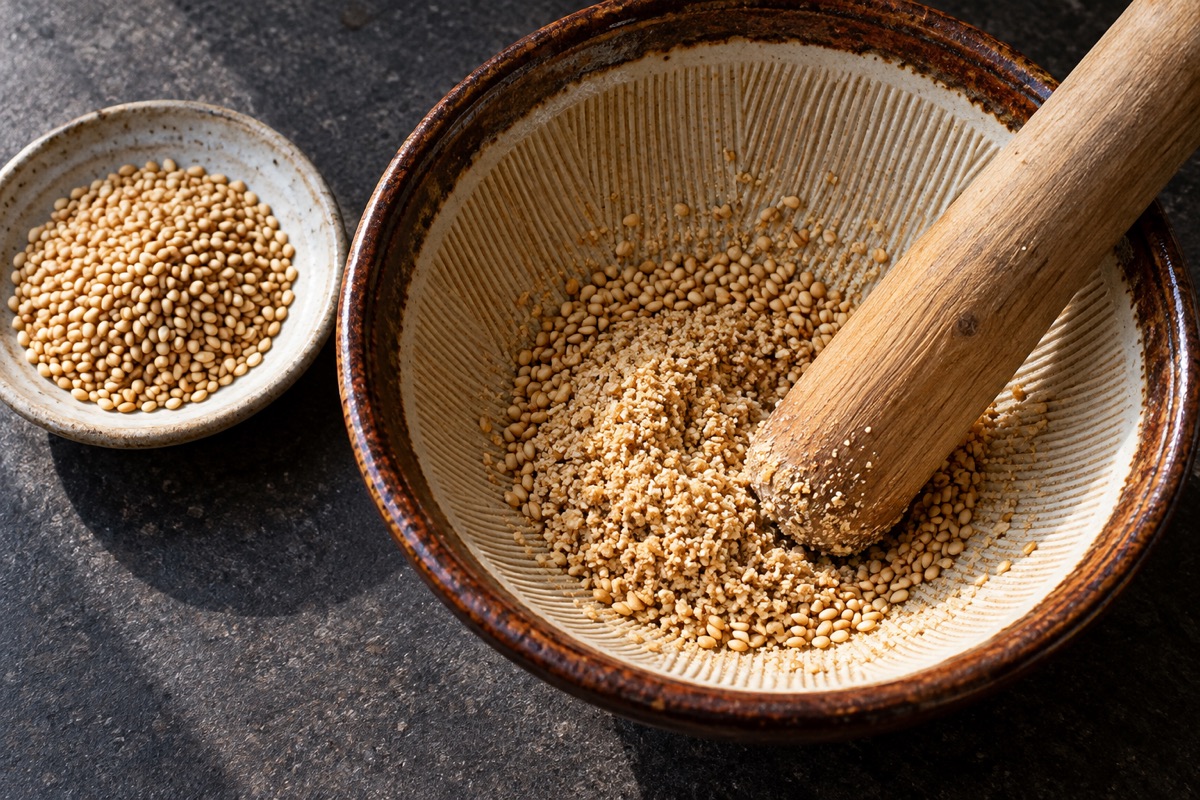
You can start with ready-ground sesame. Kikkoman’s glossary describes surigoma as roasted and ground seeds, and names both a mortar and pestle and a sesame grinder as ways to prepare it yourself. Buying the prepared ingredient is a valid route, not a failure to cook properly. Ground sesame glossary.
What matters is the result the recipe asks you to produce. A coarse grind retains recognisable bits; a smoother paste is a different endpoint. Kuki even sells a half-ground style that deliberately leaves particles. Its discussion of the three forms explains that grind level, roasting and, for paste, hulling can affect the finished product. Kuki’s guide to choosing sesame forms.
That makes “grind until fine” an instruction worth reading literally. It is not the same as “give the seeds a quick crush,” nor is every instruction to grind a request for paste. When you are following a recipe with a photograph, look at the coating: can you still see sesame fragments, or is it a continuous sauce?
Our practical preference for a first goma-ae is to follow a recipe that explicitly names ground sesame. It lets you learn the balance of vegetables and coating without making the grind itself an extra project. If grinding is the part you want to learn, use roasted seeds and the equipment specified by a reliable method; do not assume a few seconds in any appliance will reproduce a commercial paste.
A useful counterexample comes from Kikkoman’s green-bean kinpira with sesame and bonito. Its method cooks the beans with seasoning, then adds roasted white sesame and bonito after the heat is turned off. The seeds are mixed through, but are not ground into the sauce. Kikkoman’s green-bean kinpira shows that “mixed in” and “ground” are different instructions.
This particular example contains fish and cooking sake; it is not being presented as a vegetarian recipe. Its value here is the sesame’s role. A whole seed can remain a small, distinct element even when it is distributed throughout the vegetables.
By contrast, the sesame in a ground coating becomes part of what surrounds each piece. The practical question is not simply whether sesame appears everywhere in the bowl. It is whether you want to meet it as a seed or as part of the dressing.
It is tempting to blame the dressing whenever sesame collects at the bottom of a bowl. Before changing the recipe, check the vegetable preparation. Did the method ask you to drain, squeeze, cool, salt or season the vegetables first? Those verbs are not interchangeable, and they are not decorative detail.
Three official examples make the distinction clearer than a rule such as “always rinse after boiling.”
Kikkoman’s detailed Japanese green-bean goma-ae lesson calls for salt-rubbing the beans, boiling them, then cooling them in a colander without putting them into cold water. It explains that moisture leaving the surface helps the sesame coating cling. The beans also receive a little soy sauce before they join the ground-sesame mixture. The finished dish rests, covered, in the refrigerator for about 30 minutes in this recipe. Kikkoman’s green-bean goma-ae lesson.
The point is not to make all boiled vegetables wrinkled. It is that this bean recipe has designed a surface for its relatively dry coating. If you replace its cooling step with an ice-water bath because that is your usual habit, you have changed more than the temperature.
Nor should you turn its resting time into a blanket instruction to leave vegetable dishes on the counter. The source specifies refrigeration for that rest. Follow the full method, including where the bowl waits.
Kikkoman’s spinach-and-bell-pepper recipe takes another route: microwave cooking, cooling in cold water, thorough draining, then mixing with ground sesame, sugar and soy sauce. The spinach and pepper method is not a contradiction of the bean lesson. It is a different vegetable preparation and a different recipe.
Borrowing the seasoning from one recipe and the preparation from another may work, but you are then adapting rather than following. When a first attempt disappoints, returning to one complete recipe is easier than diagnosing a hybrid.
The amount of sesame also varies considerably between these examples. “Goma-ae” is not a guarantee of one fixed sesame-to-vegetable proportion. Choose a recipe whose intended finish appeals to you instead of treating every sesame side as the same formula.
For its sweet sesame dressing on daikon and carrot, Kikkoman salts the cut vegetables, waits about ten minutes, and squeezes out excess moisture. The dressing combines ground sesame with vinegar, sugar, soy sauce and sesame oil. Kikkoman’s daikon-and-carrot recipe provides a third route: raw vegetables prepared before dressing rather than cooked vegetables cooled afterwards.
Notice that this dressing contains both ground sesame and sesame oil. The oil has not made the ground seeds redundant. That is a useful warning against replacing one with the other simply because both bottles or packets say sesame.
Taken together, these examples suggest a better way to troubleshoot: ask what water was meant to remain with the vegetables. If a recipe expected well-drained ingredients, adding more seasoning to compensate for extra water can turn into a cycle of overshooting. Repeating the intended preparation next time is a more informative change than doubling everything in the dressing.
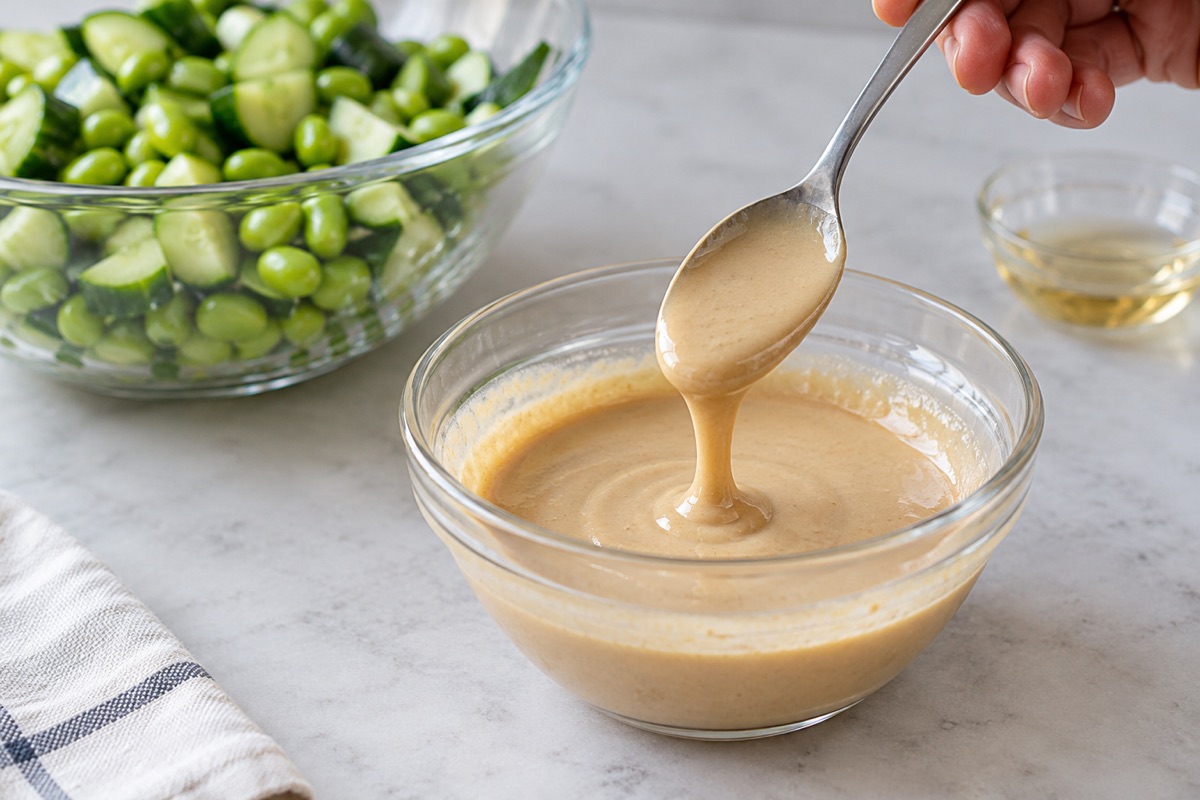
Paste offers a smooth sesame base, but it still needs the recipe around it. Think of the mixing bowl as a separate stage of cooking: here you can combine the seasonings evenly before the vegetables make everything harder to stir.
Kuki’s simple sesame dressing uses white sesame paste, sugar, soy sauce and vinegar. Its instruction is to combine the paste with sugar, then add the soy sauce and vinegar gradually while mixing. The same article presents another dressing containing mayonnaise, so even one maker’s “sesame dressing” is not a single fixed formulation. Kuki’s dressing methods.
That gradual mixing is a more useful lesson than memorising a ratio and applying it to every bottle. Start with a recipe intended for plain paste. Measure its ingredients, blend them as directed, and inspect the dressing before it reaches the vegetables.
If a thick patch of paste remains on the spoon, mixing it into delicate leaves will not necessarily distribute it evenly. Finish that work in the dressing bowl. Equally, do not keep adding soy sauce merely because it is the nearest liquid: it changes seasoning as well as consistency. Any adjustment should respect the liquids and balance of the recipe you chose.
Paste does not remove the vegetable-preparation problem. Kikkoman’s edamame salad uses a sesame-paste dressing with soy sauce, mirin and vinegar, but it also salts and presses the cucumber, drains the boiled konnyaku, and removes excess moisture from the tofu. Kikkoman’s edamame salad is a good example of a smooth dressing meeting several ingredients with separate preparation needs.
Our reading: sauce texture and ingredient moisture are two jobs, not alternatives.
The mirin in this example also matters if you avoid alcohol. We cite it to explain the method, not to certify the dish for every diet. Select a complete recipe compatible with your needs instead of assuming that a vegetable title settles the ingredients question.
Kadoya explains that the oil and solids in its plain sesame paste can separate during storage. Its guidance is to stir with a dry spoon, carefully bringing the mixture together. That separation is a property of the product it describes, not evidence that you need to pour the oil away. Kadoya’s sesame-paste FAQ.
Bring the product together as directed before measuring, rather than taking only oil from the top or solids from the bottom. Ordinary separation is not a blanket reassurance about a damaged or spoiled pack; ask its maker about any uncertainty over its condition.
The easiest shopping mistake is not buying the wrong brand. It is buying a different kind of ingredient under the same broad English word.
Plain paste and bottled dressing: Kuki’s bottled Rich Sesame Dressing contains sesame oil, paste and ground sesame, along with vinegar, sugar, soy sauce, egg yolk and other seasonings. Its ingredient list is very different from its plain paste. Kuki’s dressing specification.
If a recipe asks for plain nerigoma and you use that dressing, you introduce ingredients the recipe may already add separately. Conversely, plain paste will not taste like a finished bottled dressing by itself. Read the ingredient list, not just the beige colour or a picture of sesame.
Ground sesame and sesame oil: the daikon example above uses both for a reason. If you have oil but no ground seeds, look for a recipe built around an oil dressing rather than treating the oil as an equal spoon-for-spoon replacement. You may still make a good side dish; it will be a different finish.
Whole seeds and ground sesame: if you have the appropriate roasted seeds and a suitable grinder or mortar, grinding is a way to prepare the requested ingredient. Simply sprinkling the same volume of whole seeds into a ground-sesame recipe skips that preparation. Decide whether you want the original coating or are happy to make a seed-studded variation.
Furikake and plain sesame: a sesame-rich rice seasoning may contain salt and other ingredients. It is not automatically a packet of surigoma. Our furikake guide explains the separate question of mixed seasonings and their intended use on rice.
These distinctions matter more than buying a large collection. Before purchasing, put the recipe and label side by side. Check the sesame form, whether it is already roasted, and whether the product is plain or seasoned. We are not asserting Indian stock or prices for the Japanese products cited here; they are manufacturer examples that make the differences visible.
The sources do not all give identical storage advice. Kikkoman’s ground-sesame glossary recommends refrigeration after opening and prompt use. Kuki’s sesame guide recommends its products be sealed and kept in a dry, dark place, and discusses condensation when refrigerated products are taken out. Do not collapse these into a universal fridge-or-cupboard rule.
Follow the instructions on your exact pack, including after-opening directions. A hot shelf beside a cooker is not a sensible interpretation of a manufacturer’s request to avoid high temperatures. If the conditions in your kitchen do not fit the label, ask the manufacturer how to store that product rather than inventing a shelf life. Neither a bottle’s unopened date nor advice for plain paste establishes how long a mixed vegetable dish will keep.
For a first attempt, our recommendation is a ground-sesame vegetable side with a short, explicit method. It teaches the central distinction—a coating rather than a sprinkle—without requiring a smooth homemade paste or a shelf of sauces. The bean and spinach recipes above offer different preparation routes; pick one, including its drainage and cooling steps.
If what you really want is a pourable salad dressing, begin with a recipe written for paste. Do not choose a dry goma-ae and then keep adding liquid until it resembles a bottle. That changes the dish halfway through making it.
When tasting, include an actual piece of vegetable in the bite. A dressing tasted alone cannot tell you how evenly it is distributed or whether the chosen vegetable overwhelms it. Decide which problem you have before adjusting: scattered seeds where you wanted a coating, unevenly mixed paste, excess liquid, or a balance of flavours you simply prefer differently. Those are not all solved by more sesame.
You can enjoy all three finishes. The skill is being able to choose one on purpose: a distinct seed, a textured coating, or a smooth dressing. Once that choice is clear, the packet names stop looking like three versions of the same purchase—and start telling you what to do next.

AUTHOR OF THIS ARTICLE
SoJapan
SoJapan India Pvt. Ltd. is a Japanese-founded company based in Gurugram. We bring Japanese food, anime goods and apparel materials to Indian businesses, with a sister company in Kyoto that works directly with makers in Japan.