You are taking three damage. Two cards come off your deck, neither is a climax, and now the deck is empty. There is a waiting-room pile beside those two revealed cards. Do all of them get shuffled together? Do you finish checking the damage first? And what if the next card you turn over is a climax?
The useful distinction is not face-up versus face-down. It is which zone each card occupies, and why the next card is moving. The two damage cards are still in the resolution zone. They are not waiting-room cards simply because you can see them.
For ordinary damage processing, refresh interrupts when the deck empties: rebuild from the waiting room, put the new deck’s top card into clock as the refresh penalty, then resume the interrupted process. That penalty is not damage and cannot be cancelled by being a climax. The worked examples below show what this means without requiring a particular anime deck or an expensive card.
This guide uses the English Edition Comprehensive Rules v2.10, dated 17 September 2025 and linked from the official rules page when checked on 19 October 2026. The relevant sections are 3.13, 4.10 and 9.1–9.3. Official rules and current downloads
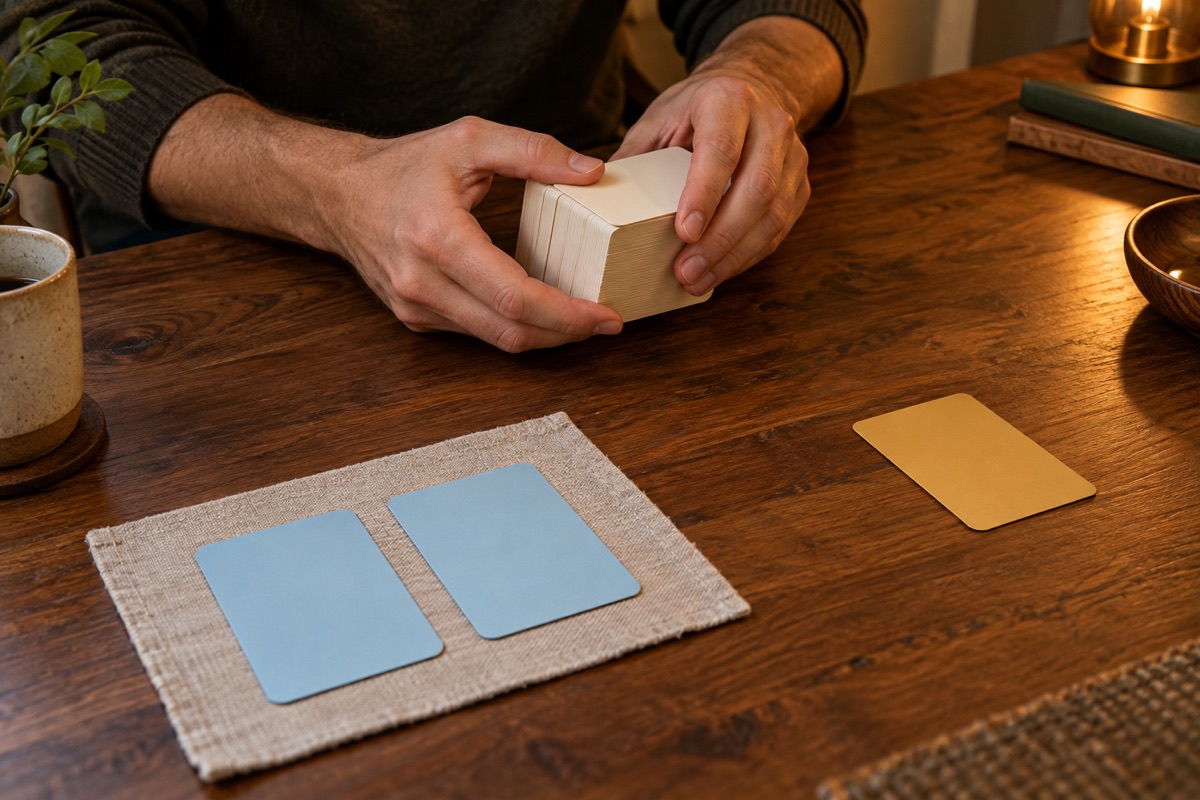
Here is a hypothetical teaching position, not a report of a played match. You have one card in clock and two cards left in your deck. You are receiving one instance of three damage. Your waiting room has plenty of cards, including enough to rebuild the deck, take the penalty and finish the check without another refresh. No abilities alter the process, and this first example will not involve level-up or losing the game.
Call the two remaining deck cards A and B, in the order they will be checked. Both are non-climax cards. These letters are labels for following physical cards, not invented card names or abilities.
Move A from the top of the deck into the resolution zone for the damage check. It is not a climax, so continue. Move B there next. B is also not a climax, but this movement has left the deck empty.
At this point, you have checked two of the three damage cards. A and B have not become two separate points of completed damage. They belong to the same unfinished three-damage process. Keep them together in their original order, visibly apart from the waiting room.
That pause matters because you still do not know whether this instance of damage will be cancelled. A climax encountered when the check resumes can cancel the entire instance, including A and B. Moving those two cards to clock early would obscure that outcome.
Refresh interrupts now. Shuffle the waiting-room cards to make the new deck. Leave A and B where they are: in the resolution zone, outside that shuffle.
There is no choice here to include a useful revealed card or hold back an inconvenient waiting-room card. The example separates the piles so you can perform the required movement without accidentally changing which cards enter the new deck.
Next, move the new deck’s top card to clock for the refresh penalty. Call it P. Your clock has gone from one card to two. P was not the third card of the damage check; it was moved for a different reason.
Only then resume the three-damage process. The next card taken from the new deck is the third damage-check card. Call it C. P and C are two different cards, even though both came from the top of the rebuilt deck in quick succession.
For the first branch, assume C is a non-climax card. The check has now reached three cards without finding a climax. Move A, B and C to clock in that order, with C on top. P is already there beneath them.
The final clock count is five: the original one, plus P, plus the three cards from the uncancelled damage. This is a count for this particular teaching position, not a claim that every refresh adds four cards to clock.
| Pause point | Unfinished damage cards | What has happened to clock? |
|---|---|---|
| A and B have been checked; old deck is empty | A and B remain in resolution | Still the original one card |
| Waiting room has become the new deck; penalty taken | A and B still remain in resolution | P added: two cards in clock |
| C is checked and is not a climax | A, B and C finish the damage process | A, B and C added above P: five cards total |
This ordering follows the damage process in section 4.10 and the interrupting refresh action in section 9.2 of the English Edition Comprehensive Rules v2.10. The letters and starting clock count are our teaching choices; they are not a separate rule or a special card interaction.
The easiest mistake in that sequence is treating every revealed climax as a cancellation. A climax has to be encountered by the damage process for the normal damage-cancel rule to apply. Looking only at the card type misses the reason it moved.
Return to the same position after the waiting room has been shuffled. This time, P happens to be a climax. Put it in clock. Do not discard it as a cancellation, replace it with another penalty card or stop the original damage check.
The three-damage check is still waiting for its third card, C. If C is not a climax, A, B and C go to clock as in the first example. You finish with five cards there, one of which is the climax P.
This can feel counterintuitive when you first learn the game through the shorthand “climaxes cancel damage.” The missing words are “when checked during that damage process.” P is a direct clock placement. Section 4.10.2 explicitly distinguishes this from damage processing; it does not offer a damage-cancel check.
It is also why “take one refresh damage” is risky teaching language. Players may use it informally, but a new player could reasonably infer that they should check and potentially cancel that one card. Saying “put the refresh penalty into clock” makes the actual operation clearer.
Now change the branch again. P has already gone to clock, whatever its card type. You resume the damage check, and C is a climax.
Move A, B and C to the waiting room for the cancellation. P stays in clock. The clock therefore ends with two cards: the original one and P. There are not two successful points from A and B followed by a cancelled third point; there was one instance of three damage, and it was cancelled.
Notice what your newly formed waiting room now contains. A and B were kept out of the refresh shuffle because they were unresolved damage cards at that time. They enter the waiting room only after the resumed check cancels. C joins them. None is retroactively inserted into the deck you just made.
This is the part worth practising with actual piles. If you slide A and B into the waiting room before refreshing, they can become part of the shuffled deck and even appear again during the same demonstration. That is not an unlucky sequence; it is a zone-handling error that has changed the position.
For the broader distinction between damage, battle power and climax cards, use our Weiss Schwarz beginner guide. Its ordinary attack example is the easier starting point if you are still learning when a damage check happens. Here, the extra difficulty is the interruption inside that check.
This is a different question from finding a climax after refresh. Set up a new hypothetical position: one card in clock, two cards in the deck, and one incoming instance of two damage. A, the first card, is not a climax. B, the last card of the old deck, is a climax. Again, the waiting room is large enough and there are no modifying abilities.
A enters the resolution zone. Then B enters it, leaving the deck empty. The refresh interrupt happens while those damage-check cards are still in resolution. Rebuild from the waiting room and place the refresh penalty into clock. After that interrupt, the damage process handles B’s climax cancellation, moving A and B to the waiting room.
The final result is a cancelled two-damage instance and a penalty still in clock. More importantly, B did not go into the deck formed by that refresh. Seeing that B is a climax does not allow you to move it to the waiting room early, before applying the empty-deck interrupt.
A useful way to distinguish the two cancellation examples is to ask where the cancelling climax came from. In the previous section, C came from the rebuilt deck after the penalty. Here, B came from the final position in the old deck. Both cancel their respective damage instances, but neither belongs in the waiting-room pile at the moment of the refresh shuffle.
This conclusion depends on interrupt timing, not on a special property of a particular climax. Section 9.1 treats interrupt-type rule actions as interruptions of the action in progress; section 9.2 makes refresh one of them. The damage process’s move into resolution and its cancellation handling are separate steps in section 4.10. Current comprehensive rules, sections 4.10 and 9.1–9.2
The earlier examples started with one clock card so that the locations stayed easy to follow. Starting with six adds another interruption. Suppose you are at level zero with six clock cards when an ordinary damage check empties your deck. Assume the same ample waiting room and absence of special abilities.
Rebuild the deck, then put P into clock. That gives you seven clock cards. Deal with level-up before continuing the pending damage process: choose one of those seven for level and put the other six into the waiting room. The unresolved damage cards are still separate in resolution.
The practical consequence is that your waiting room can contain cards immediately after refresh. Those six came from clock during level-up, after the deck was rebuilt. Do not pick up the new deck and shuffle them into it simply to make the waiting room empty again.
Likewise, a later cancellation does not undo the level-up caused by P. If the resumed damage check finds a climax, the cards from that damage process go to the waiting room; the earlier penalty and level-up were not conditional on that check succeeding.
Section 9.3 supplies the level-up procedure. We deliberately started this example at level zero to avoid mixing the lesson with losing-game-state checks. It is a timing exercise, not a survival calculation for a player at level three.
There are boundaries to these examples. An empty waiting room as well as an empty deck, an interruption during cost payment, or a card effect that changes normal processing needs its own rule check. Sections 9.2 and 9.3 contain exceptions concerning costs, and section 9.2 has an empty-waiting-room case. Do not extend “pause immediately” from ordinary damage processing into every possible action without checking those conditions.
At an organised game, leave the unresolved cards distinguishable and ask a judge about a disputed position before mixing the piles. Explaining which card moved last and which process was pending is more useful than saying only “we refreshed wrong.”
If a video or remembered lesson tells you to finish the interrupted action before taking the penalty, the disagreement may have a date behind it. Bushiroad changed refresh processing effective 1 August 2022. Its announcement contrasts the older sequence with the revised one: the penalty became part of the refresh process, before the interrupted action continues. Official refresh-rule change announcement
This is not merely a choice of how to describe the same result. Moving P before rather than after the resumed damage check changes which card is used as the penalty and which is checked for damage. It can also bring a level-up into the middle of the sequence. A demonstration that reaches the same clock count in one non-climax example can still be teaching the wrong order.
The official Q&A search also retains older penalty-timing answers alongside entries updated in July 2022. Check an answer’s date and context: remaining searchable does not make an older sequence current. Official Q&A search for refresh
For this specific issue, use the current comprehensive rules linked from the rules hub, with the dated change announcement explaining the historical difference. If someone shares a screenshot of an old answer, compare the sequence itself rather than arguing from the logo on the screenshot.
The source check is narrow: does the explanation put the new deck’s top card into clock during refresh, before resuming the interrupted action? If not, it is unsuitable as the timing model for the ordinary damage examples in this article. Other material in that guide may still be useful; the outdated timing is the part that must not carry over.

For an off-game teaching exercise, use labelled pieces of paper or cards everyone agrees are demonstration materials. Create separate spaces for deck, waiting room, resolution, clock and level. You can prearrange an example to learn the movements; this is not an instruction to arrange a deck during a real game.
Start with the three-damage position and put a small “three damage pending” note beside resolution. After A and B leave the deck, say which zone they are in before touching the waiting room. Then move the penalty and say why it is going to clock. Finally, return to the note and finish the original check with C.
Run it once with a climax as P and a non-climax as C. Run it again with a non-climax as P and a climax as C. The goal is to explain why a climax goes to clock in the first run but cancels the pending damage in the second. If you can explain that without moving A and B early, you have understood the central distinction.
Then try the last-old-deck-card climax example. Before the shuffle, point to the cancelling climax and explain why it is still outside the waiting room. Add the six-clock level-up position only after those simpler runs are comfortable; otherwise too many moving piles can hide the original mistake.
You do not need to memorise a long spoken sequence. Keep track of three things: the process that is unfinished, the zone each card occupies now, and the reason for the next movement. An empty deck interrupts the check; it does not erase those distinctions.

AUTHOR OF THIS ARTICLE
SoJapan
SoJapan India Pvt. Ltd. is a Japanese-founded company based in Gurugram. We bring Japanese food, anime goods and apparel materials to Indian businesses, with a sister company in Kyoto that works directly with makers in Japan.