Knowing what someone is and knowing how to speak to them are different problems. Time of Eve makes room for that difference inside a café.
Its starting point is easy to turn into a guessing game: which customers are human, and which are androids? That question belongs to the story, but it need not be the only one you carry into it. A more revealing question is what you expect an answer to permit. Would finding out that someone is an android change how seriously you take the same words?
This guide follows the café’s rule as a way into the drama. It covers the opening premise and two small examples of staging described by director Yasuhiro Yoshiura, without identifying the café’s customers or explaining later outcomes. The reading offered here is an editorial interpretation, not an official answer key to the characters.
The Studio Rikka introduction describes a future in which human-shaped androids are normally treated as appliances. A ring above the head distinguishes them visually. Rikuo, a high-school student, has grown up accepting that division. An odd entry in his household android Sammy’s activity record sends him and his friend Masaki to a café whose rule is that humans and robots are not distinguished.
Keep two questions separate as you watch: what has Rikuo learned, and what does he think that information allows him to assume? The distinction leaves space between uncovering a fact and understanding a relationship. A surprising fact does not automatically give someone a better way to behave.
A rule can change the terms of an encounter without settling what its participants believe. Entering a different setting is not the same as losing the habits brought into it.

In his Eiga.com interview, Yoshiura explains that he used communication to establish the difference in treatment. He gives two examples: an android silently stopping when a human blocks its path, and Rikuo’s sister facing Sammy while speaking to Rikuo behind her.
The second example offers a useful point of attention: facing a figure is not necessarily addressing that figure. Notice where a reply is expected to come from, rather than assuming that whoever is most obviously in view is the conversational partner.
This is not a request to pause every shot and hunt for a code. Let an exchange finish. Then ask who was allowed to take part in it. The answer may be simpler, and more uncomfortable, than a hidden clue.
For a viewing discussion, describe the action before assigning an emotion. Being spoken past is observable; feeling lonely is an interpretation needing further support. The same care applies to silence: ask what the situation permits before treating an absence of speech as proof that there is nothing to say.
The film distributor’s official synopsis describes the café’s android visitors without their identifying rings. The usual visible sorting device is therefore unavailable in this setting. The important distinction for this reading is between being unable to identify someone immediately and being asked not to make that distinction govern the encounter.
The same synopsis introduces regular customer Akiko through her wish to understand humans and androids, whom she regards as family. It also describes her concern with how another person sees her. Her identity is deliberately left out of this guide; the interesting starting detail is the direction of that question.
Instead of only inspecting another person, a speaker can ask how they themselves are being regarded. That turns a one-way assessment into something relational. Our reading is that the café becomes interesting before an identity is settled: there is already a concern to respond to.
Keep predictions provisional. If every exchange becomes evidence for a classification, there is little room left to consider why a character wanted to speak.
Yoshiura gives a concrete answer in his Animate Times interview: he likes cafés as spaces between public and private life. He also describes constructing the principal locations in 3D before storyboarding, and giving the café a counter, sofa and loft to support different situations.
That production detail suggests a viewing approach. Notice how people share a space, not only how an isolated close-up looks. Who sits near whom? Is someone part of the exchange or merely nearby? These are prompts for observation, not claims that a particular seat always carries a fixed symbolic meaning.
A café can hold several relationships without becoming an official tribunal. Its customers need not be making grand declarations for an encounter to matter. For this guide’s reading, the room’s value is its ordinary scale: a large question can be tested through the arrangements of a small meeting.
It would be a mistake to turn every furnishing into a clue. Start with what the staging makes legible about the people sharing it. A detailed setting is still a place where a conversation happens, not a diagram you have to solve.
The café rule is intelligible because it differs from the everyday assumptions established in the premise. When considering a change of setting, keep the comparison specific. A change of room, a change of company and a change of rules are not necessarily the same cause.
For example, in an explicitly hypothetical discussion, one viewer might say a character speaks differently because a friend is present; another might attribute it to the setting’s expectations. Rather than choosing whichever explanation sounds warmer, ask what evidence would distinguish them. Who is present in each situation? What does the speaker appear to know? What remains uncertain?
Those questions are an optional way to talk after watching, not a checklist to complete during every scene. Their purpose is to prevent a broad claim such as “the café changes everything” from replacing attention to what actually changed.
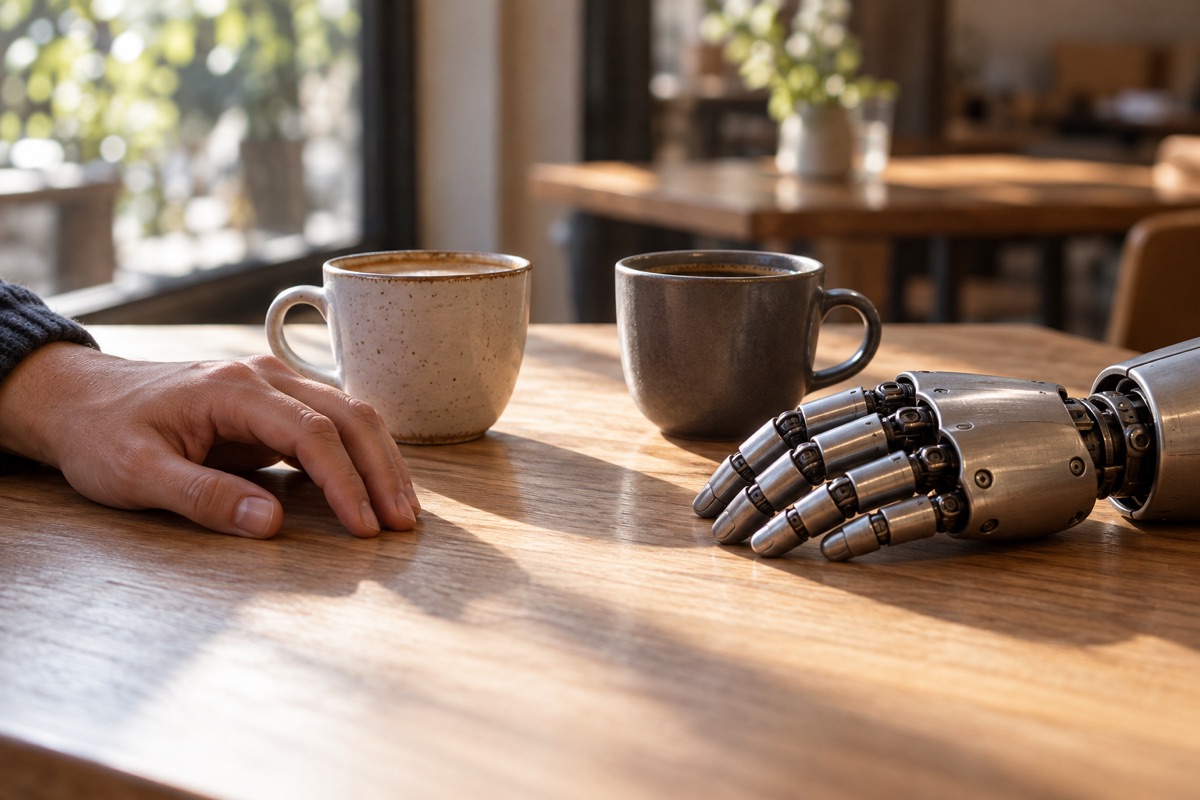
In a 2022 Japan Foundation interview, Yoshiura distinguishes accepting an unfamiliar being from assimilating it into one’s own category. In discussing humans and robots, he argues for allowing robots to exist as robots, rather than assuming they must become human.
That provides a useful limit on a tempting reading of the café: equal consideration need not mean that everyone is secretly the same. The rule can ask for a different way of relating without erasing differences in what its customers are.
The same interview links the work’s origins to Yoshiura’s admiration for Asimov’s robots: behaviour that initially seems strange to humans can have an intelligible logic. This is a creative influence, not a claim that fictional robot principles describe present-day technology.
For a first viewing, leave room for explanations other than “this character is becoming more human.” Otherwise, human resemblance becomes the reward you are waiting for, and difference becomes something the story must remove. You do not have to settle a theory of consciousness to notice that interpretive choice.
Studio Rikka records the original as six web episodes released in 2008–2009, followed by an edited and expanded theatrical version in 2010. Asmik Ace lists the film at 106 minutes. These are different presentations of the material, rather than a first season followed by a sequel film.
The official site likewise describes the film as a re-edit with new scenes. Repeated material is therefore not evidence that you opened the wrong release, and “film version” should not be read as “the next chapter.”
There is a useful complication to the assumption that the film must be the definitive version. In an August 2025 post, Yoshiura says he considers the short-series form more complete as a work because the story was structured for it. That is the creator’s stated preference, not a reason to dismiss the film.
For a first viewing, the practical choice is whether you want to approach the material in shorter units or one film-length sitting. If you can legally access both, the original structure is a sensible starting point for a reader interested in how individual encounters work. The film remains a separate viewing choice, not homework that must immediately follow.
The Japanese pages linked here verify the work and its formats. They do not establish current streaming access, subtitles or pricing in India. Check the version and language options on a service available to you before making plans around a listing.
If comparing the versions later interests you, choose a manageable question about presentation: where does an encounter seem to end, and what carries you towards the next one? That is more useful than ranking versions solely by how much footage they contain. Additional material and a preferred rhythm are different reasons to choose a release.
You need not watch both to earn an opinion about either. Nor does the creator’s preference invalidate your own response to the film. It is context for how the material was conceived, not a requirement to reproduce his judgement.
This is a promising choice if your interest in science fiction includes social rules and everyday interactions. If what you want tonight is primarily combat, tactical escalation or a detailed technical account of robot engineering, this guide’s central attraction may not be yours. The café premise is the invitation; it does not need to be sold as a substitute for every kind of robot anime.
Try a first viewing without an identity chart beside you. Follow what Rikuo has reason to believe, but keep some distance from treating his assumptions as your own. When an exchange ends, you might ask what mattered to you before you had a secure category for its speaker. That preserves the discovery while giving you something more to discuss than whether a prediction was right.
For a spoiler-conscious viewing group, agree on the stopping point before discussing patrons or searching character profiles. A name lookup can answer more than the question you meant to ask. The safe starting material is the premise, the café rule and the events everyone has already seen. Use those shared observations before drawing on later explanations.
Our spoiler-light Odd Taxi guide offers a different route into conversation-driven anime: the wants and pressures behind what people say. Here, the question comes one step earlier—who is accepted as someone worth addressing at all? The distinction makes the two useful companions without requiring their mysteries or social worlds to work in the same way.
You may finish a conversation still unsure what to believe about a customer. That uncertainty need not mean the encounter gave you nothing. The more useful thing to carry away is whether a label was doing work that listening should have done. Begin there, and let the café’s customers remain more than answers to a guessing game.

AUTHOR OF THIS ARTICLE
SoJapan
SoJapan India Pvt. Ltd. is a Japanese-founded company based in Gurugram. We bring Japanese food, anime goods and apparel materials to Indian businesses, with a sister company in Kyoto that works directly with makers in Japan.