The person on the cushion has not left the stage. Yet someone else seems to be speaking. A change of address, an answering expression, a different relationship to an object: a conversation can emerge without a second actor walking into view.
That is a useful way into Showa Genroku Rakugo Shinju, an anime about storytellers whose performances and private relationships are difficult to separate. If rakugo is unfamiliar, your first question need not be whether you understand its cultural importance. It can be much smaller: who is speaking now, and to whom?
The answer involves both words and performance. You are following people inside a story while also watching the person presenting them. The anime adds another interest: what that performance means to somebody listening.
This guide explains those distinctions for viewers who do not already know the art form. It discusses the opening premise and selected performance and practice details from the first three television episodes, without resolving the central history between the characters. Linked episode archives contain more spoilers than the discussion here. Cultural explanations come from the Japan Arts Council; the viewing suggestions and interpretations are ours.
Three things to keep in mind:
Yotaro’s interest begins with an encounter. In the official first-episode account, he hears Yakumo perform Shinigami during a prison visit. After his release, he goes looking for the storyteller and becomes his live-in apprentice. At Yakumo’s home he also encounters Konatsu, whose relationship with the master is already complicated.
The premise gives you a reason to care about a performance before knowing the story being performed. Yotaro has been affected by somebody’s way of telling it. His wish is not simply to obtain the plot and move on. He wants to be near the person who made it compelling.
That difference matters when approaching an unfamiliar performance tradition. Reading a synopsis may tell you what happens in a tale, but it cannot be a complete substitute for the encounter that attracts Yotaro. The anime’s starting question includes what a teller can do with material, not just what information the material contains.
For a basic definition, the Japan Arts Council’s introduction describes rakugo as stories performed by one seated person, commonly advancing through the characters’ dialogue. Humorous and emotionally involving stories belong to the form. Older repertoire is performed with individual ingenuity, and new stories are also created. An ending often supplies an ochi or sage, a pointed conclusion.
So “Japanese comedy” is an incomplete expectation if it makes you wait only for a succession of quick jokes. There is a story to inhabit and a relationship to its teller. Nor does “traditional” mean that recognising the title tells you everything worth hearing.
You do not need to read the ending of Shinigami before beginning the anime. In fact, researching every story mentioned can take away discoveries that a performance would otherwise give you. Let a title remain a title until curiosity about the actual tale becomes more interesting than the urge to prepare correctly.
The opening also establishes that entering an artistic household is not entering an empty classroom. Other people have memories and attachments there. Yotaro’s enthusiasm is a starting point, not a complete understanding of the place he has joined.
With two actors, a scene can show one person speaking and another replying. With one storyteller, the distinction has to be made without replacing the body in front of you. Direction offers one means of doing so.
The Japan Arts Council’s stage-direction explanation uses an audience member facing the stage as its reference. The audience’s right is kamite; the audience’s left is shimote. Its example places a landlord on the higher-status side, kamite, and Hachigoro opposite him. The teller faces towards the imagined conversational partner when portraying each role.
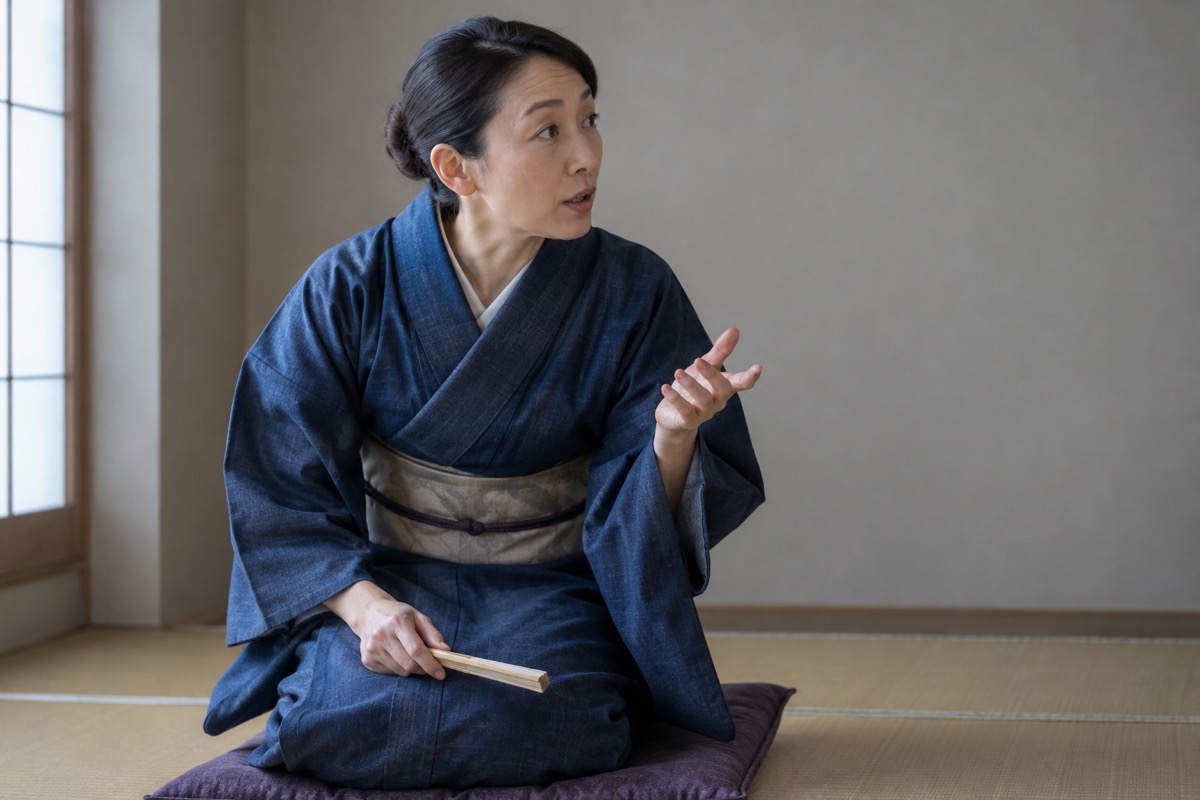
Here is that teaching example in compact form. It is not a description of a particular anime scene.
| Role being portrayed | Imagined position | Where the teller looks |
|---|---|---|
| Landlord | Audience’s right: kamite | Towards audience’s left: shimote |
| Hachigoro | Opposite the landlord | Towards audience’s right: kamite |
The important distinction is between where a person is imagined to be and where that person looks. Those are not the same thing. Memorising “important person equals right” without asking which direction their partner occupies is likely to create confusion.
For watching, start with the exchange rather than the vocabulary. Has the current line answered the previous one? Does the face turn as the answer begins? Can you identify the person being addressed? These questions let you follow a relationship even if you have forgotten which Japanese term names which side.
There is a further caution for anime. The cultural explanation assumes a stable position in front of a stage; animation can show the performer from elsewhere. Screen-left in a particular shot is therefore not a permanent label attached to one role. Follow who addresses whom, with the dialogue and surrounding shots helping you stay oriented.
That is a more forgiving approach than treating every turn as a secret code you must solve immediately. If you lose track, recover the relationship at the next clear reply. Understanding the scene does not require naming every convention while it happens.
A fan does not have to represent a fan. The Japan Arts Council’s account of gesture and props explains how an ordinary folding fan and hand towel become other objects through their use. Among its examples, the fan can stand for chopsticks and the towel for a letter. Gestures and expressions also distinguish people’s actions and feelings.
These examples are worth approaching as actions, not as a list of translations. “Fan means chopsticks” is not a permanent substitution. The way the object is handled, and what is happening in the story, make its temporary identity intelligible. When the action changes, the audience need not insist that the physical prop has retained its previous fictional job.
As a viewing suggestion, ask what the hand is trying to do. Reading, eating, offering and withholding would establish different relationships to an object even if the object itself were visually simple. You are looking for an intention carried by a movement, not waiting for the production to supply a realistic replacement.
The council’s separate explanation of audience imagination adds that sitting can concentrate attention on the face and upper-body gestures. It does not mean all movement disappears. Gaze and vocal volume can also suggest whether an imagined person is nearby or far away.
That makes a sparse stage different from an empty dramatic space. Its physical contents may be limited while the relationships implied by a performance remain extensive. A viewer can imagine a distance without seeing a painted street behind the storyteller.
You need not compete with the subtitles for every second of attention. If a passage feels hard to follow, let the words establish the basic exchange first. A short second look can then concentrate on the hands or face. This is an optional way to enjoy a passage, not homework that every episode demands.
Equally, do not expect gesture to make language irrelevant. A physical action may become clear while a pun or cultural reference remains unfamiliar. Those are different kinds of understanding. Recognising one does not prove that you have decoded the other, and missing one need not erase everything you understood about the interaction.
For an Indian viewer discovering rakugo through animation, that middle position is useful: neither an entrance examination in Japanese culture nor a promise that all meaning is universal and instantly visible.
There are several people to distinguish when talking about the acting. The real performer providing the voice, the fictional rakugo artist, and the people inside a tale occupy different levels of the experience.
For example, Kodansha’s cast-event report identifies Akira Ishida as Yakumo and Tomokazu Seki as Yotaro. When Yakumo performs a story, its characters are roles presented by Yakumo within the fiction. They are not additional members of his household merely because you hear another manner of speaking.
The simple mental map is: voice actor → fictional storyteller → people in the storyteller’s tale.
This distinction is useful when a performance becomes tense or comic. Is a person inside the tale anxious? Is the fictional storyteller struggling to hold the room? Or is somebody in the anime’s audience reacting for a reason outside the tale? The answer changes what the moment tells you.
Consider an original, hypothetical example, not an event from the series. Suppose a storyteller portrays a guest who is lying politely to a host. The guest’s awkward delivery could be skilful acting by the storyteller, not evidence that the storyteller is having a bad performance. A hesitation belongs to somebody, and identifying that somebody matters before evaluating it.
The reverse possibility is interesting too: a fictional beginner could be struggling to portray an assured character. Then an actor has the task of making us hear a performance that is not fully convincing within the story, without making the whole scene unintelligible. That is a distinction between levels of acting, not a numerical score for a voice.
It also helps separate admiration from imitation. You might enjoy the voice actor’s work, become interested in the fictional performer’s style, or want to hear another telling of the underlying tale. Those are all sensible responses, but they lead to different next steps. Credits answer the first question; the continuing anime develops the second; an identified rakugo story provides a route into the third.
The anime makes listening more complicated than deciding whether a performance is good. In the opening episode’s official scene account, Yakumo watches Yotaro perform before his solo show. The form Yotaro uses recalls Sukeroku, whom the apprentice has been listening to closely.
That is enough information to pose a question without answering the surrounding mystery: what happens when a listener recognises more in a performance than the person performing realises they are bringing into the room?
For Yotaro, learning from a compelling teller may seem an obvious thing to do. For another person, recognisable mannerisms can have associations that are not contained in the tale’s plot. Our interpretation is that the scene asks you to keep artistic influence and personal history in view together, rather than treating the performance as an isolated test.
You need not decide immediately what every glance means. Recognising that a listener has a history you do not yet know can be more useful than inventing a precise explanation. A reaction is a reason to remain curious; it is not automatically proof of jealousy, disapproval or any other single emotion.
The early retrospective gives the names some order. The second-episode archive introduces the boys who will become Yakumo and Sukeroku, with the apprentice names Kikuhiko and Hatsutaro. At their first stage appearance, Kikuhiko is tense, while Hatsutaro addresses the audience boldly. These are earlier stages of the two performers’ lives, not four unrelated central characters.
It is tempting to turn that contrast into a permanent verdict: one is naturally suited to the stage, the other is not. A more rewarding question is what each can make of the art over time. An opening manner tells you where someone begins; it need not define every possibility available to them.
The third-episode account supplies a specific development: Hatsutaro suggests that Kikuhiko try material better suited to him during practice. The question is not only how forcefully somebody can reproduce an instruction, but what kind of material might let that person work differently.
That does not mean “be yourself” solves an artistic problem without learning. Here it suggests a more concrete distinction: copying an admired delivery, acquiring a skill and finding suitable material are related activities, but they are not identical.
The same distinction gives you a way to compare performances without ranking the fictional artists after every scene. Ask what a performer seems to be attempting and how the particular listener responds. This preserves differences that a simple “better or worse” judgment would flatten.
The anime’s audience does not have to remain in a single seat facing the stage. Animation can choose a view of the teller, a listener or the space around them. That choice is part of the adaptation, not an invisible window onto an otherwise unchanged live event.
At the event recorded by Kodansha, Ishida pointed to the use of side, rear and audience viewpoints, along with music, in describing the production’s effects. Yamadera also praised his distinction between novice and accomplished performance. Those are the actors’ observations, not a claim that every scene uses the same technique.
They suggest two things worth following. One is what the fictional artist presents. The other is what the animated sequence lets you see around that presentation. A change of viewpoint can make another person’s attention important even when the story being told continues.
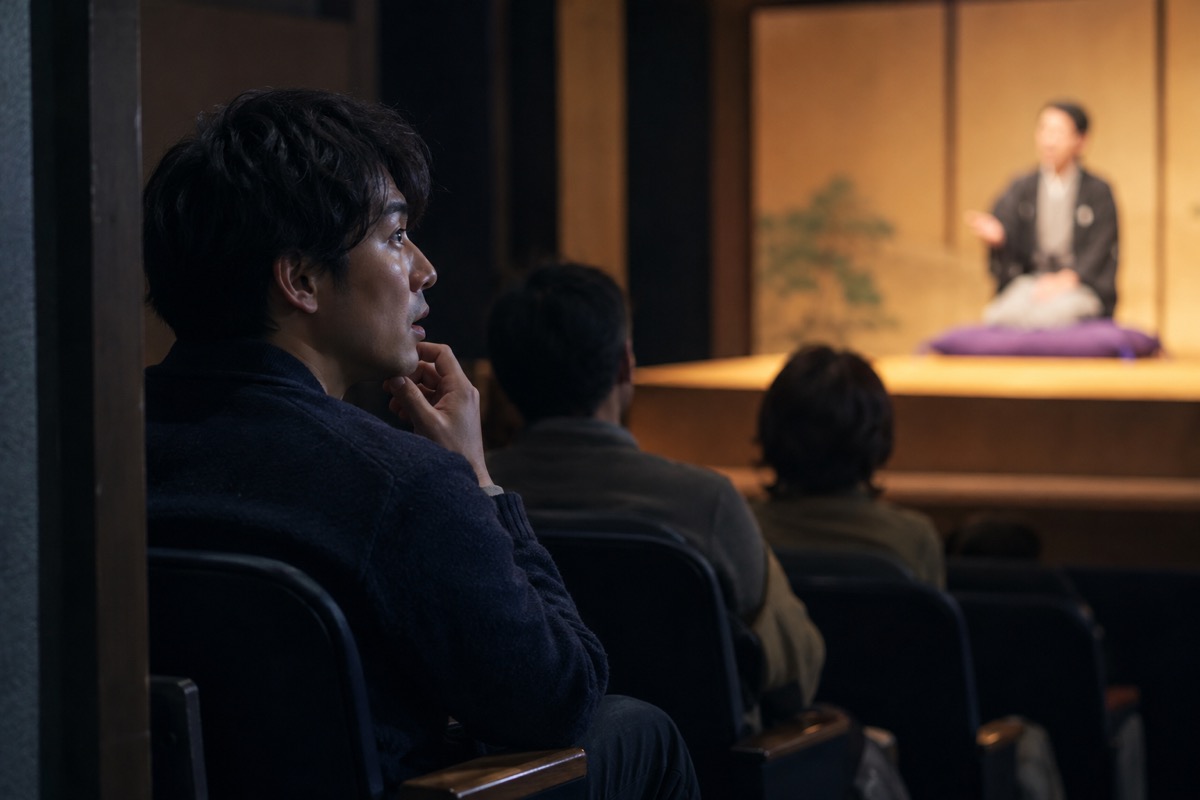
For a general comparison, imagine a presentation filmed only from the front, then the same presentation intercut with one particular listener. You would receive the spoken content in both versions. The second arrangement would also invite questions about that listener. This is a thought experiment about viewpoint, not a description of an unverified shot sequence in the anime.
The sound has its own production choices. In the Waseda Theatre Museum’s report of its 2016 event, sound director Koji Tsujitani discussed using jazz background music partly to engage viewers unfamiliar with rakugo. That is a reason to listen to the accompaniment as part of the anime’s presentation, without assuming it is something the fictional audience also hears. Music accompanying an animated scene is not a requirement of live rakugo.
This is where a newcomer can enjoy the anime on its own terms. You can become interested in rakugo through the work without treating it as a neutral documentary or a substitute for every kind of live performance.
If you have enjoyed K-ON!’s different uses of music and performance, there is a related question here about what belongs to the activity inside the story and what the anime adds for us. The dramatic focus differs: Rakugo Shinju asks you to attend to one teller creating several people, with listeners whose attachments extend beyond the current tale.
Begin with the first television season of Showa Genroku Rakugo Shinju, then continue with Sukeroku Futatabi-hen. That is the recommended first-viewing route, preserving the initial encounter before the continuation. The MBS programme archive identifies the latter season and credits Haruko Kumota’s original work, director Mamoru Hatakeyama, rakugo supervisor Hayashiya Shinpei and animation studio Studio Deen. Its introduction contains later-story information, so avoid it if you want only the starting point.
When checking a catalogue, confirm that you have found the television anime rather than a different adaptation of the same title. This guide does not establish a current Indian streaming service, price or subtitle option. Check the actual listing offered to your account and region before subscribing for it.
As a first test, let the opening episode’s performances play in context. A highlight clip may show impressive delivery without showing why a particular listener matters. A full scene gives you a chance to care about both the tale and the encounter around it.
Afterwards, choose one question that actually interested you. If you lost track of who was speaking, the council’s direction explanation is useful. If a small object seemed to change its meaning, its props page answers that. If it was a listener’s response that held your attention, the next part of the anime may be more rewarding than more preliminary research.
This approach suits viewers who enjoy acting, complicated relationships and the way a familiar piece of material can acquire significance through a particular person. It may not suit an evening when you want only quick, self-contained jokes or a straightforward performance competition. Understanding the conventions can make the drama clearer; it does not turn the drama into a different kind of show.
The invitation is modest: follow an exchange, notice the teller, then remember that somebody else is listening. A seated person need not look visually busy to give you several things to care about at once.

AUTHOR OF THIS ARTICLE
SoJapan
SoJapan India Pvt. Ltd. is a Japanese-founded company based in Gurugram. We bring Japanese food, anime goods and apparel materials to Indian businesses, with a sister company in Kyoto that works directly with makers in Japan.