The chopsticks go round and round. Pale foam gathers between the beans, and threads stretch when they are lifted. If you have watched someone prepare natto, it is easy to assume that the stirring is doing something essential that the package has left unfinished.
The useful answer is less mysterious: stirring changes the eating texture. It is not a required count that turns an incomplete food into a nutritious one. Nor does choosing the smallest-looking beans necessarily solve every concern about smell or stickiness.
This guide separates those decisions. We are looking at the familiar stringy fermented soybeans, not ranking health benefits or daring anyone to like them. The aim is to make a first bowl understandable: which features belong to the food, which can be adjusted at the table, and which require choosing a different product.
For a quick route through the article, keep three distinctions in mind: stirring and fermentation are different processes; hikiwari is a manufacturing choice, not just chopping at home; and beans, sauce and mustard are separate things to assess. The explanations below draw on Japanese manufacturers and public food-culture sources. Serving suggestions are editorial guidance, not claims from a kitchen test.
Japan’s Ministry of Agriculture, Forestry and Fisheries identifies stringy itohiki natto as soybeans fermented with natto bacteria. It distinguishes this from salt-fermented types such as hama natto and tera natto, which follow a different production process. Here, “natto” means the stringy kind. MAFF’s bean-product classification explains the distinction.
The distinction prevents a naming trap. A non-stringy product with “natto” in its name is not necessarily an ordinary breakfast pack with the threads removed. Mizkan describes the dried, salty type as a seasoning-like food with a miso-like flavour. Whole-bean natto and hikiwari, by contrast, both belong to the stringy family. See Mizkan’s account of the different forms.
What makes the threads? Takano Foods identifies polyglutamic acid and fructan among the sticky substances produced during fermentation. You do not need to memorise the chemical names to understand the important point: the sticky material is produced with the natto, rather than supplied by its seasoning packet. Takano’s natto FAQ describes the threads.
That gives you a more useful starting expectation than “beans with a thick sauce.” Leaving out the sauce is a seasoning decision, not a way of ordering plain, non-stringy boiled beans. Likewise, seeing threads before adding any condiments does not mean that you have skipped a preparation step.
It also helps to separate unfamiliarity from quality. A guide can explain why this food has threads; it cannot certify the condition of a particular pack from that observation. Check the actual product’s storage instructions and date. Do not use a photograph of normal natto to overrule uncertainty about how yours was handled.
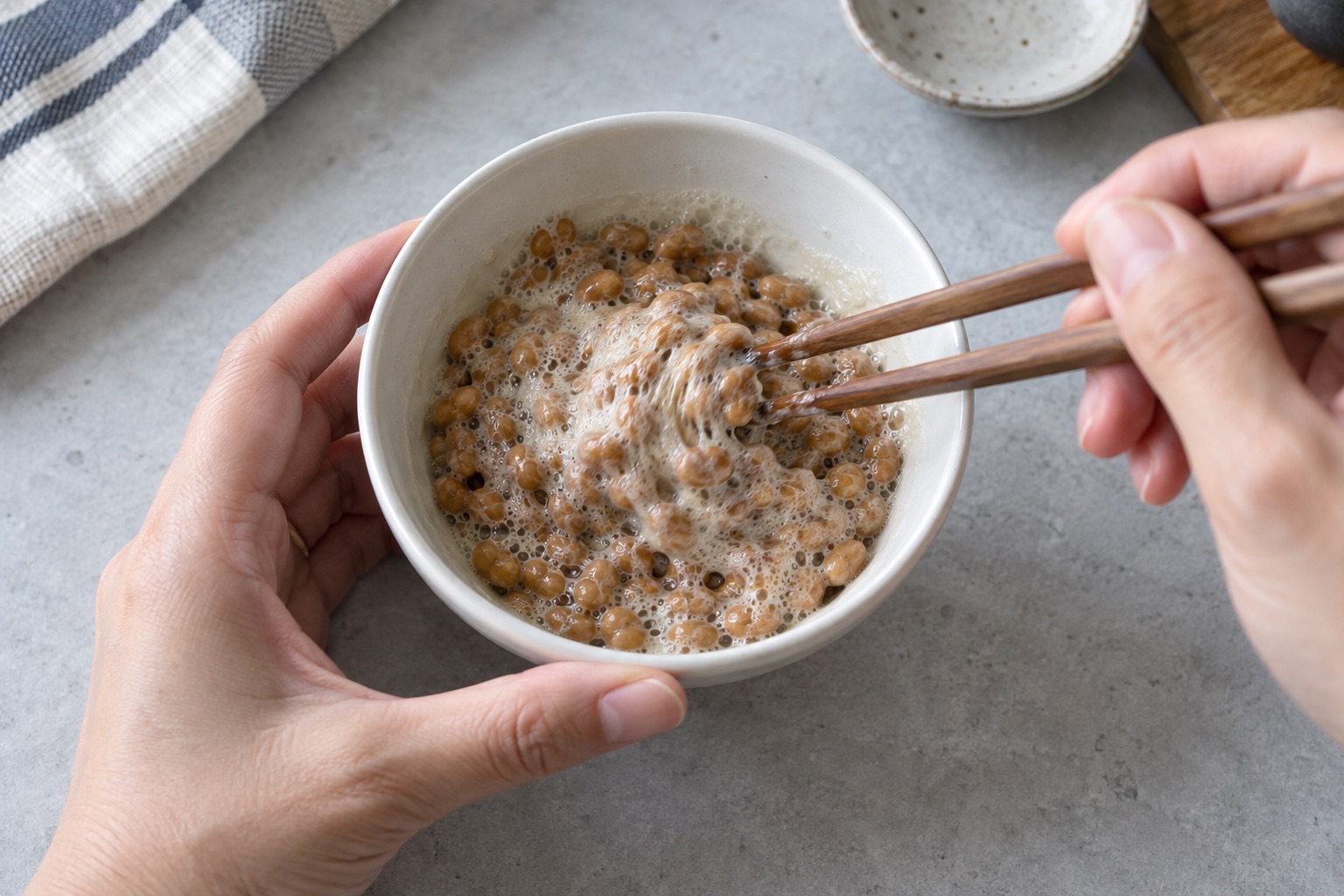
Mizkan answers the stirring-count question directly. In the checks the company describes, the number of stirs did not substantially affect nutritional value. It explains that stirring incorporates air into the sticky material, producing a fluffier texture and a milder impression, and recommends mixing according to preference. This is the manufacturer’s stated finding—not a claim that every possible preparation has been independently tested. Read Mizkan’s stirring FAQ.
There is therefore no reason in that guidance to treat a particular number as a compulsory target. Foam is a texture cue, not a score for how successfully you have unlocked the food. Someone who likes the resulting mouthfeel has a reason to keep mixing; someone who prefers less aeration does not need to imitate a long demonstration.
Takano separately says that mixing count is not what changes the natto’s nutritional or umami components. Its explanation also points to the changed eating sensation. Takano’s second FAQ page provides the corroborating answer.
At the table, a practical approach is to use the pack’s instructions, mix gently enough to keep the food in its container, and stop to look at the consistency rather than counting every movement. If the shallow tray feels awkward, transfer the serving to a clean small bowl. That is a handling suggestion, not a claim that a special bowl produces superior natto.
You may encounter confident advice about adding sauce before or after stirring. The sources cited here do not establish one universal order for every product. Follow a specific maker’s instructions where given; otherwise, do not turn a preference into an authenticity test. The same caution applies to claims that a certain utensil, speed or direction is mandatory.
The contrast between whole-bean natto and hikiwari is more than the size of the finished pieces. Takano explains that hikiwari begins with dry soybeans that are cracked and have their skins removed before natto is made. It is not simply a tray of finished whole-bean natto put through a chopping step. The manufacturer’s FAQ explains that sequence.
Its dedicated hikiwari page also describes the control of drying and cracking during production. Those operations happen before the pack reaches your kitchen. Takano’s hikiwari feature shows the manufacturing distinction.
Why should a diner care about the order? Because “I can chop these beans smaller” and “I am choosing hikiwari” are different decisions. Chopping can change the pieces on your plate, but it does not reproduce the starting material and processing of the other product. You need not treat one as more authentic; you simply should not expect the two routes to be identical.
Do not extend the word hikiwari into promises it does not make. It does not, by itself, tell you that the sauce is vegetarian, that the aroma will be faint, or that the sticky texture will disappear. Those are separate questions.
For shopping, translate a vague wish such as “something easier” into the feature you mean. Are you looking for smaller pieces? Is the aroma your concern? Would you prefer a different seasoning? A product description addressing one of those points has not automatically answered the other two.
If choosing for somebody else, ask which feature interests or worries them. “They are new to natto” is not enough information to nominate a universal best format.
Takano’s product-development account treats lower aroma, stronger stickiness and softer texture as distinct goals. It notes that reducing one aroma component can make others more noticeable. The same account describes matching sauce not only to flavour but also to bean size, stickiness, aroma and hardness. Read Takano’s explanation of culture and sauce development.
The useful inference is modest: there is more than one dimension to a pack. “Low odour” should not be read as “no threads,” and a sauce that sounds gentle does not describe the beans’ entire character. This is a reason to read precise descriptions, not a reason to buy several brands and turn breakfast into a research project.
One exact label makes the separation concrete. Takano’s Hokkaido Yukihomare Soybean Hikiwari lists the beans, tare and mustard separately. Its tare includes bonito-derived ingredients alongside kombu and shiitake ingredients. The page also cautions that information may differ after product changes, so the current package matters. This is a Japanese product example, not a claim about Indian stock. See the manufacturer’s ingredient listing.
The presence of kombu or mushrooms therefore does not settle the vegetarian question for that sauce. Nor should that one example become a claim that all natto sauces contain fish. Check the specific item you will eat, including an alternative seasoning if you replace the supplied one.
For broader dietary questions, our Japanese vegetarian food guide explains dashi and hidden ingredients. The natto-specific habit is to avoid treating the tray as one indivisible ingredient: assess the beans, each supplied condiment and anything added at serving. With an allergy or a prescribed diet, follow your established guidance rather than treating this introductory food article as clearance to try it.
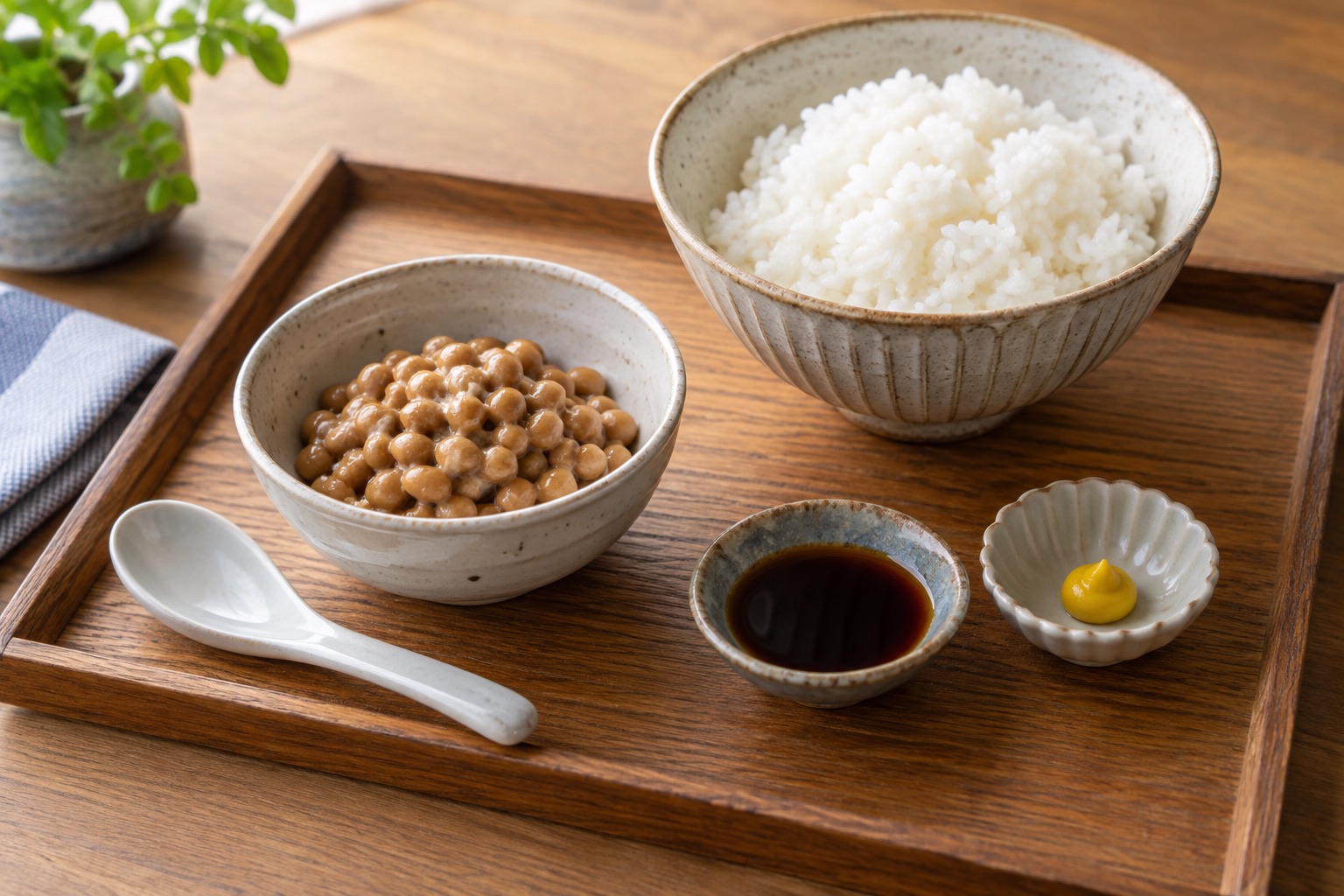
There is no need to give a first portion the job of transforming your entire opinion of Japanese food. Our suggested starting arrangement is a small serving in a bowl, a utensil you find comfortable, and any accompaniment kept within easy reach. A spoon is a reasonable practical choice if managing chopsticks would become the main event.
If you want rice with it, you can keep the two separate initially and combine them as you eat. That leaves you free to choose the balance in each mouthful without committing the whole bowl of rice to an unfamiliar texture. It is an option for control, not a claim that this is the only Japanese way to serve natto.
Set aside packaging and unopened condiment sachets before mixing. Read any opening instructions and use a stable surface; there is no need to reproduce somebody else’s speed.
There is also no obligation to add every available topping immediately. Choose additions because you want them and can eat them. A heavily altered first serving may be enjoyable, but it can make it harder to tell whether your reaction concerns the beans or something you added. That matters only if you want to understand the difference; there is no requirement to taste plain natto as an examination.
Afterwards, a specific description is more useful than a verdict about courage. You might be comfortable with the beans but not want that condiment again. You might like the seasoning but dislike the threads. Or the combination may simply not appeal to you. Those possibilities do not require the same next step, and none requires insisting on another serving.
The fact that natto is fermented does not make warm storage an improvement technique. Takano says leaving its natto at room temperature does not increase its nutritional value and advises taking it out of the refrigerator just before eating. See the maker’s handling answer.
Mizkan’s storage guidance calls for refrigeration and explains that warmth can change the product’s quality. It allows freezing with possible flavour and texture changes, and describes thawing in the refrigerator. It also warns against using the microwave to thaw the packaged product because of the container and sauce-packet risks. Follow the instructions for your particular pack rather than assuming every container is suitable for heating. Mizkan’s storage FAQ covers these points.
For a first purchase, that makes the storage arrangement worth checking before the serving ideas. Can you follow the required conditions on the way home and afterwards? If you cannot establish how a product has been handled, its fermented identity is not a reassuring answer. Ask the seller or maker about the specific pack; do not use a generic food guide to guess.
Keep the date and handling instructions until the food is finished. An unopened best-before date is not permission to leave an opened portion around: Takano advises consuming opened natto promptly. The same FAQ suggests water or warm water to loosen the sticky residue from dishes. Use that as a preliminary cleanup aid, followed by ordinary washing—not as a replacement for it. Takano’s FAQ includes opened-pack and washing guidance.
The first bowl becomes less puzzling once the tasks are separated. The maker has produced the fermented beans; you are choosing the eating texture, seasoning and serving arrangement. You do not have to earn the meal with a stirring count, mistake hikiwari for a home chopping trick, or turn a personal dislike into a failure. Understand what you are changing, and keep the parts you actually enjoy.

AUTHOR OF THIS ARTICLE
SoJapan
SoJapan India Pvt. Ltd. is a Japanese-founded company based in Gurugram. We bring Japanese food, anime goods and apparel materials to Indian businesses, with a sister company in Kyoto that works directly with makers in Japan.