← JOURNAL30 Sep 2026
Naruto’s Team 7 Explained: Rivalry, Recognition and Learning to Work Together
 By SoJapan
Put Naruto, Sasuke and Sakura on the same assignment and you have a squad. You do not immediately have cooperation. Naruto wants to be noticed, Sakura’s attention is directed towards Sasuke, and Sasuke has little interest in becoming somebody else’s social project. Their teacher, Kakashi, has to do more than give them matching instructions.
That awkward beginning is one of the pleasures of Naruto. The early story does not ask only whether these young ninja can learn impressive techniques. It asks whether they can recognise a useful contribution when it comes from someone they resent, underestimate or desperately want to impress.
For Indian anime fans starting the series—or returning after remembering mainly the fights—Team 7 offers a manageable way into its large world. Four people, a few early assignments and a change in what “doing well” means are enough to begin. You do not need a chart of every clan or a ranking of the strongest characters.
Spoiler boundary: this article discusses the opening premise, the lesson of Kakashi’s first test and selected developments through episode 10 of the original Naruto anime. That includes an early rescue and Sakura’s training performance. It does not reveal the Land of Waves conclusion, later character fates or romantic outcomes. Some linked official retrospectives contain much larger spoilers. Story details are sourced; the interpretation of the team’s behaviour is our editorial reading.
The thread to follow: attention is not the same as respect; individual skill is not the same as mission success; and cooperating once does not mean a rivalry has disappeared.
The basic setting is the Hidden Leaf Village. Naruto Uzumaki attends its ninja academy and dreams of becoming Hokage, the village’s leader. He is also an isolated child whose pranks and academic difficulties make him conspicuous for reasons he does not welcome. The official introduction connects the villagers’ rejection to the Nine-Tailed Fox sealed within him and identifies his teacher Iruka as someone who believes in him. Official Naruto story introduction.
The important emotional distinction is between being visible and being valued. A person can attract a room’s attention without gaining its trust. Read Naruto’s ambition through that gap and his noisy behaviour becomes easier to understand: he wants more than the satisfaction of performing a trick while everyone watches.
This does not mean every prank deserves approval. Sympathy and agreement are separate responses. You can recognise the hurt behind a character’s behaviour while still noticing when that behaviour inconveniences other people. The series gives you room to hold both thoughts, which is more interesting than deciding immediately that he is either inspiring or annoying.
Iruka matters because he provides a relationship that is not reducible to a score or a public spectacle. In our reading, that creates an alternative model of recognition: someone takes Naruto seriously as a person before he has become the celebrated figure he hopes to be.
Kakashi enters a different role. He is not simply a replacement for Iruka with more impressive abilities. Once Naruto graduates and joins a working squad, the question expands from whether someone believes in him to whether others can depend on him. Emotional support and practical responsibility can belong in the same story without being identical lessons.
A few terms are enough at this stage. Hokage names the village leadership position; sensei is how the students address their teacher; Team 7 refers here to the original group of Naruto, Sasuke, Sakura and its jonin leader Kakashi. The official anime introduction identifies that grouping. Original Naruto anime overview.
Treat that as the starting arrangement, not a spoiler-proof description of every team carrying a related name across the franchise. Looking up a complete membership history before episode one can answer questions you have not yet wanted to ask.
The official episode 3 synopsis gives a revealing example: Naruto tries to gain Sakura’s attention by pretending to be Sasuke, the person she likes. A technique that changes appearance cannot automatically change the relationship underneath it. Official episode 3: Sasuke and Sakura: Friends or Foes?.
That is an unusually useful starting point for understanding the group. Naruto is not merely competing with Sasuke’s ability. He is also competing with the attention Sasuke receives. From Naruto’s position, being good at something and being liked can look like parts of the same unfair advantage.
The attempted shortcut exposes the problem rather than solving it. If someone responds warmly because they think you are another person, that response does not supply the recognition you wanted as yourself. The scene’s premise therefore connects ninja fantasy to an ordinary social frustration without requiring a battle.
It is also fair to find the impersonation uncomfortable. The story uses deception as comedy; a reader need not mistake the gag for a model of respectful courtship. Enjoying the characters does not require endorsing every way they try to get what they want.
Sakura’s starting interest in Sasuke is important, but it is not the only lens through which to watch her. At this point she has preferences and prejudices that can distract her from evaluating teammates fairly. The useful question is what happens when an assignment demands attention to something beyond those preferences.
Sasuke, meanwhile, is not pursuing the same prize as Naruto. His early self-introduction sets out a desire to restore his clan and pursue revenge. The official character retrospective reproduces this motivation, but surrounds it with information revealed much later in the story. Newcomers should leave the linked retrospective until after watching. Official Sasuke retrospective—major spoilers throughout.
In other words, these children share a timetable before they share a purpose. One wants acceptance, another carries a private determination, and another begins with a strong personal attachment inside the group. Kakashi cannot fix that merely by telling them they are now teammates.
Watch who looks towards whom after something happens. Whose approval matters? Whose success produces irritation? This is not a request to diagnose fictional children. It is a way of noticing why a small exchange can carry more tension than the literal words would suggest.
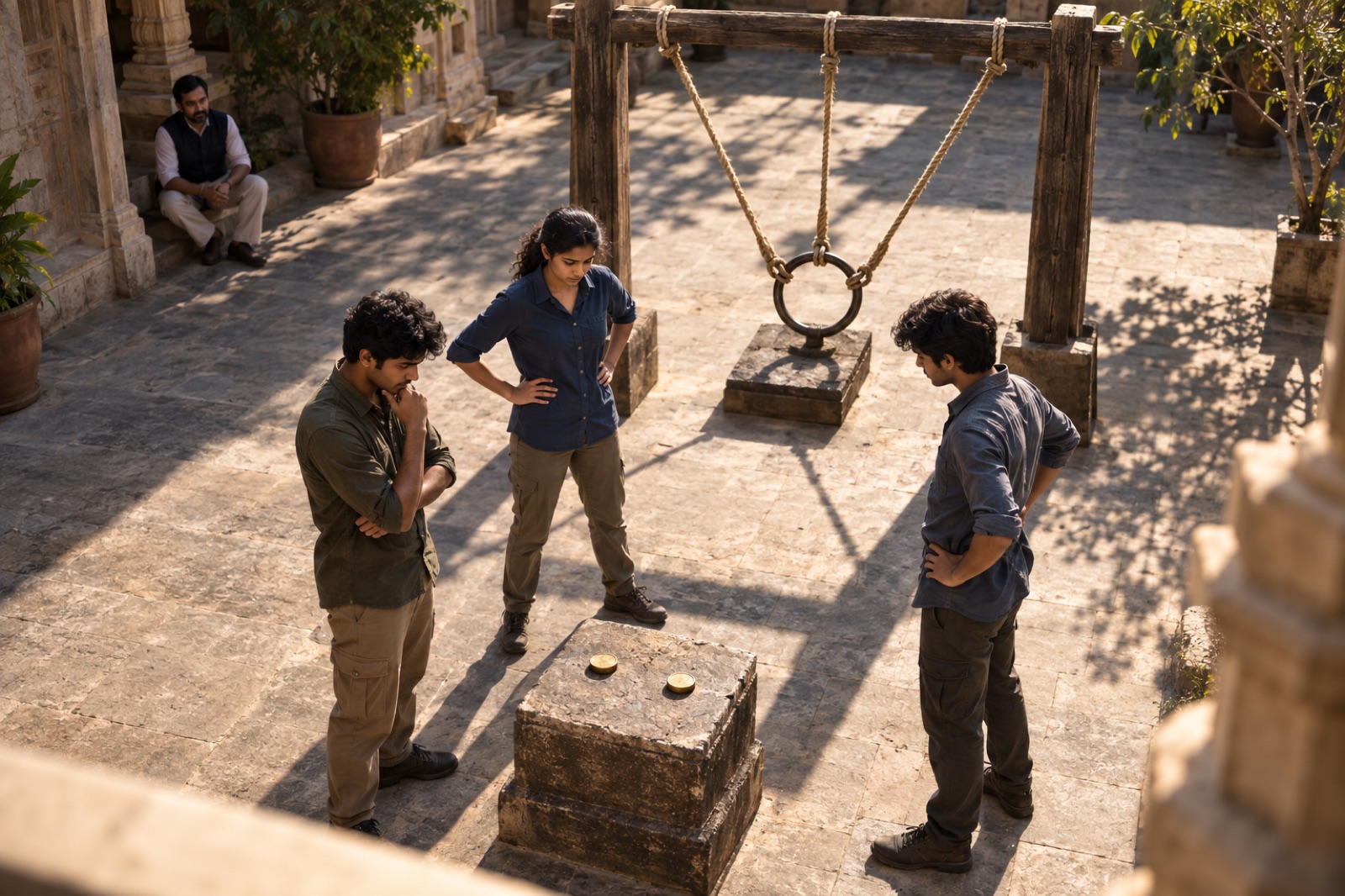
Episode 4 presents an apparently simple problem: three students face a survival challenge, but Kakashi says only two can pass. The threatened consequence for failure is a return to the academy. Official episode 4: Pass or Fail: Survival Test.
The numbers matter without needing an invented statistic. If three people accept that only two places exist, at least one teammate appears to stand between each student and success. The exercise encourages them to see the group as a competition for scarce approval.
Look at how that setup turns a potentially useful partner into a threat. If Naruto helps Sasuke, he appears to improve a rival’s prospects. If Sakura concentrates only on Sasuke, she leaves a third member outside the working relationship. Under the announced rules, cooperation can look like a poor individual choice.
Episode 5 identifies teamwork as the lesson behind the trial. That changes the question from “Can I outperform the other students?” to “What have I failed to notice while concentrating on my own result?” Official episode 5: You Failed! Kakashi’s Final Decision.
The appeal of the test is that skill now has to work between people. A student may possess a useful technique and still use it badly if the choice ignores the other people involved. Conversely, an action can matter because it supports another person’s next move, even when it is not the most impressive display in isolation.
This gives the test a different shape from a school exam. Knowing more than your classmate does not solve a problem that requires you to act with that classmate. Naruto’s wish to be acknowledged, Sasuke’s preference for pursuing his own aims and Sakura’s selective attention all affect what the group can actually accomplish.
Kakashi’s position also deserves scrutiny. He controls the instructions, the pressure and the interpretation of the result. A viewer can appreciate the dramatic lesson while questioning the method used to teach it. The story takes place in a fictional system that prepares children for dangerous work, not an ordinary classroom whose practices should be copied.
This is why “teamwork is important” is too thin a summary of the sequence. The more specific tension is that the announced incentive seems to encourage the behaviour the teacher wants them to outgrow. The students must reassess how they are reading the situation, not merely try their existing plans harder.
For Naruto, that means success cannot be only a performance staged to make everyone acknowledge him. For Sasuke, it challenges the idea that other students are simply obstacles. For Sakura, it asks for a working relationship broader than attention to a favourite teammate. Those are interpretive consequences of the test, not three identical moral lessons pasted onto different faces.
Nor should one lesson erase the personalities that made the exercise difficult. A team would become less interesting if everyone emerged with the same temperament and priorities. The question is whether they can act together despite differences, not whether those differences vanish.
Episode 6 moves the group from unglamorous jobs towards an assignment protecting Tazuna on his journey home. Naruto’s dissatisfaction with their earlier tasks helps set that change in motion. Official episode 6: A Dangerous Mission! Journey to the Land of Waves.
The mission immediately gives you a different way to judge action. In a straightforward duel, defeating the opponent may be the central objective. In an escort assignment, the client’s safety remains important even when the most exciting fight is taking place elsewhere in the frame.
This is a practical viewing distinction. Do not watch only the character closest to the enemy. Ask where the person being protected is, who remains responsible for them, and what would happen if every teammate abandoned that task to pursue a more spectacular confrontation.
The first dangerous encounter also complicates the labels the characters carry from school. The official anniversary recap contrasts Naruto freezing in fear with Sasuke acting promptly. It later describes Naruto proposing a coordinated plan when Kakashi is trapped, with Naruto and Sasuke combining transformation and shadow-clone techniques. Official anniversary recap—contains later arc spoilers.
These two moments resist a fixed reading of Naruto as either incapable or effortlessly heroic. Fear at one point does not eliminate the possibility of useful judgement later. At the same time, a clever idea does not prove that fear never mattered. The change is part of the interest.
Sasuke’s contribution is equally important to the combination. A plan that depends on another person cannot be assessed solely as its originator’s cleverness. Someone must recognise the opportunity, accept a role in it and execute that role. Rivalry becomes productive for a moment when each boy treats the other as more than a comparison score.
Episode 8 makes the immediate problem explicit: Zabuza’s Water Prison prevents Kakashi from acting freely, and Naruto refuses to flee. Official episode 8: The Oath of Pain. The beginner’s question is therefore narrower than “Which ninja is strongest?” It is “What prevents the team’s most experienced member from helping, and can that obstacle be changed?”
That is what makes tactical action satisfying: a situation has a constraint, and a choice alters the constraint. The outcome is not explained only by somebody revealing a larger quantity of power. You can follow the logic even if you do not yet know the name of every technique.
There is no need here to reproduce a blow-by-blow solution. While watching, notice what the opponent expects to see and how cooperation changes that expectation. A successful deception is interesting because the characters have arranged the situation, not because the viewer has memorised a glossary.
Read Naruto’s determination within that fictional sequence. It should not become a general instruction that retreat is shameful or that children should confront dangerous adults. Courage, recklessness and responsibility remain distinct ideas, even when an action story brings them close together.

A common shortcut in discussing an action ensemble is to count the biggest attacks and treat everything else as absence. Early Sakura is a useful challenge to that approach—but recognising her contribution should not require pretending she has equal narrative attention or equal fighting power in every scene.
The official Sakura retrospective identifies two specific early contributions. During the Land of Waves escort she attends to protecting the client despite being frightened, and in chakra-control practice she reaches the top of the tree ahead of her teammates. These are bounded examples, not evidence that she can beat anyone in a fight. Official Sakura retrospective—contains major later spoilers.
Protection belongs directly to the assignment. If the mission is to escort someone, keeping that person safe is not irrelevant merely because another character has the more dramatic exchange. It may be less visually dominant, but the task still needs doing.
Training measures something different again. Episode 10 introduces Kakashi’s exercises to improve the students’ control of chakra, the energy used in the series’ ninja abilities. Official episode 10: The Forest of Chakra.
The distinction to hold onto is capacity versus control. Having access to power, applying it precisely and making the right decision about when to use it are different questions. A test of one should not automatically be treated as a complete ranking of all three.
Here is an original comparison for reading the early team—not an official scorecard or a permanent allocation of roles:
| What a scene asks for | What to notice | What that does not establish |
|---|---|---|
| Responding to an immediate threat | Who recognises danger and acts in time? | That this person will always make the best decision |
| Coordinating a plan | Who creates an opening, and who makes use of it? | That the planner could succeed alone |
| Protecting the client | Who keeps the assignment’s actual objective covered? | That the quietest role is effortless or unimportant |
| Controlling chakra in training | Who applies the required skill precisely? | A universal winner in every kind of combat |
The table also prevents an overcorrection. Noticing Sakura’s strengths does not oblige you to find every early gag involving her satisfying. You can criticise an overemphasis on her crush or wish she had more active opportunities while still describing her actual contribution accurately.
That is a better discussion than declaring a character either indispensable in every moment or entirely useless. Ask which scene, which task and which evidence. A specific criticism gives another fan something to engage with; a totalising label mostly repeats the argument’s starting point.
The same standard should apply to Naruto and Sasuke. A loud failure does not summarise Naruto’s capacity to improvise. A composed response does not establish that Sasuke has nothing to learn. Team 7 becomes richer when strengths are treated as context-dependent rather than as four fixed bars on a character-selection screen.
Competition is not automatically the enemy of cooperation. Wanting to keep up can push a character to practise, pay attention or attempt something difficult. The problem begins when another person’s progress is experienced only as a loss of one’s own value.
That is the tension worth carrying forward from the opening. Naruto can want Sasuke’s acknowledgement and resent him at the same time. Sasuke can make use of Naruto’s idea without suddenly becoming socially warm. Sakura can care about one teammate while learning to evaluate the whole assignment more clearly.
Treat these as mixed motives, not continuity errors. People in an ensemble do not need a complete emotional agreement before every useful action. Sometimes a small act of cooperation is meaningful precisely because affection or trust has not caught up with it.
One useful distinction is between working with someone and being comfortable with them. A shared plan can demonstrate the first while leaving the second unresolved. If you expect every successful mission to produce immediate, uncomplicated friendship, you may miss the slower development the story is allowing.
Kakashi adds a further complication because he can be both a source of reassurance and someone whose judgement the students do not fully understand. His greater experience does not mean the audience has been given his complete history. It is possible to notice that something matters to him without immediately searching for the later explanation.
Our editorial reading of early Team 7 is therefore not “friendship makes all problems disappear.” It is that shared work can reveal capacities and obligations that the characters’ initial impressions concealed. A person becomes harder to dismiss after you have depended on them for something specific.
That reading is especially useful on a rewatch. Instead of looking only for hints of distant plot developments, notice the small changes in what a character is willing to entrust to another. The opening has its own movement; it is not merely a waiting room for the more famous battles.
Start with the original Naruto, rather than assuming a later title is a remake of the same opening. The official site separates Naruto, Naruto Shippuden and Boruto into different anime sections. For this article’s discussion, the relevant episodes belong to the original series, not a similarly numbered episode in another instalment.
The official anniversary column groups episodes 1–5 around the beginning and team formation, and episodes 6–19 around the Land of Waves mission. As a viewing commitment, that is five episodes to meet the group and fourteen more for the next named stretch—nineteen in total. It is an orientation aid, not a command to watch all nineteen in one sitting or a promise that an entire franchise’s appeal can be measured at one checkpoint.
Because this article discusses developments through episode 10, watching the opening first is the cleanest route if even early outcomes matter to you. On a return visit, you can use the sections above to revisit a particular question: recognition, the test, the mission objective or control in training.
For legal access, use our India anime streaming guide as a starting point and verify the current title, region and language tracks in the service itself. A platform offering one Naruto instalment or one audio version does not by itself establish availability of all the others. This article makes no current subscription-price or catalogue promise.
Tone matters as well. The opening mixes adolescent comedy with isolation, frightening combat and threats of serious harm. Do not infer suitability for every child from colourful designs or from the fact that the protagonists are students. Check the actual version’s rating and content information when choosing for a younger viewer.
If your earlier point of reference is Ninja Hattori, the useful contrast is the story’s job. Hattori brings ninja abilities into everyday comic difficulties; early Naruto turns training and dangerous assignments into an ongoing question about belonging and responsibility. Shared ninja imagery does not make their tone or structure interchangeable.
Finally, resist searching every unfamiliar name immediately. Official character retrospectives can be excellent after you have watched, but they often explain an entire life rather than the small amount of information available in episode three. Let the story decide when to introduce the wider world.
Team 7 is a good starting lens because it stays close to what the characters actually do together. Notice who wants recognition, who notices an opening, who protects the client and who is prepared to learn from somebody else. The fights become more interesting when you can see the changing relationships inside them.
AUTHOR OF THIS ARTICLE
SoJapan
SoJapan India Pvt. Ltd. is a Japanese-founded company based in Gurugram. We bring Japanese food, anime goods and apparel materials to Indian businesses, with a sister company in Kyoto that works directly with makers in Japan.