← JOURNAL19 Oct 2026
Simmered Kabocha: Skin Up, Skin Down—and What the Recipe Is Trying to Do
 By SoJapan
The photograph looks simple: orange pieces of squash, a little dark-green skin, perhaps a shallow pool of cooking liquid. Then you open two Japanese recipes. One says to put the skin down. The other carefully tells you to put it up.
That disagreement is a better starting point than a promise of one foolproof cooking time. Simmered kabocha is a dish with several legitimate methods, and the position of the skin is only one part of them. A recipe may prioritise an intact appearance, a softer skin, a particular seasoning balance or a particular finish to the cooking liquid.
This guide compares published methods from Japanese food manufacturers. It is not a new recipe assembled from their separate instructions, and we have not conducted a side-by-side kitchen test. The aim is to make your next recipe easier to understand before you start moving tender pieces around a hot pan.
Kikkoman’s detailed Japanese lesson chooses skin-side up for appearance, but explicitly offers skin-side down for softer skin and seasoning penetration. Kikkoman’s illustrated kabocha lesson
That is useful permission to ask a more precise question. Do you want to reproduce that author’s result, or have you decided that a different texture matters more to you? Neither answer requires declaring the other orientation inauthentic.
There is also an English-language counterexample from the same company. Kikkoman’s shorter simmered-kabocha recipe places bite-sized pieces skin-side down in a seasoned broth, then covers the pot and moves from boiling to low heat. Its stated finish is a pot with very little liquid remaining. Kikkoman’s English simmered-kabocha recipe
The two pages should not be treated as a long and short translation of one identical recipe. They describe different preparations. Finding both on a manufacturer’s website does not make every quantity or action transferable between them.
It establishes that a blanket rule such as “Japanese cooks always put the skin down” is too broad. It does not establish that orientation is irrelevant, or that reversing the pieces in either recipe will produce an identical result.
For a first attempt, our editorial recommendation is straightforward: choose the complete method whose intended result interests you, and keep its arrangement. Do not turn every piece halfway through simply because another page shows the opposite direction. That would introduce an action neither comparison requires.
Nor should skin direction become the explanation for every disappointment. A piece that was much larger than its neighbours raises a cutting question. Liquid disappearing unusually early raises a pan-and-heat question. A seasoning preference raises a different question again. The green surface gives you a visible clue, not a complete diagnosis.
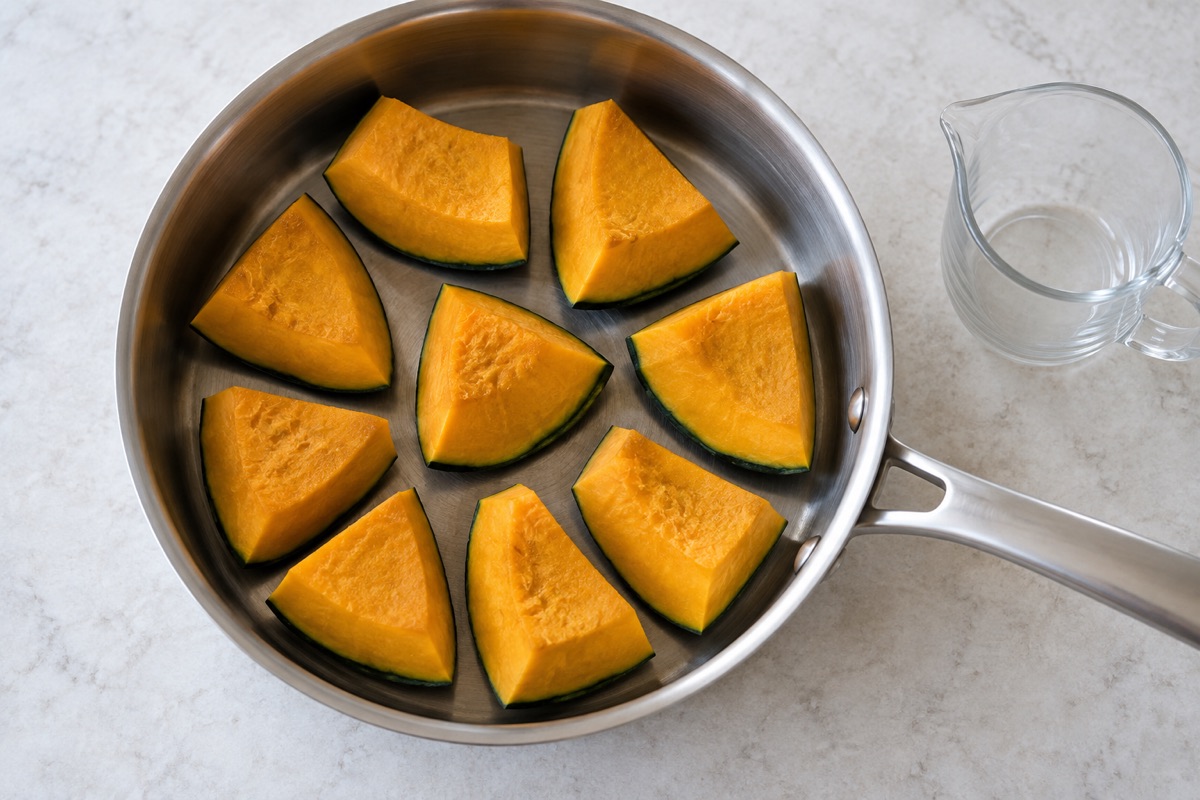
Kagome’s kabocha lesson asks for pieces arranged skin-side down without overlapping. It recommends a pan that fits them: an overly broad pan loses liquid too quickly, while a cramped one encourages stacking and breakage. Its photograph uses a 21 cm pan for the stated 400–450 g batch. That diameter describes the pictured example, not a compulsory purchase for every squash dish. Kagome’s recipe and pan explanation
This is the practical reason a recipe can be more demanding than its short ingredient list suggests. You might own every ingredient and still need to think about where the pieces will sit.
Before adding liquid, look at the bottom of the pan you intend to use. Can the prepared pieces sit in the arrangement shown? Are you imagining a single layer while actually building a small pile? Does a tiny batch leave most of a very wide base empty? Those are visible differences you can identify without calculating a new cooking formula.
Consider a hypothetical change: you double a recipe’s squash and liquid but keep the same pan. The quantities have doubled; the available base has not. If the original method depends on a single layer, the larger batch may no longer reproduce it.
That is a geometry problem, not evidence that the author made an arithmetic error. The safer editorial recommendation for learning the dish is to use a supported batch, or find a method written for the amount and vessel you intend to use. This article does not supply a universal conversion from pan diameter to simmering time.
The reverse change deserves attention too. Halving the quantities in a much wider pan does not necessarily recreate a smaller version of the photographed setup. Scaling is a decision about the cooking arrangement as well as the shopping list.
Kikkoman’s illustrated preparation uses roughly 4 cm pieces, adjusting for thicker and thinner flesh. It removes the fibrous interior and trims the edges. See the illustrated preparation
A wedge is not a cube cut from a uniform block. Looking only at the length of its outer edge can hide how much flesh lies behind it. Use the recipe’s pictures to understand the intended pieces, rather than treating one number as a command to ignore the vegetable’s shape.
Our gobo cutting guide explores a different version of this issue: choosing strips, shavings or chunks for burdock. Here the aim is not to pick a new cutting style for variety. It is to give the squash pieces a workable place in the same pan.
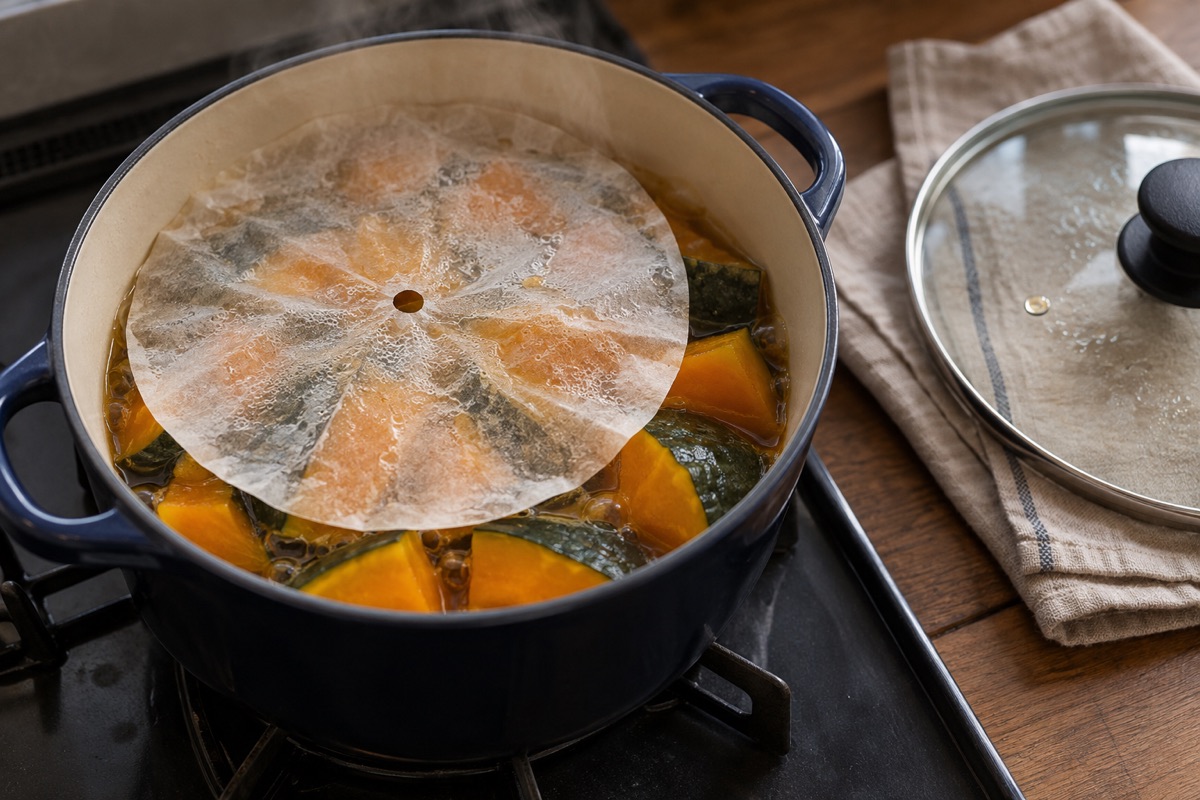
When translating a Japanese method, pay attention to otoshibuta, the drop lid used inside the pan over the ingredients. It is a different object from the lid that closes the pot at its rim.
In Kagome’s lesson with a Tsuji culinary-school professor, a drop lid is described as helping distribute seasoning with a small amount of liquid, limiting evaporation and restraining ingredients that would otherwise float and move. These are culinary functions, not a claim that a lid makes the contents impossible to break. Kagome: the role of a drop lid in simmering
Kikkoman’s detailed method uses both: a wetted paper towel over the ingredients and a pan lid left slightly ajar. Later, the lid comes off. “Cover and cook” would miss that sequence. Kikkoman’s lid sequence
If you have not used a drop lid before, read the named source’s material and placement instructions before starting. Kagome’s squash recipe also offers a cooking-paper alternative. A recipe describing one kitchen material is not a recommendation to put any available paper, cloth or plastic into hot food.
The following comparison is a reading aid, not an instruction to add an extra lid to every recipe.
| What the method says | What to identify | What not to assume |
|---|---|---|
| Use a drop lid | The specified cover over the ingredients inside the pan | That any lid sitting on the rim performs the same job |
| Leave the pan lid ajar | The separate outer lid and its stated position | That tightly closing it is a harmless correction |
| Remove the lid after heating | A finishing instruction, not merely permission to look | That leaving everything covered for longer must improve it |
On a phone, swipe the comparison sideways. Keyboard users can focus the table and use arrow keys.
The moment the soy sauce goes in is another place where the recipes diverge. Kagome’s squash method introduces it near the end, explicitly to retain its flavour, after an initial simmer with sugar, sake and water. The shorter Kikkoman English method starts with the combined seasoned broth. Kagome’s sequence; Kikkoman’s English method
This is not a contest between a careful method and a careless one. It is a reason to keep the sequence attached to the recipe. A general cooking mnemonic cannot tell you to rewrite a specific method without changing what you are making.
Imagine writing the ingredients on a shopping list and then closing the recipe. You have preserved the nouns but lost the verbs: add, bring to a boil, lower the heat, uncover, leave to stand. For simmered squash, those verbs are a large part of the instruction.
The English Kikkoman version gives a low-heat simmer of 15 minutes, with the liquid almost gone as its stated finish. Read that alongside its own batch and ingredients, not as a timer setting for all kabocha. The complete English recipe
The detailed Japanese lesson checks the thickest part with a skewer, stops while it is slightly firm, then rests it uncovered for about 10 minutes. It warns against excessive softening from retained heat. This is a finishing rest, not storage advice. Kikkoman’s final step
Ajinomoto’s kanroni, a sweet simmered preparation, supplies a third sequence: mirin is added after the squash softens, further cooking follows, and the squash then cools in its cooking liquid. Its ingredients include a named dashi seasoning. This is a separate dish specification, not a substitute finishing step for the other recipes. Ajinomoto’s kabocha kanroni
Put those side by side and “leave it longer for more flavour” stops being a reliable summary. Longer in what condition: on the heat, covered off the heat, uncovered, or in retained liquid? Those are different actions. The selected recipe, not the general desire for a stronger taste, should decide the next one.
If you are planning the rest of a meal, read this part before choosing when to start the squash. A finishing rest occupies time even when the burner is free. Conversely, a recipe that reduces its liquid needs attention to that endpoint; the pan should not be treated as an indefinite holding place while another dish catches up.
Kikkoman’s food-culture account distinguishes the traditional Japanese type, with softer, more watery flesh, from the widely used Western type with sweeter flesh. Its ingredient glossary describes the latter’s fluffy texture. Even within Japanese sources, kabocha is not a promise of one identical ingredient. Kikkoman’s kabocha background; ingredient glossary
For an Indian home cook, this is the limit of what the comparison can promise. A locally sold piece labelled pumpkin may be useful food without being the same variety as the recipe writer’s squash. This guide does not identify an unknown market vegetable from its orange colour, verify Indian stock or guarantee an unchanged substitution.
You do not have to postpone cooking until you can obtain an imported ingredient. But choose a method appropriate to the squash you have, and recognise a substitution as something you are learning about. If the result differs, that does not automatically mean you used the wrong side of the skin.
Hard skin also makes preparation a task to approach deliberately. Use a stable cutting setup and do not force an awkward cut while trying to reproduce a photograph. Pre-cut pieces can remove that particular preparation job, although their size still has to suit the method. The recipe’s intended shape matters more than proving that you started with a whole vegetable.
The vegetable’s name does not describe everything in the pan. The linked methods variously contain mirin, sake or dashi. If you avoid alcohol-containing seasonings or animal ingredients, inspect the actual ingredients and choose a complete method compatible with your requirements.
Do not treat a brief boiling step as a guarantee that a dish is alcohol-free. This article makes no such claim, and it does not certify an unspecified dashi as vegetarian. A recipe category tag is less useful than knowing which broth you intend to pour into your own pan.
The most useful preparation note for this dish is a short sequence rather than a collection of tips. Name the source recipe at the top. Under it, record the prepared pieces and batch, the pan arrangement, the liquids and their addition points, the lid arrangement, and the finish after heating stops.
When judging a finished attempt, separate appearance from preference. “The pieces stayed intact but I would like softer skin” describes a different result from “the pieces broke while I moved them.” “The liquid disappeared before the centre was ready” deserves a different investigation from “the texture was pleasant but the seasoning was too sweet for me.”
These descriptions do not prove a single cause. They help you revisit the relevant part of the method instead of changing everything at once. Check the ingredient and cut for uneven texture; the pan, heat and lid instructions for an unexpected liquid endpoint; and the seasoning sequence for flavour. Keep the successful parts of the attempt as your reference.
If the appearance is not what you intended, there may be another serving direction. Kagome includes a mashed squash-and-bean salad using its cooked kabocha. That is a named alternative for a texture problem, not a way to rescue food whose condition or handling is uncertain. Kagome’s suggested remake
For a first pot, the decision need not be complicated. Use the concise English Kikkoman recipe if that format suits you, or the illustrated Japanese lesson if you want its explicit presentation-focused approach. Read the complete linked method and check ingredient suitability in either case. Neither needs to be combined with the other’s finishing instructions.
The small green patch on a piece of squash is not an answer by itself. What matters is the arrangement around it, the liquid and lid above it, and what you intend to do when the heat goes off. Once those decisions belong to one coherent method, skin up or skin down becomes an understandable choice rather than a rule to argue about.
AUTHOR OF THIS ARTICLE
SoJapan
SoJapan India Pvt. Ltd. is a Japanese-founded company based in Gurugram. We bring Japanese food, anime goods and apparel materials to Indian businesses, with a sister company in Kyoto that works directly with makers in Japan.