A room can be important long before anyone has an impressive plan for using it. In Insomniacs After School, the school observatory first matters because of the people who find one another there. Turning it into a club sounds like a change of paperwork. It also changes what their time together can contain.
The central distinction is between having somewhere to retreat and having something to work towards. Astronomy does not replace the private connection between Ganta Nakami and Isaki Magari. It gives that connection practical tasks, reasons to go outside and people whose knowledge they can draw on. A camera is more than a picturesque accessory to a romance.
Our earlier romance-anime selection introduces the series through shared vulnerability and space. This guide takes the next question: why does that space become an astronomy club, and what should a viewer notice once it does?
We discuss selected setups from the first five episodes, without revealing later results or the ending. Plot and production details come from the linked official sources; the connections we draw between them are editorial interpretation. The source interviews and complete episode index can contain spoilers beyond this guide.
Three things are worth following:
Ganta encounters Isaki in an observatory being used for storage while his school is preparing for its cultural festival. Both have difficulty sleeping. Their meeting creates a shared, private place within the school: the starting point described in the official introduction.
That order matters. The story does not require us to begin with two accomplished enthusiasts seeking the perfect equipment. We meet a need for a place before we need to understand astronomical photography. If the technical subject feels unfamiliar, the emotional point of entry remains accessible: what would make this particular room different from the rest of a school day?
The two characters also should not be collapsed into a single description of sleepless teenagers. Ganta’s profile links his irritability and feeling unwell to long-standing sleeplessness, while describing a sincere, serious person beneath the way he is misunderstood. Isaki’s profile emphasises how difficult she finds telling others about her own sleeplessness and her secret daytime rest in the observatory.
These are different problems of being seen. Someone can be conspicuously out of sorts without the people around him understanding why. Someone else can keep a difficulty sufficiently private that others have little opportunity to recognise it. Shared circumstances do not automatically create identical outward behaviour.
For a first-time viewer, that is a more useful starting point than assigning one character the role of the troubled person and the other the role of the cheerful solution. Watch what each can reveal here that would be harder to reveal elsewhere. The room’s importance comes partly from that change in what can be acknowledged, not merely from its distance from a classroom.
Makoto Ojiro, the manga’s creator, has described beginning with ideas including insomnia, a secret hideout and high-school students in a coastal town. During research in Nanao, encountering a school’s astronomical dome led to the astronomy-club element. In the same official creator interview, Ojiro discusses asking the anime team to depict Nanao’s backgrounds carefully.
Our reading of that creative history is that the particular place helped generate an activity, rather than merely providing scenery for a hobby chosen in advance.
An observatory has two useful qualities for this story. It can be apart from ordinary classroom life, but it also has a purpose that reaches beyond hiding. The same setting can therefore support withdrawal and curiosity. Once we recognise that double possibility, the move towards club activity feels like developing something already present in the room.
It also gives the setting more weight than a collection of attractive backgrounds. A specific building can help generate a story’s next action. You do not need to have visited Nanao to follow that relationship, and the fiction should not be treated as permission to enter a real school’s grounds or facilities.
In episode three, school nurse Kurashiki discovers the pair’s unauthorised changes to the room. Her intervention leads to their recognition as an astronomy club. They then need a record of activity and seek out former club member Shiromaru. These are the relevant steps in the official episode index.
The change creates a productive tension. What the room means to its occupants is not necessarily what makes its use acceptable to the institution around it. Recognition gives their presence a name the school can understand, but that name comes with an activity attached.
It would be easy to see this only as an obstacle delaying the romance: now there is club business to get through before the pair can return to being alone. Our reading is almost the reverse. Club business opens up another way for their relationship to develop. They can encounter a problem, discover what they do not know and make a plan without every conversation having to be a direct declaration of feeling.
The adults’ roles are distinct. Usako Kurashiki is the school nurse who becomes the club adviser. Yui Shiromaru is an astronomy-club alumna who won a national high-school astronomical-photography grand prize while she was a student. One is connected to the club’s place within school; the other brings a history of doing the activity well.
That distinction helps prevent a vague reading in which every helpful older character is simply a wise mentor. Permission and expertise answer different questions. Being allowed to continue does not mean already knowing how to proceed. Getting technical guidance does not, by itself, explain all the personal reasons someone wants to remain involved.
Before asking how strong the club will become, ask what its existence makes possible for these members. Having an acceptable reason to approach someone for help is already a change, even before there is an achievement to celebrate.
Nor does recognising the value of the club mean deciding that private time was somehow worthless. Rest and company do not need a finished photograph to justify them. The narrative interest lies in the new possibilities the activity introduces, not in a moral that every refuge must become productive to deserve to exist.
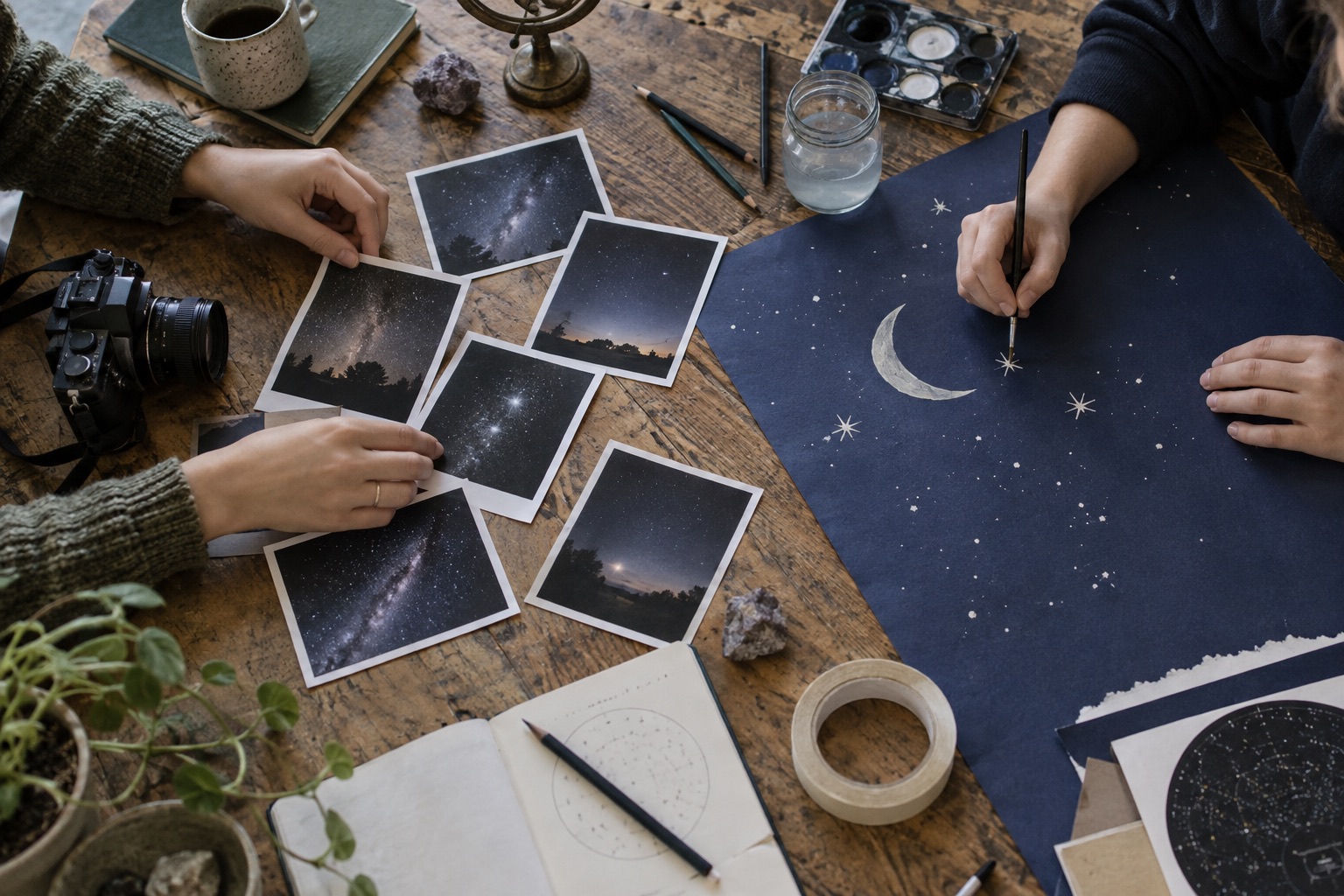
Episode four offers a particularly clear example of the club becoming practical. For a planned Perseid viewing event, Isaki works on the poster while Ganta organises photographs and notes. An invitation to watch fireworks also comes with the possibility of photography practice. The official synopsis puts preparation and an outing alongside one another.
Those small distinctions give us more to follow than the general fact that the pair share an interest. A poster addresses other people: it must make an activity understandable and worth considering. Organising images and notes concerns the material the project already has. The tasks belong to a common purpose, but they direct attention towards different things.
We need not turn that division into permanent personality types. Making one poster does not establish that Isaki must always handle the public-facing work; working with photographs does not make Ganta the only person whose contribution counts as serious astronomy. The more useful observation is that cooperation can remain shared without becoming symmetrical.
This matters in a romance because perfect sameness is a limited picture of compatibility. If every interest, ability and response had to match, another person would add little except agreement. Here, a project supplies a reason to notice a contribution that is not the same as your own.
There is also a difference between the visible result and the work that enables it. A finished image may be the part a viewer remembers. Preparing an event, gathering material and making the activity legible to others belong to the same undertaking. Attending to that preparation keeps the hobby from shrinking into a succession of beautiful images presented as romantic rewards.
The practice element of the fireworks invitation is worth keeping in view without pretending it tells us everything about anyone’s feelings. A practical purpose and an interest in someone’s company can coexist. One does not automatically expose the other as an excuse.
For a viewer, the helpful question is what the stated activity allows the characters to propose. It can be easier to suggest doing something together than to explain the full emotional significance of wanting the other person there. That does not make the practical task unreal; the task can provide the terms on which the time together begins.
This is an interpretive possibility, not a translation of every invitation into a hidden confession. Resist treating the hobby as a code that can be discarded once a romantic meaning has been extracted. If photography mattered only as cover for a date, learning, preparation and the resulting images would become expendable. The more interesting approach allows both the activity and the company to matter.
It changes what counts as movement in the story, too. A scene may advance a shared undertaking without immediately settling how either person would name the relationship. You can follow that progress without demanding a major romantic milestone every time they spend an evening together.
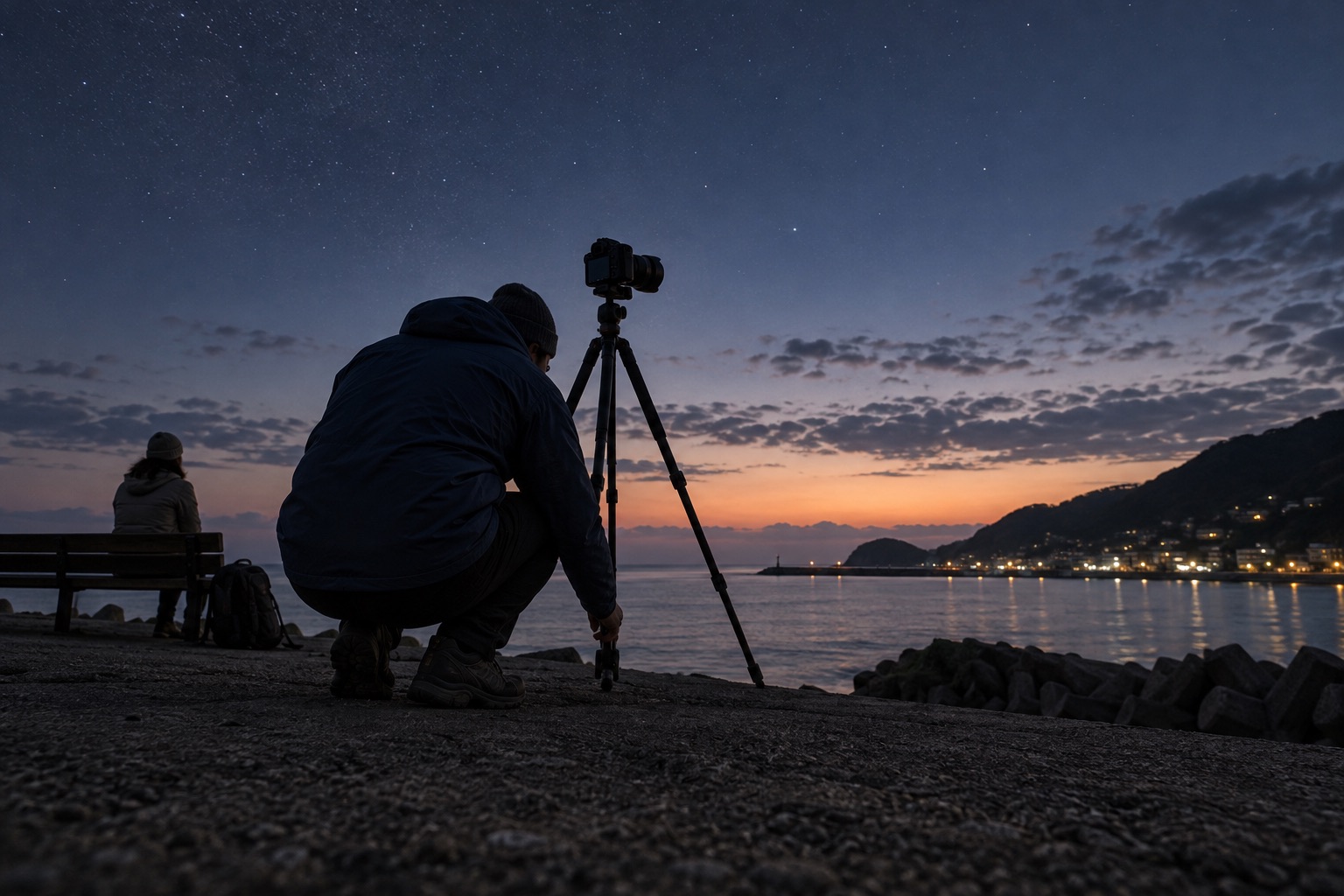
There is a practical problem in adapting a quiet story: an outline can tell us that two characters spend time together, but it cannot make us spend that time with them. Duration has to be built into the animation, performance and editing.
Series-composition writer Rintaro Ikeda discusses deliberately short scripts that leave room for intervals. The fifth episode was especially brief on the page, with the director’s agreement. He also describes moving from an initial twelve-episode plan to thirteen and not organising the adaptation around constant cliffhangers. These are specific production choices explained in his official staff interview, not a general rule for all slice-of-life anime.
They provide a useful answer if you find yourself wondering why the show does not hurry to the next clearly summarised event. There was an intention to leave room around the words. Fewer lines on a script page need not mean there was less thought about how the scene should feel.
Director Yuki Ikeda gives the complementary view. In earlier work, he had often shortened shots to improve pace; here, some intervals needed extending. He wanted silence to convey the distance between the pair rather than simply register as empty time. He also discusses care with photography scenes and transitions between dusk, night and dawn in his director interview.
The two Ikedas have different production roles. Read together, their accounts connect writing that leaves room with direction that has to decide what occupies it. A pause does not become expressive merely because a writer omits dialogue. The surrounding actions and the way the interval is presented still have to give us something to attend to.
This context is an invitation to look more carefully, not an instruction that you must enjoy the pace. A sustained interval may help one viewer notice a change in ease between two people and leave another viewer impatient. Both reactions can be genuine. Production intention explains a choice; it does not settle your response to it.
Try a modest question when watching: does the interval change how you understand the characters’ presence together, or are you waiting only for the next line? You need not identify a symbolic meaning for every shot. Sometimes the relevant effect is simply that the episode lets an ordinary action take up enough space to register.
Photography makes this question especially apt. A plot summary naturally privileges the finished picture: an image exists, and the story moves on. A scene can give attention to the preparation and the person making it. The distinction is between learning what resulted and experiencing some of the time around its making. This guide is not asserting exact exposure lengths or claiming that animated scenes reproduce a camera’s operation in real time.
The changes in light matter for a similar reason. Night is not necessarily one unchanging blue backdrop. A transition into darkness or towards morning can make time perceptible without a character announcing it. Watch how the scene presents the transition rather than assuming every night view has the same narrative job.
The most distinctive production detail here is easy to miss if photography is treated only as a visual theme. Composer Yuki Hayashi says he incorporated camera shutter and mechanical-operation sounds as percussion in the music. In the same composer interview, he discusses clear melodies, lighter arrangements and the use of a felt-dampened upright piano.
That gives the camera two possible kinds of presence: an object involved in what the characters do, and a source of material for how the anime sounds. It is a concrete example of the hobby helping shape the adaptation rather than remaining inside its dialogue or scenery.
For listening, keep a distinction between a sound belonging to the action and a sound incorporated into a musical arrangement. A camera noise need not always perform the same function. The interview supports the composer’s use of those sounds; it does not establish that every click in an episode is part of the score or that every track contains one.
Listen for whether the music crowds an interval or leaves room for the scene’s other sounds. A clearly present melody and a dense arrangement are different things; a recognisable score need not fill every available space.
This also gives a better reason to pay attention to the camera than treating the series as a shopping prompt. The relevant question for this guide is not which device to buy. It is how an activity can become audible even when the story is doing something other than explaining technique.
A still image from the anime can show its setting and design. It cannot convey a pause’s duration or the relationship between a mechanical sound and a musical rhythm. That is a good reason to sample a complete episode rather than judge the adaptation solely through a collection of attractive night scenes.
Begin with episode one of the 2023 television anime. The official credits identify Makoto Ojiro’s manga as the source, LIDENFILMS as the animation studio, Yuki Ikeda as director and Rintaro Ikeda as series-composition writer. This guide concerns that animated adaptation, not the separate live-action film.
Choose it when you want a romance in which a place and an activity can carry some of the work that another show gives to overt declarations. Photography knowledge is not a prerequisite for understanding why permission, preparation and shared time matter. Technical curiosity can be a further interest rather than an entrance examination.
The trade-off is that the quieter rhythm is part of the offer, not a temporary obstacle before the “real” story begins. If you want rapid comic reversals or constant competitive escalation tonight, another selection from our romance guide may suit you better. Sleeplessness and health-related concerns also mean that gentle presentation is not a guarantee of emotionally effortless viewing. The story is fiction, not evidence that romance cures insomnia.
For a reading alternative, the English volume-one listing identifies Ojiro’s manga in its VIZ Media edition. Starting there lets you encounter the source rather than using later-volume summaries to fill in the anime’s future. The production choices discussed above belong specifically to animation and sound; they should not be attributed unchanged to the printed page.
For access from India, check the exact title, edition or adaptation, language options and regional availability with the service or seller you intend to use. The official Japanese production pages and English book listing establish information about the work, not current Indian streaming rights or local stock. No particular platform or retailer is being promised here.
Once you start, there is no need to turn every scene into an analytical exercise. Keep one change in mind: the observatory offers somewhere to be, while the club introduces things to attempt. Following that change lets you see preparation, assistance and time spent making something as part of the romance itself—not an interruption between its important moments.

AUTHOR OF THIS ARTICLE
SoJapan
SoJapan India Pvt. Ltd. is a Japanese-founded company based in Gurugram. We bring Japanese food, anime goods and apparel materials to Indian businesses, with a sister company in Kyoto that works directly with makers in Japan.