A character announces a life-changing invention. Then the story sends him looking for materials, enough people to work with them, and someone who can actually make the required object. Has the adventure been interrupted?
In Dr. STONE, that is often the adventure itself. Knowing that something can exist is not the same as being able to build it here, with these tools and these people. Senku’s enormous knowledge does not make that gap disappear. It makes the gap visible.
For Indian anime fans wondering whether a series about science will feel like extra homework, this is a useful distinction. You do not have to solve chemistry questions ahead of the characters. The pleasure is following a difficult goal as it becomes a sequence of smaller, unexpectedly human problems.
Spoiler boundary: this article discusses the opening premise and selected projects introduced through season one’s episode 11, including the village, Ruri’s illness and the plan to make glasses for Suika. It does not reveal later project outcomes, the resolution of the conflict with Tsukasa, or the explanation for humanity’s petrification. Linked official character pages contain major later spoilers.
The story details are supported by the anime’s official episode pages and publisher information. The interpretation of why those details work is our editorial reading, not a claim about the creators’ private intentions.
Three ideas will help you follow the discussion:

The opening begins with a mysterious event that petrifies humanity. Approximately 3,700 years later, Senku and his physically strong friend Taiju reunite in a world without the modern civilisation they knew. The official first-episode synopsis establishes this large time gap and their rebuilding ambition.
That number describes the fictional setting. It is not a prediction of how every building, material or ecosystem would behave over the same period. The petrification itself is the extraordinary premise you accept in order to enter the story.
The original manga is written by Riichiro Inagaki and illustrated by Boichi. VIZ’s volume-one description introduces the contrast between an apparently hopeless world and Senku’s determination to restart civilisation. You can understand that premise without reading a franchise timeline or learning the names of later inventions.
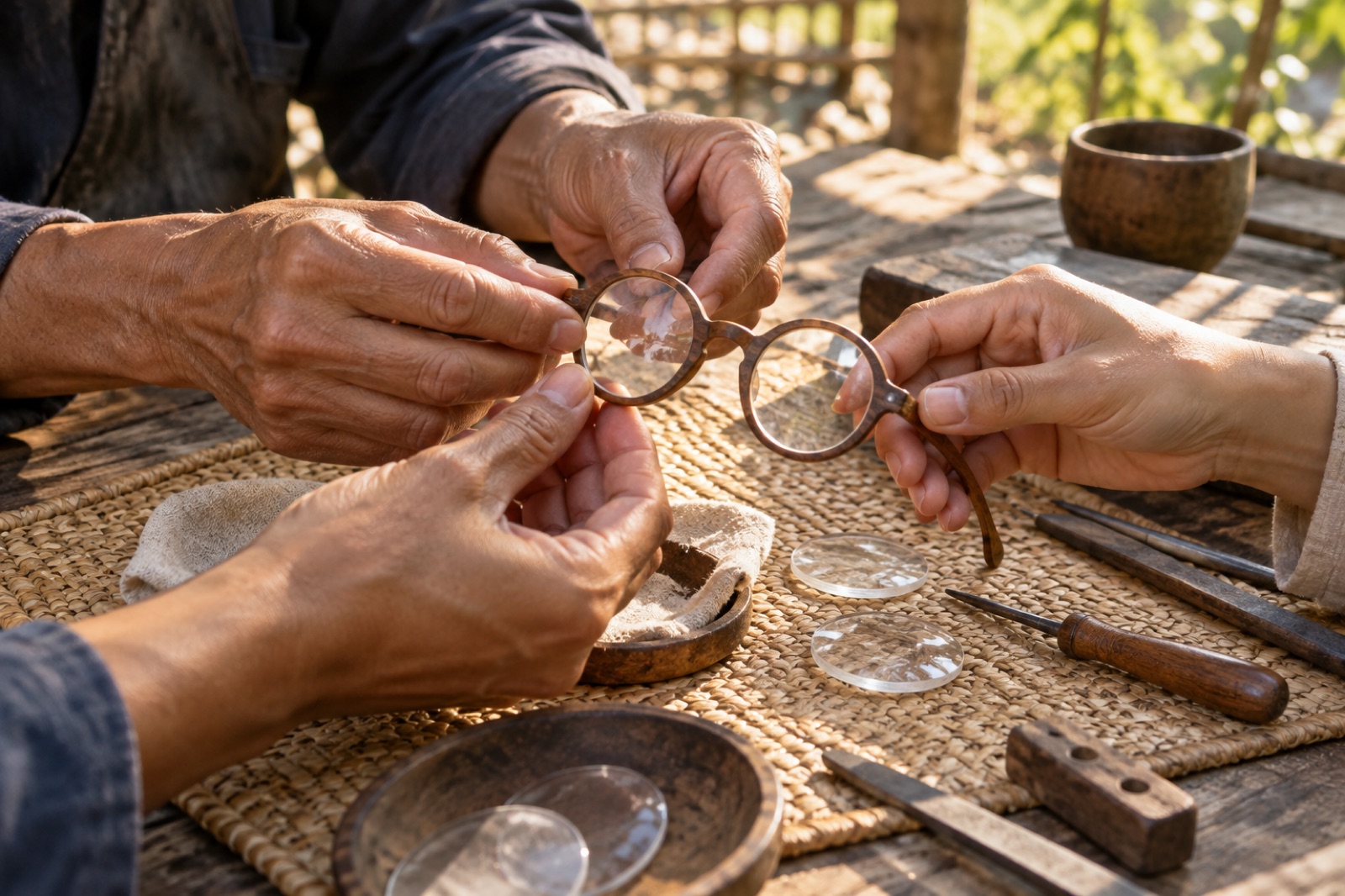
Imagine remembering what a familiar object does while losing every shop that supplies it. A pair of glasses, for example, is no longer something to select from a display. Before anyone can use it, somebody must be able to produce and work the material. The object you normally encounter at the end of a process becomes evidence of everything that process required.
This is why a photograph of the finished invention cannot capture the appeal of an entire episode. The photograph answers “what did they make?” The story asks “what had to become possible first?”
There is also an important limit to calling this a return to zero. People still have knowledge, abilities and relationships. Senku brings memories of modern science; other people bring capacities he cannot replace simply by explaining a principle. As the cast expands, rebuilding becomes less like one person filling an empty world and more like discovering which existing strengths can work together.
Watch for that distinction early. A missing factory is a problem; it does not make every person outside the factory ignorant. The series becomes more interesting when you notice knowledge that is practical, local or embodied in a craft, rather than counting only the facts Senku can recite.
Senku’s competence can initially suggest a familiar fantasy: the exceptional person will solve everything while everyone else reacts. Taiju makes that reading uncomfortable.
Episode six looks back at Senku’s solitary struggle to secure basic necessities and the limits of his physical stamina. It connects that struggle to his wish to revive Taiju. The official synopsis supports this contrast, although the page also reveals a major event from the preceding episodes.
The useful point is not that brains and muscles belong to separate kinds of people. It is that knowing the next task does not perform the task. A good explanation does not carry an object, gather a supply or create more hours in the day.
For a viewer, this changes the value of effort on screen. Repetitive work can look narratively unimportant because it produces no surprising answer. Yet the person who can keep doing it may be the reason an answer ever becomes useful. An invention’s history contains actions as well as ideas.
Think of a group making an original cosplay prop. Someone may understand the shape immediately, but the project still needs careful cutting, fitting, finishing and checking. The person with the clearest initial concept is not automatically the person whose contribution is most needed at every stage. This is an everyday comparison, not an event from the anime.
That comparison also exposes a weak interpretation of teamwork: “Senku thinks; everyone else obeys.” A stronger reading asks whether the work changes depending on who participates. If practical ability makes a previously blocked stage achievable, the collaborator has altered the story’s possibilities. They are not merely decorating the genius’s victory.
You can enjoy the exaggerated character contrast while resisting the idea that someone’s worth is a single stat. Taiju’s importance does not require assigning him an invented intelligence score. Nor does recognising Senku’s limitations make him less impressive. It gives his plans something real to push against inside the fiction.
Chrome enters the early village story calling himself a sorcerer. Episode seven stages the encounter as science meeting apparent sorcery. The official episode-seven introduction also makes clear that Senku wants the village’s help; this is not simply an academic debate conducted without practical stakes.
The labels invite an easy joke: a modern expert arrives and corrects someone who uses the wrong word. But that is not the most generous or useful way to understand Chrome.
His official character profile describes a curious, intelligent person who collected materials while trying to help Ruri, and whose flexible thinking can surprise Senku. The vocabulary is different; the impulse to investigate is already present. Be careful browsing the rest of that page, which includes later-story information.
Someone can know a standard explanation because they have encountered it before. Someone else can notice a pattern without possessing the standard explanation. Those are different starting positions, not a complete ranking of their potential.
That distinction makes Chrome worth watching beyond his reaction to modern knowledge. When two characters have different histories, an exchange can be more than a lesson flowing in one direction. One may recognise the significance of something the other has gathered; the other may have noticed or preserved something the expert did not yet have access to.
Our reading is that this relationship makes rediscovery emotionally different from recall. Senku can value a known possibility as a route towards a larger objective. Chrome can encounter that possibility as a change in his understanding of the world. The same explanation therefore does not have to produce the same reaction in both people.
It is a good reason not to watch only for the next spectacular device. A moment in which a person learns to ask a better question can be a meaningful development even before the group owns anything new.
For someone accustomed to an everyday technology, surprise at it can look childish. But familiarity is not the same as comprehension. Most of us use objects whose production we could not reproduce from their raw materials.
Chrome’s position invites the audience to reverse the usual smugness of an explanation scene. Instead of asking why he does not know a modern term, ask what you would actually be able to discover with his information. That is a viewing question, not a claim that the anime accurately simulates a particular historical society.
This is also where the series can work for viewers who dislike school-subject hierarchies. You can be interested in observation, construction or the consequences of a discovery without treating every scene as a competition to identify the cleverest person.
Episode eight gives the early village story a personal goal: Senku intends to make a drug for the ill Ruri. The official synopsis identifies ironmaking as an early stage and a shortage of workers as an immediate obstacle. The episode’s summary is useful because it shows the distance between the named goal and the next thing that must happen.
We are discussing the story’s project structure, not giving medical or chemical instructions. Its dramatic language about a cure should not be read as a real-world promise about treating illness.
If you expect an invention sequence to move directly from an idea to a finished object, an intermediate task may seem like a delay. A dependency changes that judgment. It means the later task needs something the earlier task provides.
The easiest way to read such a sequence is backwards. Start with the desired result and ask what must already exist for it to be possible. Then ask the same question of that requirement. The distance between the first ambition and the first feasible action is where much of the adventure lives.
Here is an original, non-technical illustration—not Senku’s actual project or a reconstruction of a chemical process.
Suppose a fictional workshop must complete five tasks. Three take one hour each, a fourth takes six hours, and a final check takes one hour. If everything must happen in sequence, the total is 1 + 1 + 1 + 6 + 1 = 10 hours.
Completing the first three tasks means three of five task labels are crossed off: 60% by count. But only three of ten hours, or 30% of the assumed work time, have passed. Task count and effort are not the same measure.
The figures are deliberately simple assumptions. They are not episode runtimes, measurements of the characters’ labour or a prediction of how real manufacturing works. Their purpose is to explain why a small-looking box on a plan can support a large part of a story.
The reverse can happen too: a new collaborator can unlock a stage without adding a new scientific discovery. The important change is not how impressive the label sounds. It is whether the project can now do something it could not do before.
For the viewer, a plan creates anticipation. You can recognise progress without knowing the ending because you understand an obstacle’s role. A setback then has shape: it threatens a connection you have already been shown, rather than merely announcing that the characters must try harder.
The next obstacle is human. People are not tools that become available because a knowledgeable stranger needs them.
Episode nine connects the group’s improvised ramen with recruiting help for ironmaking, then introduces the ambition to generate electricity. The official synopsis sets out these developments. We do not need to reproduce a recipe, technical build or later result to see why their connection matters.
Food changes the scale at which a promise can be understood. An enormous future project can be difficult to evaluate. Something offered in the present gives another person a nearer reason to pay attention. In our interpretation, that makes persuasion part of the invention story rather than a distraction from it.
It also stops the village from functioning as an anonymous supply of workers. If someone has to be persuaded, their response matters. Senku’s goal and another person’s reason for helping do not have to be identical for cooperation to become possible.
That does not mean every exchange is ethically simple. A viewer can admire a clever appeal while asking whether the people involved have been told enough, whether the benefits are shared and whether they can refuse. A science-centred protagonist does not remove the need to judge how people treat one another.
This is a richer question than whether the ramen is authentic to a modern restaurant menu. Within this sequence, its narrative job is to connect a proposed future with a present appetite. If the food itself catches your interest, our ramen guide examines the components of ordinary ramen separately; the anime’s improvised meal is not a substitute recipe for that guide.
Notice, too, that a technical solution can create a social problem rather than end one. A useful idea may still need trust, work and agreement. The show becomes easier to follow when you allow those to count as obstacles in their own right.
A project described as rebuilding civilisation can become too large to feel. Episode eleven supplies a smaller point of focus: Senku promises glasses for Suika and brings the village craftsman Kaseki into the glassmaking effort. The official episode-eleven synopsis ties this to the broader ongoing plan.
The useful contrast is between a capability and a use. “We can work with this material” describes what a group can make. “This person needs this object” gives the capability a particular purpose.
Those questions should not be collapsed. An impressive demonstration may establish that something is possible without establishing who benefits. Conversely, an object can matter enormously to one person without looking like the largest achievement in the series.
Kaseki’s official profile identifies him as an experienced village craftsman who has devoted 50 years to making things. That is a description of sustained practice, not a power level or a guarantee that every new task is effortless.
This introduces a form of expertise that is easy to undervalue while watching an explanation-heavy story. A verbal description can tell you what should be made while leaving the challenge of making it well unresolved. Material handling and workmanship are not merely slower versions of remembering a scientific fact.
Consider drawing the same curve twice with a brush pen. Knowing the intended curve does not make your hand execute it identically each time. The example is much simpler than the crafts in Dr. STONE, but it distinguishes an instruction from practiced control without pretending that they are unrelated.
The question to carry into Kaseki’s scenes is therefore not “Could Senku explain this?” It is “What does this maker contribute that an explanation alone cannot supply?” That shift makes the ensemble more interesting. The person who describes an invention does not have to own every kind of excellence involved in it.
Our reading of the glasses project is that it gives the grand ambition a human scale. You do not need a bigger explosion, a larger machine or an enemy’s defeat to understand why a useful object deserves attention.
This is not an invitation to reduce Suika to a problem someone else fixes. Instead, separate what a person wants to contribute from the obstacle they face. Helpful technology can be read as enabling participation rather than as conferring value on a supposedly unimportant person.
That distinction is worth keeping beyond this particular project. Ask not only whether a new object makes the group more powerful, but whether it changes whose abilities can be expressed or whose needs receive attention. It is one way to notice the emotional stakes beneath a technical-looking sequence.
“Is the science real?” is a reasonable question, but it contains several different questions. Does a named phenomenon exist? Does an explanation capture its principle? Would the depicted materials and equipment produce the result? Could someone reproduce it safely?
A yes to the first question does not automatically answer the others. An animated explanation may omit checks, unsuccessful attempts or conditions that matter outside the story. Likewise, the fictional petrification premise does not tell you that every ordinary scientific reference must be invented.
The most useful approach is to keep three categories separate: the story’s extraordinary premise, its references to real ideas, and the way it compresses work for entertainment. This is a critical-reading framework, not a numerical accuracy rating for the whole series.
If a particular idea makes you curious, write down the concept and investigate it separately through a suitable textbook, museum, university or supervised educational resource. Do not start by copying the characters’ procedure and hope the missing details are unimportant. This article intentionally does not reproduce chemical preparations, improvised treatments or hazardous workshop instructions.
You also do not have to stop watching every time an unfamiliar term appears. First understand its role in the scene. Is it a desired material, a tool, an energy source or the result of a test? Once the role is clear, you can decide which underlying concept interests you enough to pursue later.
That prevents two opposite frustrations: believing that everything on screen is a verified tutorial, or believing that you need advanced subject knowledge before you are allowed to enjoy it. Neither is a good entry requirement for an adventure story.
Dr. STONE is a promising choice if you enjoy watching a goal become understandable through preparation. Its early appeal lies in the connection between a large ambition and a small next action: an explanation needs a material, a material needs work, and work needs people with reasons to participate.
It may be less immediately satisfying if you want uninterrupted combat or a lead character whose knowledge removes every practical inconvenience. The obstacles discussed here are not all interruptions to the main attraction. For this reading, they are what gives the attraction substance.
Start with the first season rather than a compilation of impressive inventions. Seeing an object before seeing the problem it answers can preserve the surprise of its appearance while losing the satisfaction of its necessity. If platform labels make the sequence confusing, our guide to seasons, cours and anime watch order explains those terms without requiring a deep dive into later plots.
Then let the question change as the project develops. At first, you may ask whether Senku knows how something works. Later, the better question may be whether the group has the means to make it—or whether anyone has noticed the person for whom it matters.
That is the early series’ most rewarding adjustment. The invention is not only the object at the end. The adventure is discovering what, and who, must come together before that object can exist.

AUTHOR OF THIS ARTICLE
SoJapan
SoJapan India Pvt. Ltd. is a Japanese-founded company based in Gurugram. We bring Japanese food, anime goods and apparel materials to Indian businesses, with a sister company in Kyoto that works directly with makers in Japan.