You already know who is doing it. You have seen the notebook. So why is watching someone investigate its owner so tense?
Death Note makes the distance between knowing and proving feel dangerous. Light Yagami has a supernatural advantage, but he still needs information. L has an investigation, but cannot read the scenes the audience has watched. Neither can simply reach across that gap and end the contest.
For Indian viewers moving from action anime into psychological thrillers, that is the useful starting point. This is not a series you enjoy by memorising a genius’s supposed IQ or trying to predict every twist. Much of the pleasure comes from recognising that an apparently successful move can also give something away.
Spoiler boundary: this article discusses the opening premise and important developments in episodes 1–3 of the 2006 television anime, including the television confrontation and the offer involving Shinigami eyes. Watch those episodes first if you want their surprises intact. We do not reveal later investigations, character fates or the ending. Some linked official pages contain later spoilers.
The story facts below are drawn from the original publisher and broadcaster. The explanations of suspense, character choices and possible alternative readings are our editorial interpretation—not statements about what the creators privately intended.

The original manga pairs Tsugumi Ohba’s story with Takeshi Obata’s art. Light, an academically gifted student, finds a notebook connected to a Shinigami, or death god, and begins using it to kill people he judges deserving of death. L investigates the killings. That is the premise, not a twist you need to protect until the final episode. VIZ’s official series introduction establishes the central conflict.
The television adaptation is a 37-episode series produced by Madhouse, with its original Japanese broadcast beginning in October 2006. Nippon TV lists the later Relight specials separately. For this reading, begin with the television series rather than assuming a film, special or live-action version follows precisely the same route. Nippon TV’s anime catalogue identifies the format and production.
In a conventional whodunnit, the viewer may work alongside a detective to identify a hidden culprit. Here, an important part of the answer is already visible to us. The uncertainty moves elsewhere: what can the investigator discover, what will the culprit risk, and which person has misunderstood the other’s position?
That changes the meaning of a quiet scene. A name is not just an introduction. A public statement may be a challenge. A small change in behaviour can matter more than an impressive display of force, because it changes what another person thinks is possible.
Light and L also do not have identical objectives. Light wants to continue acting while protecting his identity. L needs to work from observable events towards an explanation and an identifiable person. Preventing one discovery and establishing a defensible conclusion are different tasks. Calling the story a battle between two clever people is accurate as a first impression, but it misses that unevenness.
If you enjoyed guessing individual culprits, our Detective Conan guide explores that pleasure. Death Note asks you to tolerate a different kind of frustration: you may know the answer while watching someone else struggle to obtain even a small part of it.
An unrestricted power would make a very short contest. The notebook instead establishes conditions. The opening manga chapter explains that writing a name requires the writer to have that person’s face in mind; a shared name does not simply strike everyone who has it. It also gives a 40-second window for specifying a cause of death, with a heart attack as the default when no cause is specified. The opening rules appear in Shueisha’s official Chapter 1 reader.
These are fictional mechanics, not claims about the real world. You do not need an exhaustive rules list before starting. In fact, reading one can reveal situations that the opening has not introduced. The immediate point is that possession of the notebook and possession of the information needed to use it are different advantages.
Think about what usually makes a detective impressive: recognising a person, connecting an alias to an identity, finding the individual behind an event. In this story, identity has an additional function. A missing piece of identifying information is not merely an inconvenience for a conversation. It can prevent the supernatural advantage from being applied to the desired person.
That is why “Why doesn’t Light just use the notebook?” is sometimes the wrong question. Ask instead whether the information he actually possesses meets the condition. A viewer can know which rival is being discussed without that rival having supplied everything Light needs.
This distinction makes withholding information active rather than passive. A character does not need a stronger supernatural weapon to create an obstacle. An absence—a name that has not been disclosed, for example—can carry dramatic weight.
The 40-second figure is easy to remember, but do not flatten it into “every written death must happen in exactly 40 seconds.” The opening rule concerns a window for specifying the cause. Later explanations and particular written conditions matter to how events occur. Treat a rule as a constraint to read carefully, not a slogan that replaces the story.
Likewise, knowing a tool’s conditions does not tell you whether a person will use it patiently, impulsively or at all. The interesting part begins when mechanics meet temperament. A powerful option can be available and still be a poor choice for the person who takes it.
For a fan of card games, there is a familiar distinction here: understanding what an effect permits is not the same as knowing when using it helps. Death Note is not literally a balanced game, however. Its participants have unequal knowledge, uncertain motives and human lives at stake. The comparison helps explain constraints; it should not erase the people harmed by the contest.
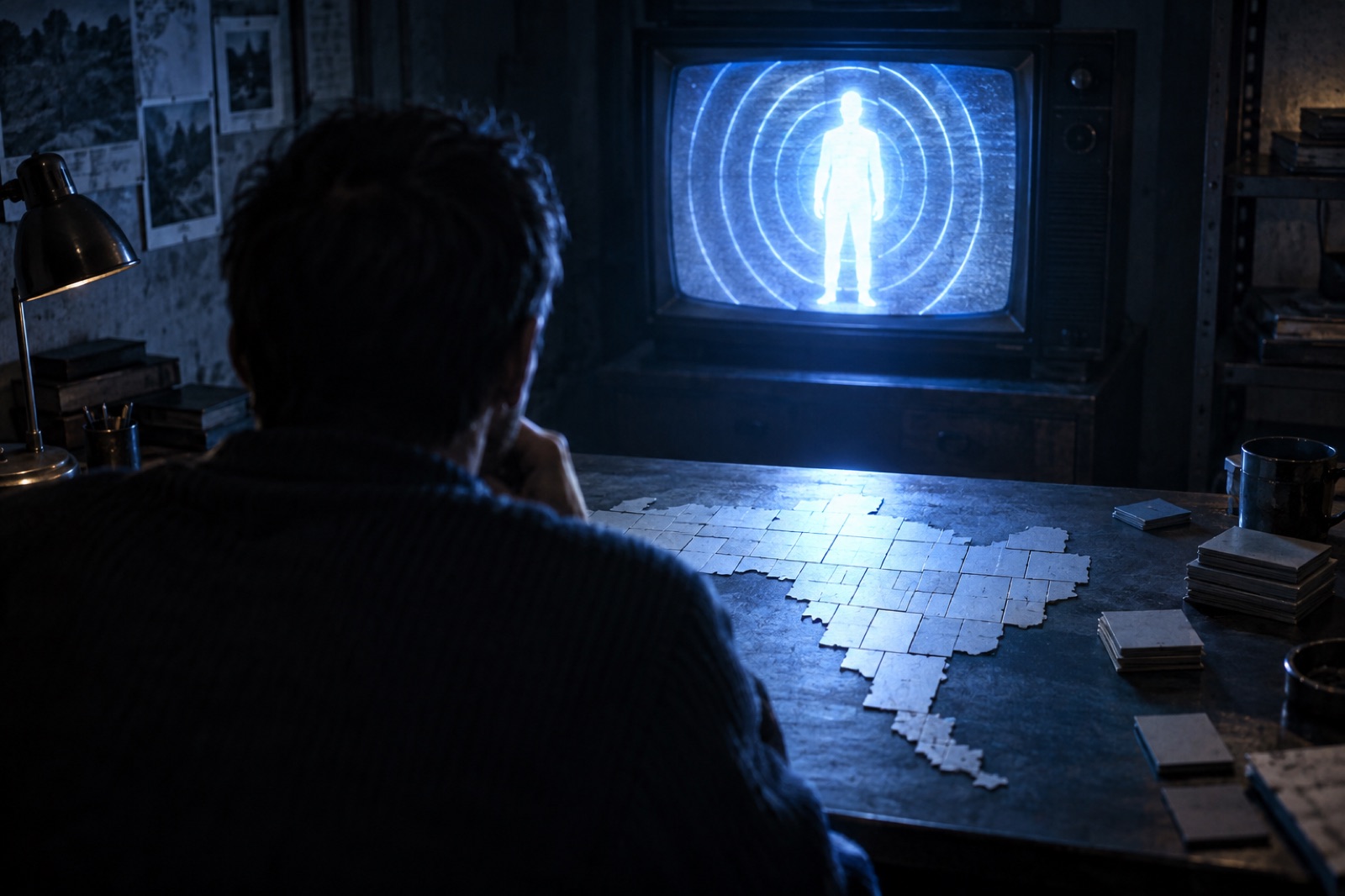
In episode 2, a televised figure condemns Kira, the name associated with the killings. Light responds by writing the displayed name. The actual L then reveals that the speaker was a substitute and that the supposed worldwide broadcast was restricted to Japan’s Kanto region. Nippon TV’s episode 2 synopsis describes the confrontation; its archive contains later spoilers.
That is enough plot to examine the reversal. We do not need to reproduce the speeches or retell every exchange.
Our reading is that Light mistakes an immediate result for an overall advantage. An action can achieve its narrow purpose while worsening the position around it. Once that distinction becomes visible, the scene stops looking like a simple competition over whose power is stronger.
Consider three questions separately:
| Question | Why the distinction matters |
|---|---|
| Did the immediate action work? | A visible result can satisfy the person acting. |
| Was the situation what that person believed it was? | Success against the wrong understanding can serve someone else’s plan. |
| What did the response reveal? | The observer may gain information even without solving the whole case. |
This table is an analytical lens, not additional dialogue from the episode. It explains why one person can celebrate an outcome that another person was waiting to observe.
A purely mechanical explanation would say that one character lacked information. That is true but incomplete. The confrontation also matters because Light reacts to being condemned. His judgment of the situation is bound up with his judgment of himself.
Our interpretation is not that intelligence vanishes when someone becomes angry. It is that intelligence does not automatically determine which objective feels urgent. Avoiding exposure, establishing superiority and defending a self-image can pull in different directions. A person may be capable of elaborate reasoning while allowing the wrong objective to lead.
That makes the opening more interesting than a story in which a supposedly brilliant character simply forgets how their own power works. Light’s weakness can emerge from what he wants, not only from what he fails to calculate.
You can admire how sharply the scene changes direction without treating its participants as models of behaviour. The human cost of the demonstration remains part of the scene. If discussion turns into cheering for points scored, it is worth asking what that scoreboard leaves out.
The geographical revelation is a major change in the investigation’s position. It is not the same thing as naming the culprit. This is an important check on the common impression that L somehow knows everything immediately.
A useful way to appreciate a deduction is to notice its size. Has it supplied an identity, eliminated a possibility, suggested a category or created a new question? Those outcomes differ. Progress does not need to equal completion to be exciting.
Nor should you import population figures and calculate a supposed arrest probability from the scene. A smaller search area is narratively meaningful, but a precise chance of success would require assumptions the episode does not provide. The improvement is clear without invented mathematics.
Episode 3 develops a different problem. L considers whether Kira may be a student. Light, who has access to information through his police-official father, learns about the investigation and changes the timing of the killings. L reads significance into that change. The broadcaster’s episode 3 summary supplies the sequence.
The important idea is not a timetable to memorise. A response to an inference can itself become evidence that the inference was heard. This is our interpretation of the exchange, and it explains why the opening’s dialogue is not confined to people speaking in the same room.
Do not reduce this to an accidental leak, however. The same official synopsis explains that Light wants mistrust to develop between L and the police. He is making a calculated provocation. Whether a disclosure is intentional and whether it will produce the desired result are separate questions; intention is not a guarantee of control.
A simple, harmless comparison helps. Imagine a puzzle host privately tells a small group that a player always chooses red. At the next round, the player suddenly chooses blue. Blue does not prove that the player heard the remark: they might have changed for another reason. But if the change closely answers the private observation, access to that information becomes a question worth considering.
That imagined puzzle is not a scene from Death Note. It separates two ideas that are easy to blur: changing behaviour and explaining why the change happened. The first is observable; the second is an interpretation that may require more evidence.
In the anime, the viewer occupies an unusually comfortable position. We can follow the reason behind an action that another character must infer. It is tempting to mistake that comfort for superior reasoning. “Obviously he changed because he knew” feels obvious partly because we were allowed to see more.
Hindsight can make a thriller seem easier than it was. A useful discussion restores the missing uncertainty: what alternatives were still reasonable before the next scene settled the question?
There is another pleasure here for viewers who like competitive games: a move has a second meaning because an opponent can interpret it. But unlike an open board, the participants may not even agree on what information the other side possesses. The contest concerns their models of each other as much as the visible action.
The result is a thriller in which being adaptable has a cost. A change can solve one problem and open another. That does not mean every response is a mistake. It means that cleverness is judged in a changing situation, not by collecting isolated moments that look impressive in a clip.
VIZ’s first-volume description explicitly connects Light’s access to case information with his father’s police role. That relationship is an important part of the opening, not background trivia. See the publisher’s Volume 1 description.
For our reading, its value goes beyond explaining how information reaches Light. The person associated with investigation is also his father. The audience must hold a family relationship and an investigative relationship in mind at once.
A thriller can generate tension by making a stranger dangerous. This setup makes familiarity uneasy instead. Knowing someone’s everyday role does not give a character the audience’s knowledge of everything that person is doing. Family closeness and factual certainty are not the same thing.
That is more interesting than reducing Soichiro Yagami to an obstacle who should somehow guess the premise of the show. Imagine judging any fictional parent while secretly possessing scenes from the child’s private life. Your confidence would come from your viewing position, not necessarily from evidence available inside the relationship.
It also changes how we hear Light’s ambition. A grand claim about improving the world does not remain abstract when the story places it beside people with duties, loyalties and limited information. The household makes consequences personal even before the wider conflict can be resolved.
For conversation with friends, this offers a better question than “Who is stupid for not knowing?” Ask what a person would have to learn before their behaviour should reasonably change. That preserves the tension instead of flattening everyone outside the central rivalry into less intelligent spectators.
Near the end of episode 3, Ryuk offers the ability to see people’s names through Shinigami eyes in exchange for half of Light’s remaining lifespan. The episode 3 synopsis states the bargain.
The distinction between remaining lifespan and total lifespan matters. As a purely hypothetical illustration, a character with 40 years remaining would surrender 20, not half their current age. This is arithmetic explaining the fictional offer, not a claim about Light’s actual lifespan or a prediction about his fate.
The offer changes the kind of question the viewer asks. Until now, missing information can look like an external obstacle. A bargain turns it into a choice about what the person is willing to give up. The story does not need a larger explosion to raise the stakes; it can attach a personal cost to a desired advantage.
Notice that wanting an advantage and valuing it enough to pay the price are separate judgments. An option can be exceptionally useful and still be unacceptable to the person offered it. This makes character preferences part of the mechanics rather than decorative emotion added between clever plans.
Ryuk is also not simply a reassuring guide accompanying a young hero. VIZ’s editorial introduction describes his boredom and amusement at human behaviour. That framing helps explain why an explanation from him need not feel like encouragement towards a morally good outcome. VIZ’s article discusses Ryuk, but also includes later-series spoilers.
Our interpretation is that he creates an unsettling distance between importance and entertainment. What is a matter of life and death to people can be fascinating to an observer without becoming that observer’s moral mission. His presence leaves room for dark humour while preventing the supernatural side from functioning as a simple seal of approval.
That distinction matters for the viewer too. Finding the contest entertaining is not the same as sharing Light’s values. A compelling fictional perspective can hold your attention while asking you to question the choices it makes visible.
Death Note is often discussed through the question of whether Light or L is smarter. The opening supports a more revealing conversation: what counts as success to each person, and what must be ignored to call it success?
For Light, the ability to enact a judgment can look like confirmation that he is entitled to make it. Those are different propositions. A supernatural tool that produces an effect has not, by producing that effect, evaluated the fairness of the decision behind it.
As an ethical reading of the story, we should keep effectiveness, certainty and legitimacy apart. A decision can be carried out effectively while resting on incomplete knowledge. A person can feel certain while refusing scrutiny. Neither fact alone establishes that they have the right to decide another person’s fate.
This does not require turning an anime conversation into a legal seminar. Stay with the opening’s concrete conflict. When a character reacts to criticism as though it were proof of an opponent’s badness, ask whether the standard being applied has shifted. Is the goal still the stated ideal, or has protecting the self become part of the definition of that ideal?
Equally, opposing Light does not require treating every investigative choice as beyond criticism. You can question the human cost of a method while recognising the significance of what it reveals. “That was clever” and “That was justified” are not interchangeable compliments.
For a group discussion, try finishing two different sentences: “The move succeeds because…” and “The choice troubles me because…” Different answers are possible without either person misunderstanding the plot. This is more productive than letting an argument about morality become a contest over which character a fan is allowed to enjoy.
Avoid attaching unsupported diagnoses or invented IQ numbers to these observations. Pride, secrecy, curiosity and determination are useful descriptions of behaviour. They do not require a clinical label or a numerical ranking to become interesting.
Our suggested stopping point for a first discussion is episode 3. By then, the series has introduced its central power, a confrontation and a costly new option. That is enough to ask whether its style of suspense interests you without searching for an explanation of the ending.
The recommendation is about sampling the storytelling, not a promise that everyone will be hooked on a deadline. If you dislike sustained tension, calculated cruelty or stories centred on killing, it may not be the right choice. School-age characters and animation do not make it a children’s comedy.
VIZ labels the first manga volume Teen Plus; its rating guidance describes that category as potentially suitable for older teens and adults. That is publisher guidance for the product, not an Indian certification or a substitute for checking the advisories on the version you intend to watch. VIZ explains its rating system and its limits.
For Indian viewers, also check the exact animated-series listing, available audio, subtitles and episode access in your own service before paying. This article does not claim current Indian availability on a particular platform. A foreign catalogue entry is useful for identifying a title, not proof that your account can play it.
If the main appeal is having a short but meaningful conversation after watching, choose one moment rather than listing every rule. Discuss the gap between an immediate result and what it reveals, or the difference between what you knew and what L could establish. Both lead back to scenes, not spoilers from a character wiki.
If instead you discover that you want warmer adventures or lighter everyday comedy, our beginner anime guide offers other starting points. Choosing a different mood does not mean failing to appreciate a famous series.
Death Note’s opening works because power does not abolish uncertainty. A notebook can change what Light is capable of doing without making him immune to pride, ignorance or consequences. L can make progress without possessing the answer the audience already knows. Between those unequal positions, an ordinary piece of information becomes something worth watching very closely.

AUTHOR OF THIS ARTICLE
SoJapan
SoJapan India Pvt. Ltd. is a Japanese-founded company based in Gurugram. We bring Japanese food, anime goods and apparel materials to Indian businesses, with a sister company in Kyoto that works directly with makers in Japan.