← JOURNAL6 Oct 2026
Beyblade X Explained: Anime Battles, Finish Points and the Parts Behind the Spin
 By SoJapan
A Beyblade X battle can look settled until one collision changes the score. The top still spinning proudly in the stadium is not necessarily evidence of a comfortable match lead. How a battle ends matters as much as who survives it.
That is the best starting point if you know Beyblade from animation but find X confusing. Its appeal is not simply “the same spinning tops, only faster”. The rail creates a recognisable burst of movement, different finishes carry different rewards, and a combination of parts gives fans something concrete to discuss after the spectacle.
For Indian viewers returning to Beyblade, this guide connects those three layers: the opening anime story, the scoring you can follow, and the toy system you can inspect. It uses the official English character names. Story discussion includes early premises through episode nine, not later tournament results or character revelations.
The short answer: outlasting an opponent is only one route to points. Know the finish, read the running score, and then ask what the top’s movement contributed. You do not need to memorise an entire product catalogue to enjoy that sequence.
The opening introduces Robin Kazami after his amateur team falls apart. His encounter with the mysterious Blader X brings him towards The X, the tower at the centre of the professional scene in Xenon City. X approaches blading through enjoyment, while Robin is trying to find a way forward after failure. That contrast is already present in the official first-episode synopsis.
Our reading of the setup is that Robin gives the audience a useful position: ambition without mastery. If the most experienced person on screen were the only viewpoint, every unfamiliar manoeuvre could feel like another unexplained superpower. A learner makes room for the less glamorous questions. What went wrong? What did the opponent understand? Can enthusiasm survive another disappointing result?
Jaxon Cross and Multi Nana-iro complicate that learning process in different ways. The early story is not merely waiting for Robin to acquire a more impressive-looking top.
In episode two, Jaxon’s identity and the formation of Team Persona enter the story; Robin also needs an actual Bey. Multi gives him Scythe Incendio, but she is not introduced only as someone handing over equipment. Her own Team Rainbow is an upcoming opponent.
That makes the gift more interesting than a simple upgrade scene. Equipment can allow Robin to participate without closing the difference between him and a capable rival. For a new fan, this is worth keeping in mind whenever an attractive product appears on screen: possessing the named Bey and understanding how to battle are different achievements.
Episode three’s introduction emphasises Multi’s strategy as well as her change of outfit and Bey. It also sets up the possibility of turning an opponent into a teammate. Her presentation and her competitive thinking therefore deserve separate attention. A colourful persona is not evidence that the character is only comic decoration.
The practical viewing question is not “which member is strongest?” at every moment. Ask what each person contributes that another cannot yet supply. Someone may reveal a gap in Robin’s play; someone may understand equipment; someone may change the atmosphere around a discouraging loss. Those functions can matter before a scoreboard improves.
By episode five, Komaba Sushi’s sponsorship lets Team Persona enter The X’s professional environment. The story’s scale changes: the team is moving into a place full of trained potential opponents, not merely arranging another informal challenge.
That setting gives the anime a useful tension between play and performance. Jaxon’s enjoyment does not remove the pressure of competing, and Robin’s seriousness does not automatically produce competence. You can enjoy the battles as colourful action while also watching how the team handles that mismatch. There is no need to read sponsorship here as a business lesson; for the viewer, it marks a new level of expectation.
For the basic two-player format discussed here, the target is four points. A finish is the result of an individual battle; a match can contain several battles. Confusing the two makes the score harder to follow.
The names also vary across official materials. Hasbro’s F9588 instructions use Survivor and Knockout, while Takara Tomy’s Japanese regulations use Spin Finish and Over Finish for the corresponding basic outcomes. The table pairs those names so that a different label does not look like a fifth way to win. See the Hasbro F9588 manual, page two.
| Finish | Basic result to recognise | Points |
|---|---|---|
| Survivor / Spin Finish | Your opponent stops spinning before you in the battle area | 1 |
| Knockout / Over Finish | Your opponent finishes in the designated knockout/over zone | 2 |
| Burst Finish | Your opponent’s Bey separates through its burst mechanism | 2 |
| Xtreme / Extreme Finish | Your opponent finishes in the designated extreme zone | 3 |
This is a beginner summary, not a substitute for a judge’s ruling. In particular, an Over Finish is not “anything that leaves the central bowl”, and a top momentarily entering a zone is not always the end of the story.
The Takara Tomy regulations, version 12 effective 13 March 2026, distinguish the zones and address a still-spinning Bey returning to the battle area. They also handle simultaneous results and special parts. Follow the applicable rules rather than awarding points from an incomplete glimpse.
Consider this invented score sequence, using the basic point values above. It is an arithmetic example, not an anime result or a report from a tournament.
A won three battles. B won two. The final match score is 3–4.
This is why counting “how often my favourite won” can give the wrong impression. A single high-value finish can offset several lower-value results. Conversely, a dramatic three-point result is not a complete four-point match by itself when the player began on zero.
There is another useful change at a 3–3 score: any one of the four successful finish types is sufficient to reach the target. Extra points no longer create a different match winner. That does not tell a player exactly what to launch, but it helps a viewer understand why the scoreboard is part of the tension rather than background decoration.
Do not turn this arithmetic into “attack is always best”. The point value describes the reward if a finish happens; it does not state its probability. A plan aimed at three points still has to succeed. A steady one-point result can be enough at the right score. Without actual observations of a particular matchup, multiplying imagined success rates by points would only make a guess look scientific.
The defining physical feature to notice is the interaction between the top and the stadium’s rail. In the X-Celerator system, the gear on the bit engages the stadium rail to produce an Xtreme Dash. That is a mechanical interaction, not a hidden battery or an effect that exists only in the cartoon. The stadium diagram in Hasbro’s manual shows the connection.
For watching a battle, separate three moments that the animation can compress into one exciting attack: approaching the rail, accelerating along it, and meeting the other Bey. A spectacular movement is only part of that chain. It is not the same event as a successful finish.
This suggests a better question than “which top looks fastest?” Ask where the opponent was when the movement happened. Speed without a useful encounter is not automatically a scoring result. Equally, a less visually busy Bey has not failed simply because it is not doing the most dramatic thing at that instant.
That distinction is an editorial way to read the action, not a claim that a specific toy will always take a predictable route. We have not run a controlled comparison of these products. Launch differences, the assembled combination and the actual stadium are reasons to observe a battle rather than announce its winner from the box art.
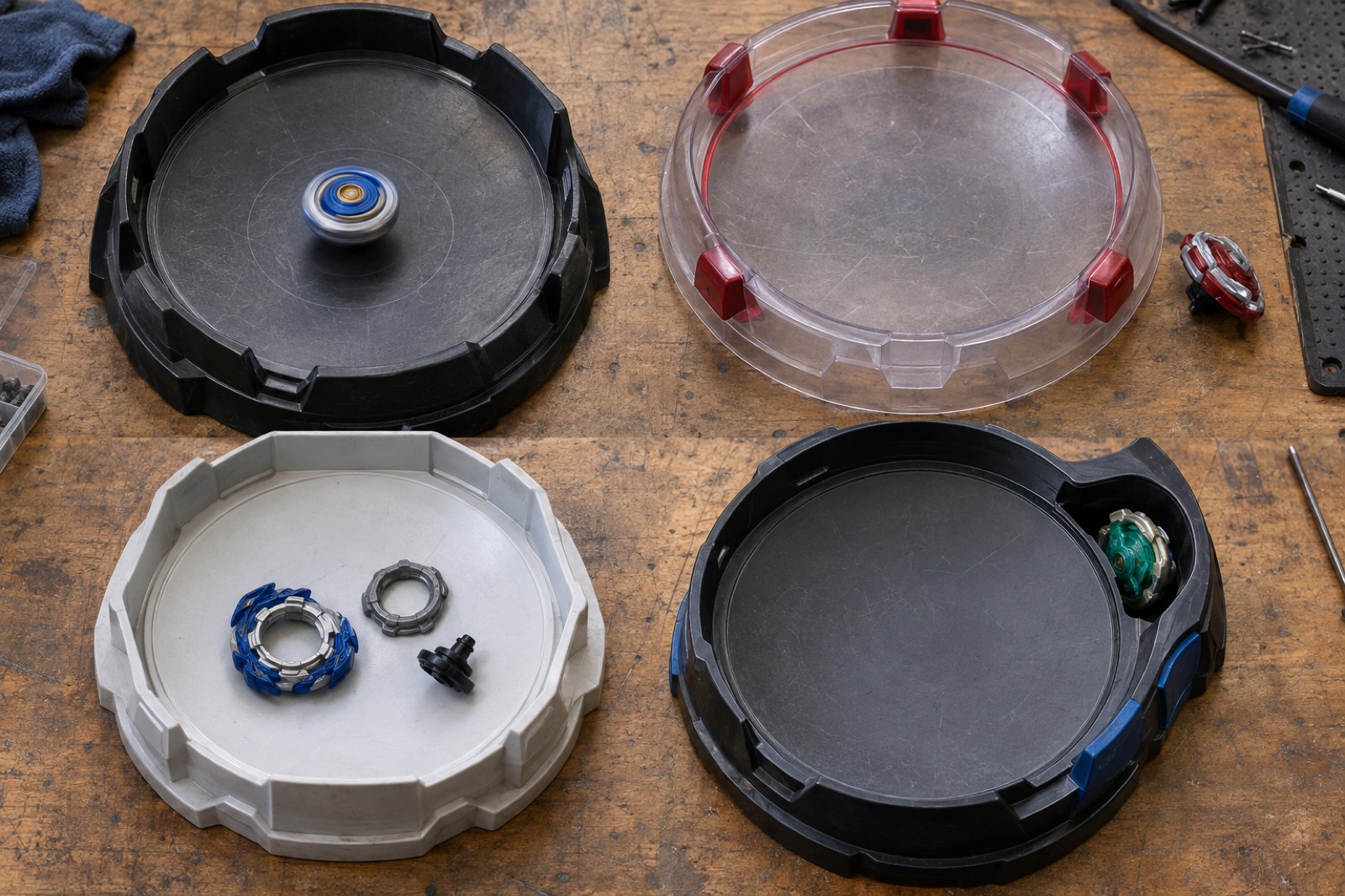
The arena also needs to be identified properly. Takara Tomy’s current regulations illustrate different layouts for the standard Extreme, Wide Extreme and Infinity stadiums. Their pocket positions are not interchangeable diagrams. Before assigning a finish, locate the marked zones in the instructions for the stadium being used; do not assume that “the opening at the front” always has the same meaning. The official event hub links the current regulations.
In an anime scene, the useful habit is simply to keep the arena in view mentally. Where is the danger area? What movement brought the Bey towards it? Then let the announced result settle the score. You do not have to pause every collision or pretend to referee a sequence that has deliberately been edited for drama.
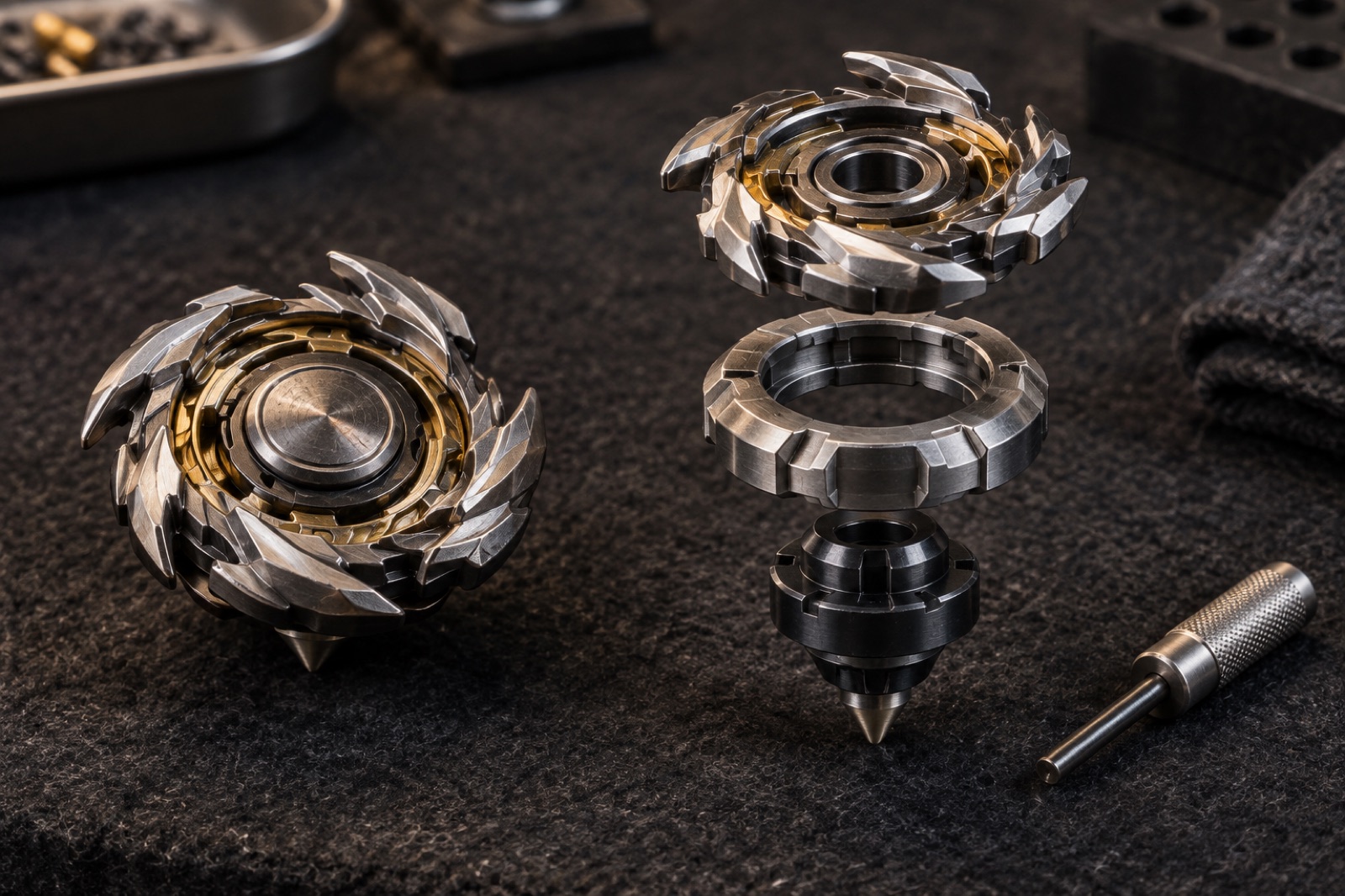
A name such as Scythe Incendio 4-60T can look like a character name followed by a strength rating. For the basic combination, it is more helpful to separate it into three identities: the blade, the ratchet and the bit.
Takara Tomy’s beginner guide and component diagrams explain those three roles. The blade is the main contact part; the ratchet is the middle component that affects height and how the assembly sits; the bit is the tip component associated with movement. The guide also shows how the component names form the complete Bey name.
Use that as an identification skill before attempting a ranking. In the example, Scythe Incendio identifies the blade, 4-60 the ratchet and T the bit. Writing down only “Incendio” leaves out two parts of the combination. Writing down only the final letter leaves out the rest.
The code is not a single numerical score. You should not read 4-80 as “twenty points better” than 4-60, or decide that a higher-looking number must be more advanced. Part identity and competitive quality answer different questions.
The official season-one Bey descriptions provide approachable examples: Sword Dran 3-60F is presented as Attack, Helm Knight 3-80N as Defense, Arrow Wizard 4-80B as Stamina, and Scythe Incendio 4-60T as Balance. The accompanying tip descriptions include flat, needle, ball and tapered forms respectively.
These labels give you an initial expectation, not a guaranteed outcome. Think of Attack as a prompt to look for effective contact, Defense as a prompt to examine resistance to the opponent’s plan, and Stamina as a prompt to notice what happens when the contest continues. Balance invites the question of which compromise the combination is trying to make.
“Balance” should not be translated into “best at everything”. Nor does “Defense” promise that a Bey cannot be knocked out. A category helps organise your attention; it does not replace the battle.
For a beginner, a clear comparison might be: “This is the complete combination named on the package; what movement and finish did I actually see?” That is much more useful than attaching a permanent winner label to a character’s favourite Bey.
Customisation makes precise naming especially important. If someone changes a component, the resulting setup is no longer fully described by the original packaged combination. An online claim about one build may be irrelevant to another build using the same blade. Ask for the full combination and stadium before treating the claim as advice for yours.
The three-part explanation is deliberately a starting point. Current X products include more elaborate blade constructions, so do not insist that every modern product must separate into exactly the same three loose pieces. Read the instructions for that model. Knowing the basic roles should make a newer design easier to investigate, not encourage forcing unfamiliar parts together.
The bridge from anime to equipment is clearest when the story treats the Bey as something to understand, not merely unveil. The official episode-nine synopsis describes Multi using Beycrafting to help Robin improve, with a café exhibition providing a place to try his new Bey.
That premise shifts the question from “what did he acquire?” to “what is this supposed to help him do?” It is a valuable distinction for viewers who enjoy the products but do not want every discussion reduced to buying the next release. A change needs a purpose before its result means anything.
This is also a way to appreciate Multi without making the article a list of character biographies. Her contribution makes another person’s development part of the team story. The support work around a battle can be interesting even when the supporter is not the person launching.
The limitation is important: story Beycrafting is not a manufacturer’s permission to modify physical toys. A narrative breakthrough may be emotionally satisfying without supplying a repeatable engineering explanation. Enjoy that dramatic language, but use the real instructions for assembly and permitted component changes.
Likewise, a named attack or a creature visualisation should not be read as a measured product specification. The anime can communicate confidence, threat or a change in momentum through images that a real stadium cannot reproduce. That does not make the physical hobby disappointing. It gives you two related pleasures: a story in which a battle means something to its characters, and an observable game in which the finish can surprise you.
If you enjoy this relationship between rules and drama, our Haikyu!! guide to volleyball, rotation and the libero explores another series where understanding the activity makes the character decisions easier to follow. The point in both cases is better viewing, not turning an episode into an exam.
You do not need a large collection to begin learning. A useful first question is narrow: “Can I correctly recognise the finish and keep the match score?” That is already more informative than repeatedly launching and declaring the latest winner unbeatable.
First, make the play area safe. Follow the exact manufacturer’s assembly, launcher and age guidance. For Hasbro’s F9588 set, the instructions say to use X tops with an X Beystadium, not to lean over the arena during play, and not to place the stadium on a table or another elevated surface. Keep hands out while the tops are moving. The product is labelled ages eight and up; its small parts are unsuitable for children under three. These are practical constraints, not optional tournament etiquette. See the manufacturer’s instructions.
Once the equipment is correctly set up, agree which rules you are following and identify each scoring zone before the first launch. If two beginners are using different names for a finish, settle the vocabulary at the start. It is easier than arguing over a result while one person has already picked up the tops.
For a small observation session, keep a simple record: complete combinations, stadium, finish, points and running total. “A won” misses the information that distinguishes a one-point result from a three-point result. You do not need launch-speed estimates or an elaborate spreadsheet.
An optional second question could be whether a permitted component change appears to alter the kind of finish you see. Keep the comparison modest. Changing the bit, ratchet, opponent and stadium all at once leaves no clear explanation for the difference. Even with one deliberate change, a handful of launches is only an observation, not proof of a universal advantage.
For example, six wins in ten trials is 60% of that small sample. It is not evidence that the combination has a 60% chance against every opponent, in every stadium, with every player. Record what happened without promoting it into a worldwide ranking. This hypothetical calculation is about reading your own notes honestly, not prescribing a scientifically sufficient test size.
A burst also needs to be understood correctly. Separation through the intended mechanism is a game outcome; cracked or otherwise damaged parts are not a desirable “stronger burst”. Stop using damaged equipment and follow the maker’s guidance. Do not glue parts, add weight or disable a mechanism to chase a screen effect.
The most useful first purchase is the one that completes a playable setup for your circumstances. A top by itself may be enough if a friend already has compatible equipment and you have agreed how to play. It is not enough if you also need a launcher and stadium.
Check the actual contents list rather than assuming that “set”, “starter” and “booster” mean the same thing. The F9588 example contains a stadium, two right-spinning tops and two launchers. That makes it a useful illustration of a two-person setup, not a claim that it is the best-value or currently available option in India. An overseas official listing establishes specifications, not Indian stock, delivery costs or warranty arrangements.
Similarly, a familiar Beyblade logo is not proof of cross-generation compatibility. Takara Tomy’s beginner guidance specifically separates X from earlier systems such as Burst. An old top or launcher should not be forced into service because it looks approximately right. Match the actual system and the manufacturer’s compatibility information.
For a fan gathering, practical questions beat vague enthusiasm: which stadium is being used, are newcomers welcome, is equipment available to borrow, and what rules apply? If it is advertised as a tournament, ask the organiser for the current eligibility and equipment policy. A Japanese rules document is useful background; it is not proof that an Indian event uses that document unchanged or accepts every imported product.
One naming trap is worth avoiding: Takara Tomy’s 3-on-3 deck format refers to two players each bringing an ordered selection of three Beys. It is not simply three people launching simultaneously. The regulations distinguish that from multi-player formats. Check what an organiser means before arriving with the wrong expectation.
For watching rather than playing, check the Indian catalogue of the service you intend to use. An official website’s US streaming table does not establish availability in India, and language tracks can differ. Our legal anime viewing guide for India explains how to check the region, title and language without relying on an old global platform list.
Beyblade X becomes easier to enjoy when you stop asking one object to explain everything. The character supplies a goal. The combination supplies a physical setup. The stadium supplies the space, and the scoring system decides what the result is worth.
On your next episode, watch for the finish before judging the whole match. On your first real session, identify the complete combination and the correct zones before launching. That is enough to move beyond “the faster-looking one should win”—and to notice why a small spinning top can support both a competitive game and a surprisingly expressive team story.
AUTHOR OF THIS ARTICLE
SoJapan
SoJapan India Pvt. Ltd. is a Japanese-founded company based in Gurugram. We bring Japanese food, anime goods and apparel materials to Indian businesses, with a sister company in Kyoto that works directly with makers in Japan.