Finding a spaceship sounds like the end of a survival problem. In Astra Lost in Space, it is a better place to begin asking questions. A vehicle can offer shelter and movement without making the distance home manageable. The passengers still need a reason to believe they can complete the next part of the journey.
Kenta Shinohara’s story starts with a school trip that goes catastrophically off course. VIZ describes eight high-school students and a child stranded about 5,000 light-years from home. Its first-volume introduction adds the crucial opportunity: they find an empty spaceship. That is the premise, not the explanation of what happened to them. VIZ series introduction · VIZ volume 1
It is tempting to watch everything after that as a hunt for clues. Who knows something? Which detail will matter later? Those are reasonable questions, but they can make the actual travelling feel like a delay before the answers. This guide proposes another way in: follow what makes the next stage possible. Supplies, useful knowledge and the ability to live together deserve attention before you know where the mystery leads.
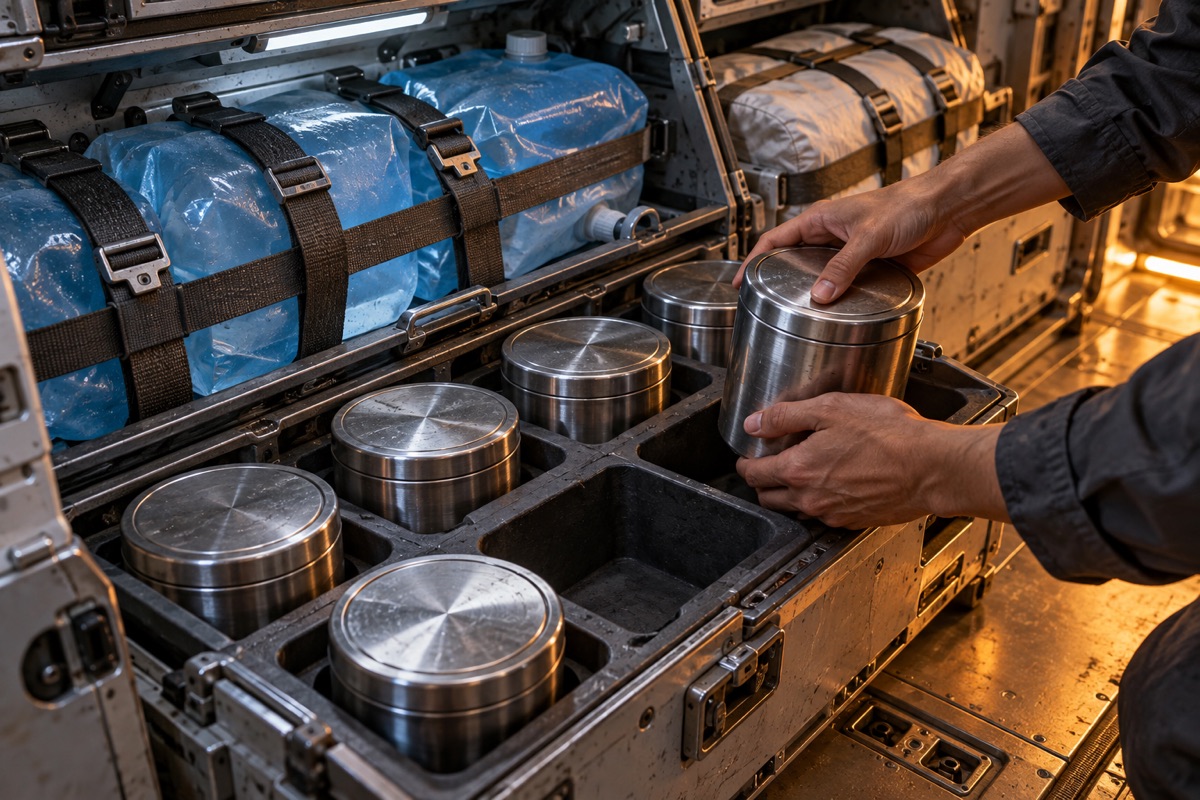
The official synopsis for episode 2, “WILDERNESS,” gives the first resupply visit a concrete objective: obtain twenty days of food and water. The destination has an unfamiliar ecosystem, so arrival alone is not success. Official episode 2 synopsis; archive contains later spoilers
That is a small but useful shift in scale. An enormous distance is difficult to imagine doing anything about. A supply target has a practical shape. It makes a landing relevant to the onward trip rather than merely providing an exotic background for an episode.
Our reading is that the series becomes easier to follow when you separate the destination from the condition for leaving it. “They have reached a planet” answers where the group is. It does not answer whether the visit has made the next leg possible. Watch for the moment when those two answers begin to align.
This is also a useful way to judge the pacing for yourself. An exploration sequence can move the journey forward without moving the ship. Conversely, an impressive departure can leave a practical question unresolved. Progress need not be measured only in changes of location.
Do not turn the number into homework. You do not need to invent calorie allowances, calculate a cargo mass or construct a realistic interstellar flight plan to enjoy this premise. None of those quantities follows from a short synopsis. The point is the existence of an objective that can be met, not a claim that the anime supplies a complete engineering model.
The opening cast can initially look like a collection of ready-made functions. The official profiles give Kanata athletic and survival abilities; Zack has mechanical knowledge and a piloting licence; Quitterie is studying medicine; Charce knows biology. Those descriptions establish different starting points, not interchangeable forms of expertise. In particular, “studying medicine” should not be inflated into “qualified doctor.” Official character profiles
For a first watch, resist turning those abilities into a ranking. A person can know a great deal about one part of a problem and still need someone else’s contribution before anything useful happens. The interesting unit is often the connection between abilities, rather than the most impressive individual.
Consider a deliberately hypothetical expedition, not an additional scene from the anime. One person can identify a promising place to search. Another can reach it. Someone else can work out whether the finds can be carried back. Picking a single “most useful” person would hide how the result depends on the handovers. This is the kind of connection worth noticing in a group adventure.
There is a trap in calling a fictional group “balanced.” It can make people sound like equipment chosen to fill vacant slots. A cast also needs room to be irritating, uncertain, funny or quiet without those qualities being treated as defects in its operating system. A character’s value is not exhausted by whether a particular emergency happens to need their specialty.
For comparison, our Space Brothers guide approaches a different question: what selection situations allow candidates and observers to learn about one another. Here, the proposed viewing lens is not who would pass an assessment. It is how a group already in trouble can make use of what its members know.
The official early glossary describes a device Zack builds from spare parts to test whether food is edible. A positive result produces a smiling symbol and his recorded “Yummy!” The same object has a practical function and an unmistakably personal flourish. Official episode 2 glossary; later spoilers elsewhere on the page
This is a fictional convenience, not a real method for deciding whether an unfamiliar plant is safe. Its value for a viewer is different: it shows how the story can simplify one technical obstacle while leaving people with other decisions to make.
An invented yes-or-no indicator is an efficient storytelling shortcut. It can settle suitability without settling quantity or the effort needed to collect something. That is a general distinction, not an additional specification for Zack’s device. It explains why accepting a fictional tool need not make every practical question disappear.
The more productive question is therefore: what uncertainty has the story chosen to remove? Once you recognise the shortcut, you can give your attention to the uncertainty it leaves in play. You need not demand a laboratory demonstration from every prop, or excuse an inconsistency that you actually notice. Accepting a fictional premise and paying attention to its consequences are compatible habits.
The recorded voice is a particularly economical detail. A tool need not be visually elaborate to carry a trace of its maker. Our interpretation is that this small joke helps keep the practical side of the voyage attached to a person. It is not just an anonymous box delivering the answer the plot requires.
If your main interest is the relationship between space technology, paid work and institutional responsibility, our Planetes guide is the closer companion. The distinction is one of viewing interests, not a declaration that all space anime should satisfy the same realism test.
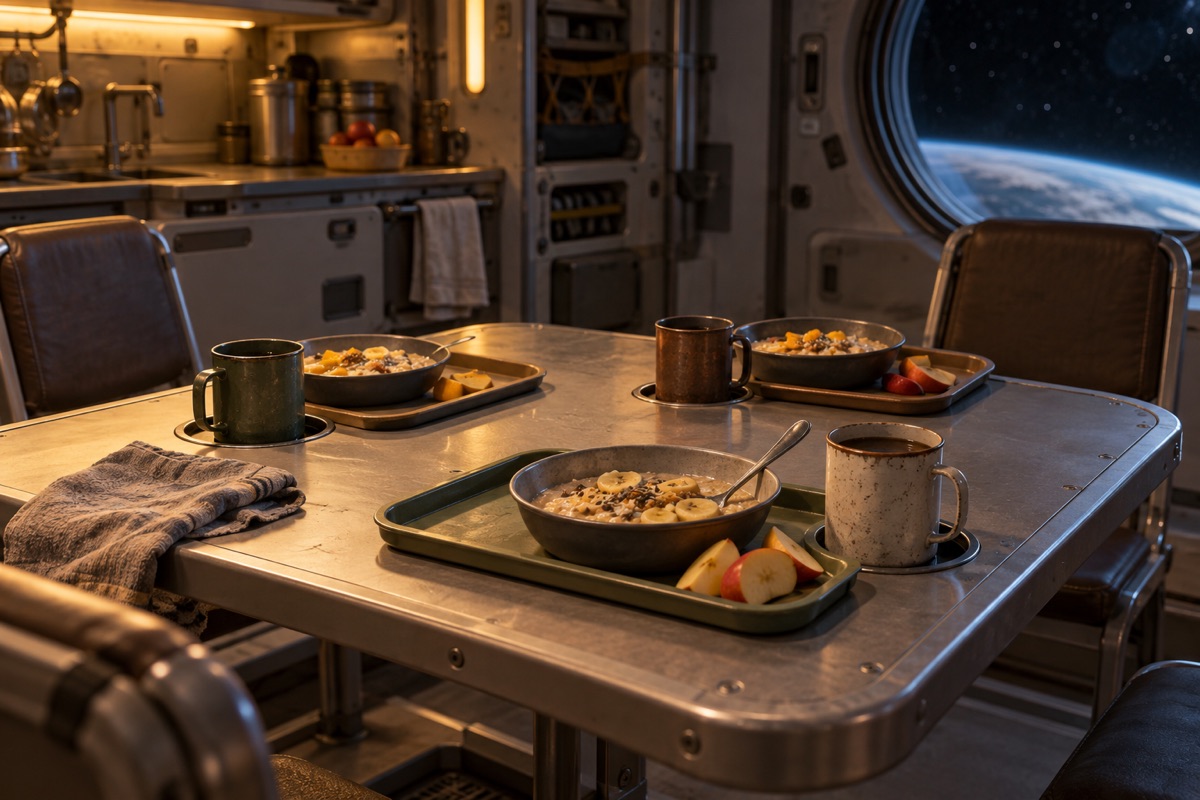
The episode 3 glossary records a shipboard routine: a shared breakfast, time for assigned work and hobbies, and lights-out, organised around a twenty-four-hour day. Official onboard rules; episode archive contains major spoilers
A timetable is easy to overlook next to a crisis. Yet it gives you another way to imagine the ship: as a place people have to occupy repeatedly, not only a control room from which the next exciting event begins.
The revealing distinction is between being rescued from one immediate danger and having a life that can continue tomorrow. A shared routine belongs to the second problem. Our editorial reading is that ordinary time deserves its own attention here. It need not be dismissed as filler just because it does not produce a new destination or a dramatic answer.
That does not mean every relaxed exchange must be decoded. Sometimes the useful thing is to notice a change in conversational ease, or simply to enjoy the company for a moment. Requiring every joke to be evidence can make a mystery exhausting to watch. It also removes the possibility that the people are worth spending time with before their secrets are understood.
Nor should a schedule be mistaken for proof that everyone feels equally comfortable. A routine describes an arrangement. Belonging to the group is an experience. Those can develop at different speeds, and the distinction gives you something to attend to without anticipating any particular character’s later story.
The hopeful energy is not something a viewer has to explain away as an accidental mismatch with danger. Director Masaomi Ando discussed it directly. In Sokoani’s October 2019 interview summary, he describes wanting an engaging youthful adventure at the outset and an emotional resting point or sense of achievement within each episode, even when unease remained. Ando interview; substantial ending spoilers
That distinction—some satisfaction without complete reassurance—is a good reason not to judge an episode solely by its final unanswered question. A cliffhanger and a worthwhile piece of progress can coexist. You can be glad about something the group has managed while still wanting to know what comes next.
There is a visual counterweight to that energy. In an October 2019 interview with Cho! Animedia, Ando discusses the black bands above and below the image: alongside a cinematic aspect, he wanted a constricted frame to retain a sense of danger even while the characters stayed positive. That is one of his stated intentions, not a rule for decoding every shot. Director interview; major ending spoilers
This offers a concrete thing to notice without hunting clues. The characters’ energy and the space the image gives them need not communicate the same feeling. A cheerful voice can coexist with an enclosing composition. You can respond to both without deciding that one cancels the other. The interview goes on to discuss later uses of the framing, which this guide deliberately leaves alone.
A separate WebNewtype interview offers another useful detail. Ando credits the performances with adding dimension to the characters, while series-composition writer Norimitsu Kaiho says the manga voices he imagined had been quieter; the cast’s energy helped him recognise the anime’s brightness. These are the creators’ comments about performance, not a claim that one language track is the only valid way to watch. Ando and Kaiho interview, September 2019; major finale spoilers
Try listening for the difference between the information a line supplies and the attitude its delivery gives you. A practical statement can also sound eager, defensive, awkward or amused. You do not need to study voice acting formally to hear that difference, and you do not need to anticipate where the plot is heading to enjoy it.
Ando also identifies an adaptation problem in the Cho! Animedia interview: a manga reader controls the speed of reading, whereas the anime presents information at its own pace. Dense spoken information had to remain understandable. This is a useful distinction if you enjoy the premise but find an explanation moving too quickly. Pausing or replaying an exchange is not failing to appreciate the adventure; the two media ask you to process information differently. Ando on adapting the dialogue; spoiler-heavy interview
If you are about to begin, you already have enough orientation. There is no need to learn a complete character chart or read a chronological account of the mystery first. Those aids can answer questions that the story has not yet invited you to ask.
The biggest practical spoiler risk in the sources above is the official episode archive itself. It presents later material as well as early synopses. The production interviews were also published after the original broadcast had finished and openly discuss the ending. They are useful evidence for this article, but they are not safe pre-watch browsing simply because they are primary sources.
For a reader in India, this guide does not certify a current streaming service, language option or subscription tier. Check the title in the licensed service you can actually access before paying. A historical Japanese broadcast listing or a page visible in another country does not establish the catalogue available to your account.
The English manga is another entry point identified by VIZ’s volume 1 page above, not evidence of Indian stock or a local price. If you choose the anime first, avoid browsing later-volume descriptions just to find out how much material exists. Product summaries can disclose far more than their covers suggest.
The approach proposed here is simple enough to carry into an episode without taking notes: ask what has become possible by the time it ends. Perhaps your attention stays with a practical step; perhaps it stays with an exchange between people. Neither requires you to solve the mystery ahead of the characters.
An empty spaceship creates an opportunity. A journey is what people manage to do with it. Astra Lost in Space is worth approaching with room for both that adventure and the unanswered questions around it.

AUTHOR OF THIS ARTICLE
SoJapan
SoJapan India Pvt. Ltd. is a Japanese-founded company based in Gurugram. We bring Japanese food, anime goods and apparel materials to Indian businesses, with a sister company in Kyoto that works directly with makers in Japan.