Makoto can be a witch and still need someone to show her around. That is the inviting contradiction at the beginning of Flying Witch. A magical identity does not cancel the awkwardness of moving into someone else’s home, meeting their friends or discovering that a familiar place is full of things you do not recognise.
If you have come from an anime about magical academies, it helps to change the question. Instead of asking which lesson will unlock the next power, ask who knows how to handle the situation in front of them. The answer can be the witch, her younger relative, her classmate or the person who knows what grows nearby.
This is a guide to that shared-home appeal, especially for Indian anime fans deciding whether a quieter fantasy is their kind of show. It explains the early character relationships and how the story brings magic into ordinary routines, without recapping the whole series.
Spoiler boundary: premise, character introductions and selected situations from episodes one to three. Later adventures and outcomes are left alone. The linked official character pages and interview may mention material beyond this boundary. Interpretations are our editorial readings, not claims about the author’s intentions. This article does not establish current streaming availability in India.
The official introduction describes a witch custom: at fifteen, a young witch leaves home to become independent. Makoto’s move to Aomori begins that process. It is a rule of this fictional world, not a description of what Japanese teenagers generally do. Official introduction.
The interesting word is independent. We often picture independence as having an entire space under our own control. A story can complicate that without abandoning it. Learning to live away from your parents may involve accepting help from other people, recognising what you cannot yet do and becoming a considerate member of a different household.
Makoto moves in with the Kuramoto family, relatives who include Kei and his younger sister Chinatsu. Her familiar, the cat Chito, comes too. High school is part of her new life; Kei introduces her to their classmate Nao. The opening therefore supplies several overlapping connections rather than separating school, family and magic into sealed compartments. Official episode-one synopsis.
That arrangement gives the viewer a useful starting map. Makoto is the newcomer, but she is not arriving without any connections. Kei belongs to both the house and her school day. Chinatsu shares the house without sharing the same stage of education. Nao enters through an existing friendship rather than through a magical entrance examination.
It is worth resisting the assumption that the protagonist must be the most capable person in every room. Makoto’s official profile pairs her gentle, unhurried personality with a terrible sense of direction. Moving somewhere unfamiliar is therefore a genuine practical adjustment for her, even before any supernatural complication arises. Makoto’s official profile.
For a first-time viewer, the house is consequently a better anchor than an imagined syllabus. Learn who lives there and how they are connected. There is no need to turn every new detail into a clue about the highest possible level of magic. A newcomer can learn a place without conquering it.
Chinatsu does not begin by automatically accepting everything about the new arrival. In episode one, overhearing Makoto talking to Chito makes her wary. From Makoto’s position, the conversation belongs to normal life; from Chinatsu’s position, something needs explaining. The same moment therefore has two emotional meanings. Episode one’s introduction to the household.
The series does not need to make either person foolish for that gap to work. Familiarity is uneven. A behaviour can be ordinary to the person doing it and strange to the person encountering it for the first time. This is a more generous comic starting point than treating surprise as a defect that a child must immediately overcome.
Chinatsu’s profile calls her active and curious, and says meeting Makoto gives her an admiration for witches. It also includes a wonderfully small preference: she enjoys eating but dislikes bitter flavours. The profile does not reduce her to a permanent expression of wonder. Chinatsu’s official profile.
Those details belong together. A child can be enthusiastic about something spectacular and selective about dinner. Wonder does not erase taste, hesitation or stubbornness. When fantasy preserves those ordinary distinctions, a younger character feels less like an audience instruction to be amazed and more like someone with a life of her own.
The broom ride in the opening offers a concrete example of excitement. In the official interview after recording episode one, Chinatsu’s actor Eri Suzuki describes performing the child’s delight with improvised reactions and simple language. She also points to the way Chinatsu opens up to Makoto. Official first-episode cast interview.
A useful distinction here is between understanding a fact and trusting a person. Discovering that magic exists is one kind of change. Becoming comfortable around a new housemate is another. A story can connect them without making them identical: knowing somebody has an unusual ability does not tell you everything about what spending time with them will feel like.
Chito also deserves more than a mental label saying “witch’s accessory.” The official profile describes a seventeen-year-old familiar, older than Makoto, who is intelligent and composed but also mischievous. Chito’s official profile. That combination allows a familiar to suggest company and experience without becoming a solemn instruction manual.
You do not need a complete theory of animal speech before following the opening. Start with the relationship the scene makes legible: Makoto is addressing a companion, while someone else is trying to make sense of that exchange. The difference in understanding is already enough to support the encounter.

Kei is Chinatsu’s older brother and Makoto’s classmate, the same age as Makoto. His profile emphasises household skills and an enjoyment of cooking. It also notes an uneasiness about ghosts and frightening stories. Calmness, in other words, is not the same thing as having no vulnerabilities. Kei’s official profile.
His place in the story is a good reason not to rank every character by supernatural ability. A household needs people who can do ordinary things well. Being able to make a meal or help a newcomer does not become less useful because someone else can fly. It changes what counts as competence in the scene.
Episode two puts local knowledge beside magical knowledge. Kei recognises bakke growing by the roadside and suggests taking some home after learning that Makoto has never eaten it. We are using the name given in the official synopsis, not offering plant-identification or foraging advice. Official episode-two synopsis.
The key point is who notices something and who encounters it as new. Makoto has moved to a place Kei already knows; the practical value of that familiarity comes into view.
This is where the household angle differs from a simple “witch surprises normal people” premise. That description would leave knowledge moving in only one direction. It is more interesting when the extraordinary newcomer also has reasons to listen.
Kei’s actor Shinsuke Sugawara similarly describes a character with several functions: comic exchanges, cooking and fieldwork, rather than a single permanent reaction to other people’s oddness. Official cast comments. That is a useful correction to the temptation to call a calm character merely the sensible one and stop looking.
The social world extends beyond the house, too. Nao’s profile identifies her as Makoto’s classmate and Kei’s childhood friend, and notes that she helps with her family’s shop for spending money. Nao’s official profile. Those connections give her a place in the town that predates Makoto’s arrival.
It makes a difference when a supporting character can be introduced without starting with their response to the protagonist. A friendship has history; a family has work to do. The newcomer joins that network. The town is not simply a waiting room full of people whose only purpose is to notice a witch.
For viewers unfamiliar with Aomori, it is fine to encounter a local word as something new. Understanding every regional reference in advance is not an admission requirement. Equally, an anime detail is not enough evidence for a real-world cultural generalisation. Enjoying the setting and making claims about daily life across Japan are different activities.
The early household receives more than one kind of visitor. Episode two introduces a figure responsible for bringing spring: he comes to greet Makoto after completing his seasonal work in Aomori. The official synopsis contrasts Makoto welcoming him as a witch with Chinatsu’s response. The episode-two visitor.
There is something distinctive about staging an extraordinary encounter as a call at somebody’s home. A greeting has familiar social questions attached to it: who has arrived, who recognises them, and who is comfortable letting them in? Those questions make the strangeness approachable without having to make the visitor visually or conceptually ordinary.
A supernatural character can therefore belong to a social world rather than exist only as an obstacle. “What does this visitor want?” is not necessarily the same question as “How will the hero defeat them?” The difference matters when deciding what kind of satisfaction to look for in a fantasy episode.
Episode three places a different kind of work beside magic. Makoto borrows a neglected field for vegetable growing as part of her studies, and Kei and Chinatsu help prepare the soil. Later, her travelling older sister Akane arrives and offers a simple magical exercise after discovering how little spellwork Makoto has been doing. Official episode-three synopsis.
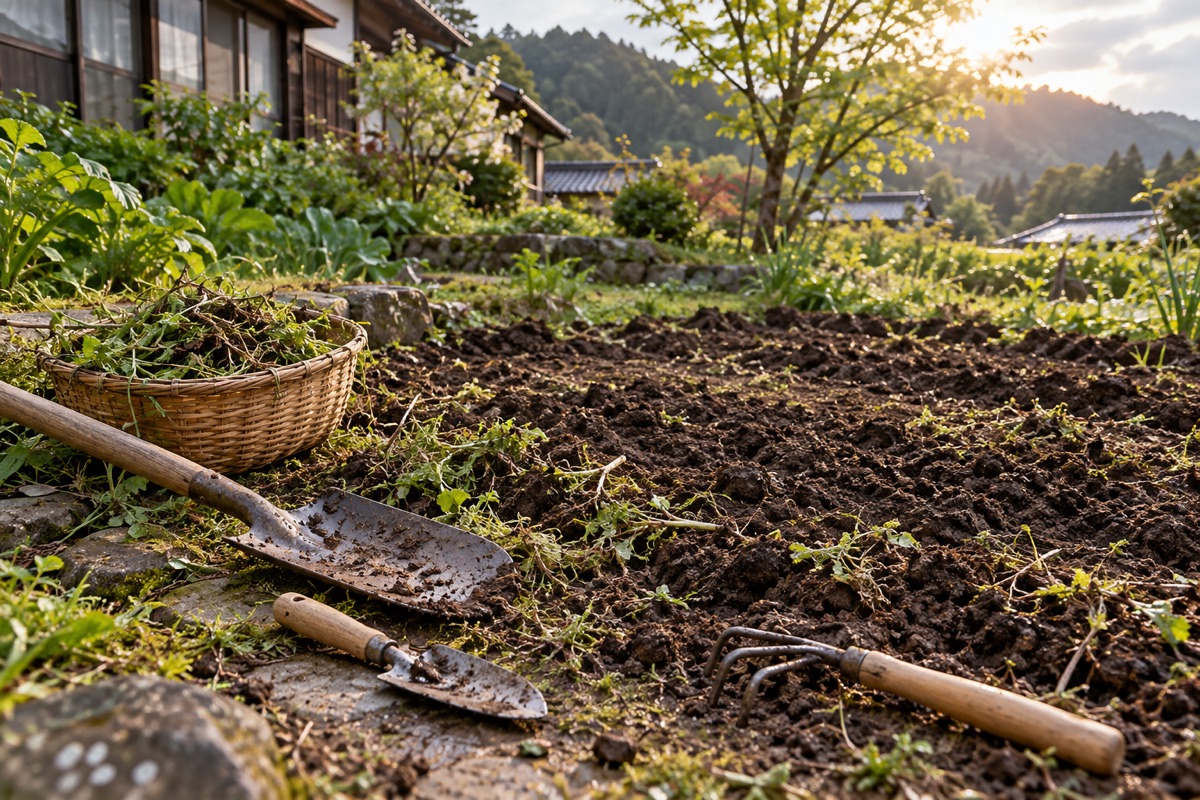
These are not interchangeable lessons. Preparing somewhere to grow food involves practical participation; learning a spell involves a different kind of instruction. Putting both inside the opening stages of training broadens the idea of what a witch’s life contains. It does not establish that every task has a hidden magical purpose, and the episode does not need that claim to make ordinary work worth watching.
Akane’s official profile supplies a contrast with her sister’s new settled arrangement: she is a talented witch with a reputation among witches, sociable and inclined to travel rather than remain in one place. Akane’s official profile.
That makes her useful to the story as more than a walking measure of Makoto’s progress. An experienced person can represent another way of living as well as another level of skill. A younger character’s future need not be a photocopy of an older sibling’s present.
This is also why “nothing happens” is an unhelpful shortcut for quiet storytelling. It confuses the size of an event with the existence of one. A greeting, a shared task and a lesson can all alter somebody’s experience without producing a crisis. Whether that scale holds your attention is a matter of taste, not a test of whether you understand anime correctly.
The atmosphere becomes more interesting when you stop expecting every character to be relaxed in exactly the same way. In the first-recording interview, Minami Shinoda says she was directed not to make Makoto match the other character’s energy in a particular scene. Together with Suzuki’s account of Chinatsu’s spontaneous excitement, that gives a concrete performance reason to pay attention to contrasts rather than only to gentleness. Cast interview on the opening recording.
This is not a claim that every exchange follows one rule. It is an invitation to listen for how two people can occupy the same moment differently. One may find an event familiar; the other may still be deciding what to make of it. If their responses were always identical, much of the personality would disappear.
Suzuki’s separate introductory cast comment also draws attention to small expressions and reactions within the peaceful setting. Official cast comments. The useful word for a viewer is small, not absent. A show can reduce the urgency of a situation while leaving room for surprise, uncertainty and comic disagreement.
For anyone watching with subtitles, it can help to let a scene finish before deciding what its joke was. The information in a line and the way another character receives it are different parts of the exchange. This is general viewing advice, not a claim about a particular subtitle edition or dub.
Nor does appreciating a soft-spoken fantasy require treating it as a wellness product. “I like spending time with these characters” is a sufficient judgment. The show does not have to cure stress, demonstrate a superior way of life or teach a universal philosophy to earn a place in your watchlist.
The official credits identify Chihiro Ishizuka’s manga as the source, Katsushi Sakurabi as director and J.C.STAFF as the animation studio. Those are useful attribution details; they are not evidence that every impression a viewer has was a deliberate, stated production goal. Official staff credits.
The strongest reason to try Flying Witch is an interest in how unusual people fit into familiar social situations. If meeting a housemate, getting to know a child or learning something from a classmate sounds like worthwhile story material, the opening gives you a clear way in. The magic adds another layer of familiarity and unfamiliarity rather than replacing those relationships.
If what you want tonight is a tightly escalating contest, a ladder of magical achievements or a plot that constantly forces the protagonist into urgent decisions, choose with that preference in mind. A quiet fantasy does not become better by being described as a disguised version of a different kind of show.
Our Little Witch Academia guide explores a contrasting question: what happens when a fan’s magical ambition meets a school and its expectations. That is a useful companion, not a prerequisite. The presence of witches is less revealing than what each story asks its newcomer to learn.
The contrast with Non Non Biyori’s mixed-age classroom is different. There, sharing a small school does not make everyone the same kind of classmate. Here, sharing a home does not give everyone the same relationship to the strange. Neither series needs to stand in for every possible story about rural life.
For an initial viewing, start at episode one and let the relationships establish themselves. The early material discussed here can answer a practical question about your own taste: are you interested in these people when nobody is asking them to save the world? There is no obligation to keep watching simply because a series has a reputation for being comfortable.
Makoto’s new life is appealing precisely because a witch is not all she is. She is also a relative, a classmate, a newcomer and somebody with things left to learn. Flying Witch’s shared home makes room for all of those roles. The door opens onto magic, but the people on either side still matter.

AUTHOR OF THIS ARTICLE
SoJapan
SoJapan India Pvt. Ltd. is a Japanese-founded company based in Gurugram. We bring Japanese food, anime goods and apparel materials to Indian businesses, with a sister company in Kyoto that works directly with makers in Japan.