One recipe tells you to shave the burdock. Another asks for fairly substantial strips. Both are called kinpira gobo. If you are learning Japanese cooking through recipes, that can look like a contradiction before the pan is even hot.
It is a useful clue instead: the name of a dish does not always specify its texture. Gobo is the burdock root used in these recipes, and the way it is cut helps decide whether a mouthful contains distinct little sticks, flexible shavings or a chunky piece to bite through. The cooking method has to make sense for that cut.
This guide compares published Japanese manufacturers’ methods rather than presenting a new, independently tested recipe. The aim is to help you recognise what a recipe is trying to achieve—and choose one that matches the burdock dish you want to eat.
Japanese cutting terms are more helpful when you treat them as descriptions of the pieces in front of you, rather than vocabulary to memorise. Kikkoman’s English introduction to cutting styles explains that shape affects flavour, mouthfeel and presentation. It describes sasagaki as pointed, bamboo-leaf-like shavings that interrupt burdock’s tough fibres and bring out its earthy aroma. The term is about the cut, not a separate variety of root. Kikkoman: cutting styles.
Three forms matter most for the comparison here. Think of the following as a recognition aid, not a rule assigning every dish to one shape.
On a small screen, swipe the comparison sideways. Keyboard users can focus the table region and use the arrow keys.
| Form | What you are looking at | A useful recipe direction |
|---|---|---|
| Fine strips | Separate narrow pieces, with thickness chosen deliberately. | A crisp-textured kinpira; check whether the recipe starts with diagonal slices. |
| Sasagaki | Thin, elongated shavings rather than square sticks. | A lighter-textured kinpira or cooked preparation where the pieces mingle with other ingredients. |
| Ran-giri | Chunks made by turning the root between angled cuts. | A simmered dish with recognisable, substantial pieces. |
Amano Foods’ illustrated cutting guide associates narrow strips with crispness, shavings with a more flexible cooked texture, and larger rolling-cut pieces with simmering. It also shows diagonal slices for soup. Those examples make a useful visual reference when a translated recipe simply says “cut the burdock.” Amano Foods: cuts and suggested dishes.
The distinction worth noticing is not whether the pieces look impressively neat. It is whether they resemble the input the recipe was written for. A bowl containing both paper-thin scraps and thick pieces is not the same starting point as a bowl of reasonably consistent strips. Calling them all “small” does not resolve the difference.
For a first attempt, choose one form and aim for consistency within it. That gives you a clearer reference when you judge the cooked result. You can decide whether you like a firmer bite without also wondering whether the pieces were accidentally different sizes.
Start by distinguishing soil removal from removing a thick outer layer. Hokuren’s Kitayasai guide recommends scrubbing or lightly scraping burdock, noting that its characteristic flavour and aroma are near the skin. It also shows that sasagaki can be made on a cutting board or with a peeler, rather than requiring the root to be held aloft throughout. Hokuren: preparing burdock.
That is a reassuring place to begin if a long root looks awkward. You do not need to imitate a fast demonstration or use a knife technique that feels unstable. Prepare a secure working space and choose a method you can control. The objective is usable pieces, not a performance of professional speed.
An English instruction such as “julienne” may describe the final stick shape without making the earlier cuts obvious. Kikkoman’s burdock basics demonstrates one method using approximately 5 cm lengths, cut into planks around 3 mm thick and then into narrow sticks. That is a specific illustrated method—not the only size that a burdock strip can be. Kikkoman: burdock preparation and cuts.
Before starting, look for three pieces of information: the length, the thickness and whether the first slices run diagonally across the root. If the recipe supplies photographs, use them alongside its wording. A direction to slice diagonally and then make strips is more informative than the word “julienne” alone.
Sasagaki is often explained through the motion of sharpening a pencil. Kikkoman’s illustrated explanation shows the blade lying against the root to shave thin pieces from the end, with a bowl of water ready to receive them. Kikkoman: burdock shavings.
The comparison describes a shaving action; it is not an instruction to produce one continuous ribbon. If you use a peeler, look at the result rather than assuming that the tool automatically makes the right shape. The pieces still need to suit the recipe you chose.
Do not struggle to shave the last small piece while your fingers approach the blade. Stop before your grip becomes insecure. There is no culinary advantage in turning an ordinary preparation step into a difficult balancing act.
Ran-giri is sometimes rendered in English as a random or rolling cut. The root is turned between diagonal cuts, producing differently angled faces. In Ajinomoto’s frying-pan chikuzenni, the burdock is cut this way into bite-sized pieces. Ajinomoto: frying-pan chikuzenni.
Read “random” as a description of the changing angles, not permission to mix tiny fragments with large sections. For a home cook, a more useful target is a group of pieces that belong in the same mouthful-sized family. The root may narrow along its length, so copying one spacing mechanically is not necessarily the best visual guide.
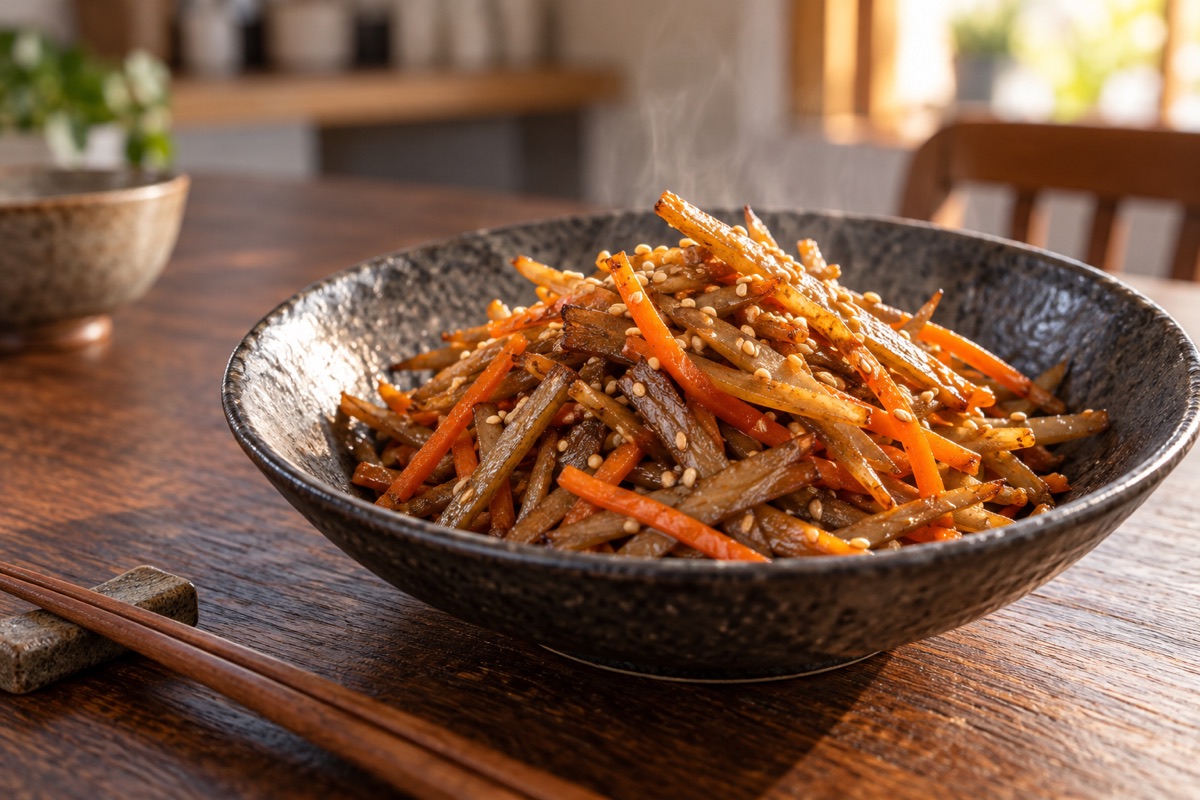
Here is the comparison that makes the cutting choices concrete. Two manufacturers publish kinpira methods with different preparations. Neither needs to be declared the winner; they give you different reference points.
Kikkoman’s detailed kinpira guide begins with diagonal slices about 5 mm thick, then cuts these into strips about 5 mm wide. It calls this namasu-giri and deliberately retains a substantial bite. After roughly five minutes in plain water and draining, the burdock gets an initial two-to-three-minute period in the pan without constant stirring. Carrot follows, then the combined seasoning. These details belong to that particular recipe. Kikkoman: kinpira gobo.
Amano Foods’ kinpira starts instead with sasagaki burdock and carrot cut to a comparable size. Its method initially cooks them together over high heat until lightly browned, then lowers the heat and introduces sugar, soy sauce and mirin in stages. The linked page gives the full amounts and sequence. Amano Foods: kinpira method.
Put the two descriptions side by side and the important difference becomes clear: changing the cut is not the only change. The order of cooking and seasoning also differs. If you borrow the shavings from one method and the initial pan treatment from the other, you have made your own adaptation. That may be a perfectly reasonable experiment, but it is no longer a faithful attempt at either published recipe.
For a first kinpira, our editorial preference is to choose the photograph and cut that appeal to you, then follow that recipe all the way through. If substantial, individually visible strips are what attracted you, begin with the strip-based method. If you prefer the look of finer shavings mixed through the carrot, begin with the shaving-based one. This is a choice about the meal you want, not a test of authenticity.
Neither example justifies the claim that kinpira must always be cut to one exact thickness. Nor does it establish that every strip-based version should use the same timing. Use the examples to recognise meaningful differences between recipes, not to turn two published approaches into a new universal formula.
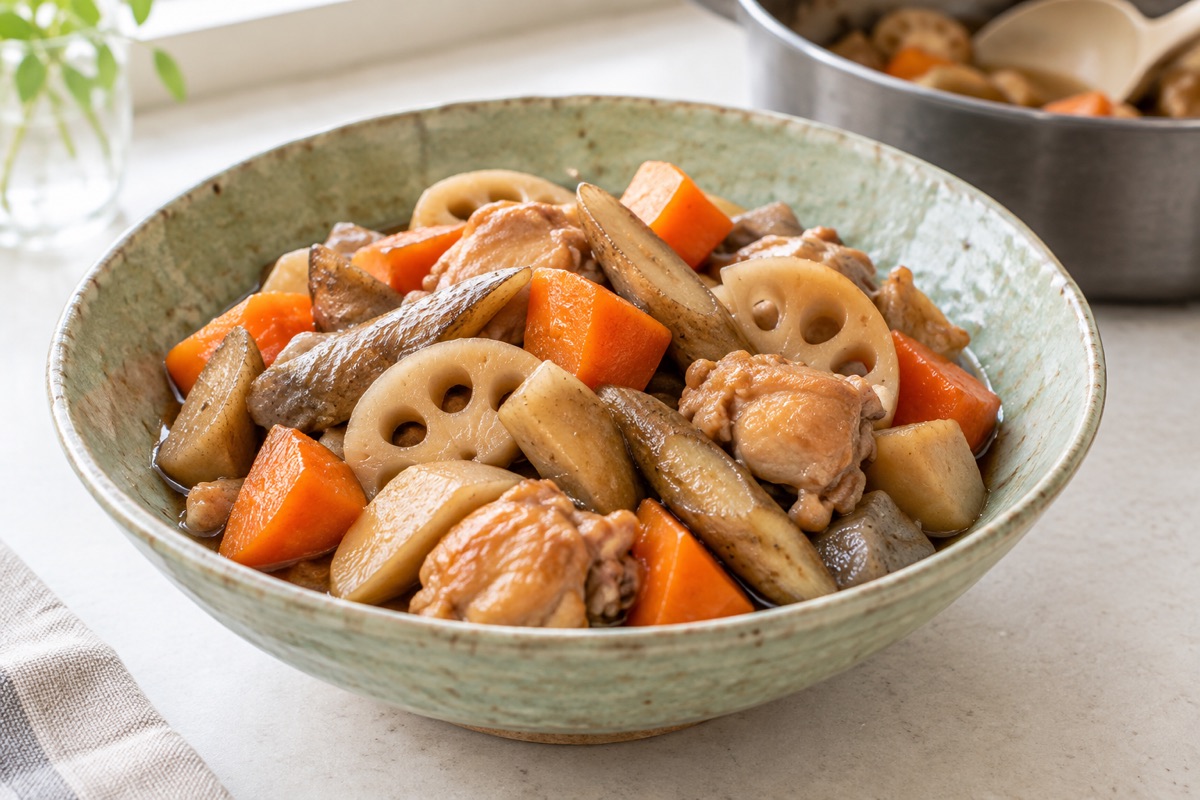
Now move from a small portion of kinpira to chikuzenni, a dish in which burdock joins other ingredients in a simmered preparation. The question changes from “How do I want these strips to eat?” to “How should this piece sit alongside the other pieces in the dish?”
Ajinomoto’s frying-pan version combines rolling-cut burdock with chicken, lotus root and carrot. After the initial frying, liquid and seasonings are added; the covered simmer lasts 10–15 minutes before a final uncovered reduction. That timing belongs to the full recipe, including its ingredient quantities and cuts. It is not a standalone instruction for any piece of burdock in any pan. Ajinomoto: ingredients and complete method.
Kikkoman’s chikuzenni offers an especially useful detail: it cuts burdock a little smaller than the carrot and lotus root, explaining that the burdock takes longer to cook. Its preparation also soaks the cut root for five minutes to manage the strong aroma and darkening of the shared cooking liquid. Kikkoman: chikuzenni preparation.
The editorial lesson is that “make everything the same size” can be too crude. The pieces need to work together in the finished dish, but that does not mean identical dimensions for every ingredient. When a recipe deliberately specifies a smaller burdock piece, that instruction deserves as much attention as the sauce.
This is also why a chunky cut cannot simply replace shavings while every later step stays fixed. Imagine, as a hypothetical adaptation, replacing the shaving-based kinpira’s prepared root with rolling-cut pieces. The recipe would now be receiving a different physical ingredient shape from the one its author described. Rather than guessing how many extra minutes will repair the mismatch, choose a recipe built for chunks.
If you are comparing this with oden, keep the dishes separate. Our oden ingredient and simmering guide looks at managing a mixed pot with different ingredient textures. Here the narrower issue is the burdock itself: its cut, its relative size and its role among the other pieces.
One of the least helpful ways to learn burdock preparation is to collect every soaking time you find and then try to average them. The instructions may be pursuing different results.
Hokuren explains that cut burdock darkens through oxidation on exposure to air. Water or vinegar water is used during preparation, but long soaking and repeated water changes can also remove flavour. That is a trade-off, not an invitation to keep soaking until nothing more changes colour. Hokuren: colour and soaking guidance.
For the strip-based kinpira discussed above, Kikkoman says plain water is sufficient and keeps the soak to about five minutes. Amano Foods’ separate sasagaki preparation page uses a roughly ten-minute vinegar-water method aimed at a whiter appearance. Read these as the publishers’ respective methods, not two measurements of one mandatory minimum. Kikkoman’s kinpira preparation; Amano Foods’ sasagaki preparation.
“Aku” is another word that can make translated instructions sound more alarming than intended. In the Amano preparation guide it concerns bitterness or harshness. A direction to remove aku should not be read as a promise that the ingredient needs every trace of its own character washed away, or as evidence that a longer soak is automatically better.
For the home cook, the useful sequence of questions is short. Does your chosen recipe specify plain or acidulated water? Does it give a duration? Is it trying to preserve a pale appearance, or to manage the effect on a shared cooking liquid? Read those details together before changing the preparation.
This guide is not establishing a food-safety soaking threshold. None of the recipe comparisons provides a universal sanitising time, and a colour change alone does not tell you whether an ingredient is safe. The discussion is about the published culinary preparation of burdock intended for cooking.
For readers in India, the most useful starting point is the ingredient and equipment you genuinely have, not an imagined shopping list. This article does not verify local stock or prices. If you do find culinary gobo, identify whether you have a whole root or a prepared product before choosing a method.
With a whole root, you can choose the cut yourself. With a packet of pre-cut pieces, that decision has partly been made already. Read the packet’s preparation and cooking directions; do not assume a washed, frozen or otherwise processed product should repeat every step written for a whole root. Nor should a photograph of the finished dish be treated as proof that two packets are interchangeable.
A useful recipe note has three lines: the form of burdock, the target cut, and the named recipe you intend to follow. For example, “whole culinary root; diagonal strips; the Kikkoman kinpira linked above” is a clear plan. “Burdock; any small pieces; whichever timing is shortest” is not. These are planning examples, not claims about a particular product for sale.
Check the rest of the dish too. The chikuzenni example uses chicken and a named dashi seasoning; it is not a vegetarian recipe merely because the vegetables occupy much of the ingredient list. If you avoid particular animal ingredients or alcohol-containing seasonings, select a complete recipe and products that meet your requirements. Do not assume that removing one visible ingredient makes the remaining dish suitable.
The same care applies to adjacent ingredients. If your chosen recipe includes konnyaku, its preparation is a separate decision; burdock’s cut does not answer it. Our konnyaku and shirataki preparation guide explains why the product and intended dish matter there.
Finally, “salad” does not necessarily mean raw burdock. Kikkoman’s burdock salad uses thick sticks that are boiled in vinegar water and cooled before dressing. That is a useful reminder to read the method, even when the finished dish appears uncooked. Kikkoman: burdock salad.
If the finished dish does not match your expectations, first describe the problem precisely. “Not quite right” is difficult to act on. “Some pieces are pleasantly firm and others are awkwardly thick” gives you a preparation question. “The pieces are consistent, but I wanted a finer texture” gives you a recipe-selection question.
These observations are not diagnoses that one particular mistake must have occurred. They are a way to decide what to inspect before changing several things at once.
There is no need to change all four aspects on the next attempt. The aim is to learn something repeatable about your own preference without inventing a new recipe every time.
For a first dish, choose between the two kinpira references or follow a complete chunky simmered preparation. Look at the pieces the author starts with, prepare those pieces deliberately, and keep the rest of the method attached to them. Once you recognise the cut, the long brown root becomes a much more understandable ingredient—and the first decision happens on the chopping board, before the seasoning reaches the pan.

AUTHOR OF THIS ARTICLE
SoJapan
SoJapan India Pvt. Ltd. is a Japanese-founded company based in Gurugram. We bring Japanese food, anime goods and apparel materials to Indian businesses, with a sister company in Kyoto that works directly with makers in Japan.