The most useful words in an umeboshi recipe may be the small instruction beside its weight: pits removed. They tell you what actually belongs on the scale—and what should never disappear into the sauce.
Umeboshi can move from a whole Japanese pickled plum beside rice to minced flesh in pasta or a component of a dressing. That does not make every plum, tube of paste and bottle of sauce interchangeable. Pitting changes the usable quantity. A tube may contain extra seasonings. A finished dressing includes ingredients that were never part of the fruit.
For a concrete starting point, Kikkoman’s tofu and okra with umeboshi specifies 10g of umeboshi after removing the pits. That is an ingredient instruction, not a promise that any one plum—or 10g of anything labelled “ume”—will do the same job.
Three distinctions make cooking with it much easier:
This guide compares published recipes and current maker information, with practical editorial suggestions for adapting carefully. It is not a report of our own kitchen testing. For readers in India, the named products are examples to help interpret a packet, not claims about local stock, prices or delivery.
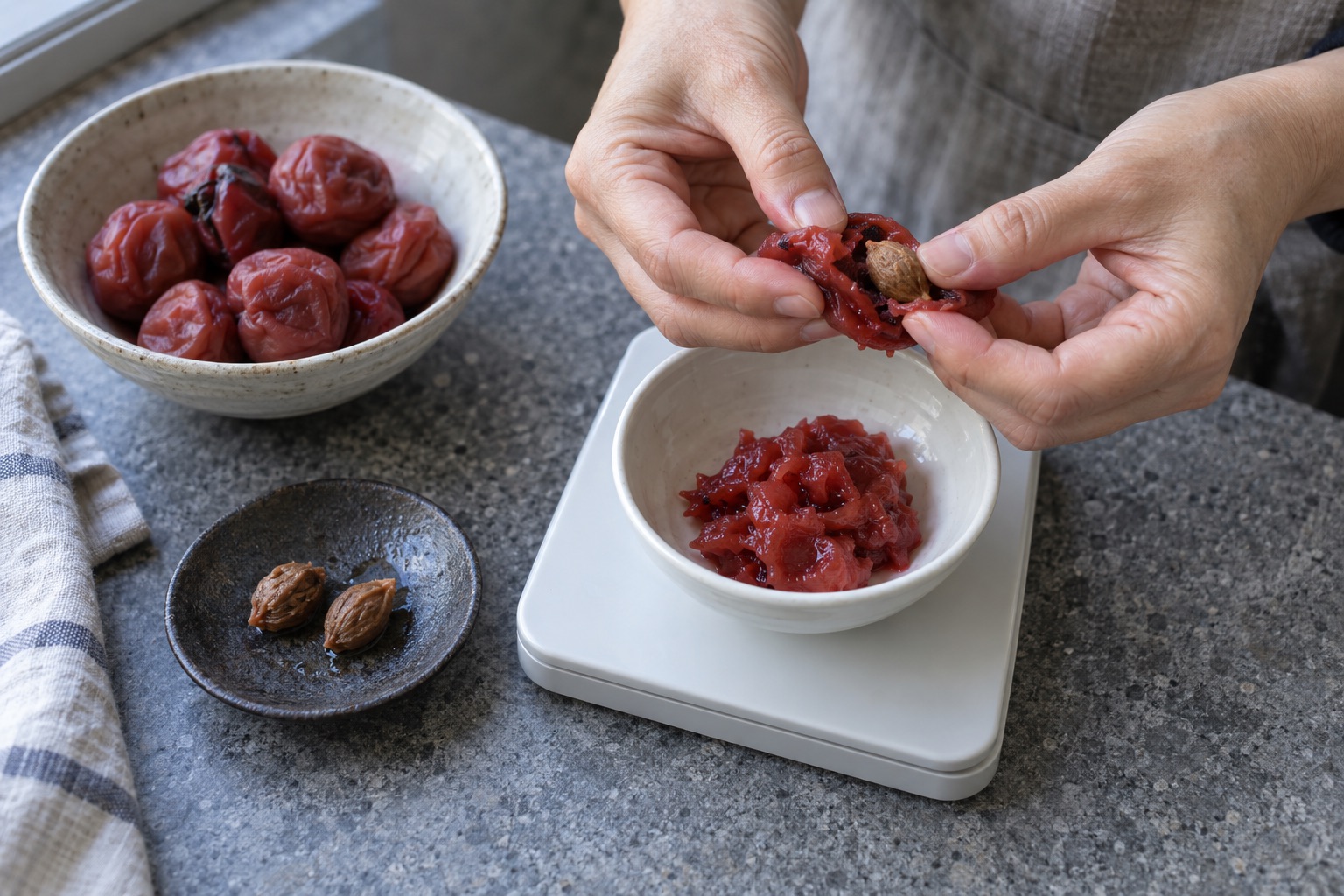
When a recipe gives a count, keep that count attached to its recipe. When it specifies pitted weight, measure the edible portion. The temptation to turn both into a single rule—one plum equals one spoonful—is understandable, but it erases information you may need later.
A whole fruit includes its pit. A spoonful depends on what fills the spoon: roughly chopped flesh, a smooth paste or a more liquid sauce. Even before discussing salt and sweetness, those are different objects to measure. A kitchen scale helps with a weight instruction; it cannot tell you whether you selected the right ingredient.
For a pitted-weight recipe, set a small bowl on the scale and zero it. Remove the pit, check that no hard fragments remain with the flesh, then weigh the portion required. If a recipe says to mince or mash it, do that as directed. Do not weigh an intact plum and count the discarded pit towards the requested flesh.
This is also a useful distinction when shopping. A pack’s net weight tells you about the product in the pack, not how many recipe portions of pitted flesh you will obtain. Unless the maker supplies that information, there is no reason to invent an edible-yield percentage. Use what you actually remove and measure.
Look at the handling in Kikkoman’s ume and ginger rice. The recipe calls for one umeboshi. It removes the pit, tears the flesh finely and loosens it with sake and soy sauce before it joins the rice and ginger. Water is then added to the rice cooker’s specified level. The pit is removed before cooking, not discovered afterwards at the table.
Our reading of that sequence is that the plum becomes part of the seasoning mixture. It is no longer simply a whole topping that each person can divide on their own plate. The method also accounts for liquid within the rice preparation; it does not invite an extra, unmeasured pour of sauce after the cooker has been filled.
The practical question is therefore not just “How many plums?” Ask, “Where does the flesh need to go?” A few pieces in a filling, minced fruit distributed through noodles and a smooth sauce poured over vegetables call for different handling. Follow the texture described in the recipe instead of assuming everything must become a perfectly smooth purée.
If you are making rice balls, the plum question is only part of the job. Our onigiri guide covers the separate issues of rice that holds together, filling moisture and nori. Adding umeboshi does not remove those requirements or make a finished lunchbox safe to leave unrefrigerated.
The word bainiku refers to the flesh with the umeboshi’s seed removed; House Foods explains that it can be further crushed for dishes such as sushi or dressed vegetables. Neri ume is a name you will encounter for ume paste. Those terms help identify the ingredient’s form, but they are not a complete ingredient list. See the maker’s ume product overview.
A tube can save you the pitting and chopping stage. That is a real convenience, especially when you want a small quantity for a dressing. It does not follow that squeezing more generously is harmless, or that two tubes have the same seasoning strength.
Consider two specific products, checked on 13 October 2026:
S&B’s 40g ume paste lists ume and salt as its ingredients. Its nutrition panel gives salt equivalent as 2.2g per 10g of product. The ten-gram basis matters; reading that as a figure per 100g would be a substantial mistake. This is a pitted, convenient ingredient, not an unsalted fruit purée. S&B product details
House Foods’ 160g neri ume includes, among other ingredients, shiso umezu, tamarind extract, bonito powder and bonito extract. The maker presents it as a seasoning that can make a dish without additional seasonings. It is a different proposition from the simple ume-and-salt example above. In particular, the bonito ingredients mean this specific product is not a vegetarian choice. House Foods product details
Neither example needs to become a verdict that one is “better.” A ready-seasoned paste may suit someone who wants to dress a dish with fewer separate ingredients. A simpler formulation may be easier to work into a recipe whose other seasonings are already specified. The choice depends on how much of the flavour-building you want the packet to do.
Match the exact product, not just the manufacturer’s logo. A brand can sell several ume products with different names, pack sizes and purposes. A nutrition panel or ingredient list for one is not evidence about the others. Check the packet in your hand, particularly if an online listing uses an old image or combines several variants.
For a vegetarian meal, inspect the paste and the rest of the recipe separately. A suitable plum ingredient does not settle what is in the stock, dressing or topping. Likewise, “plum” on the front of a blended seasoning is not enough to establish that its ingredients are all plant-derived. The specific fish-containing example above makes that a practical check, not an abstract warning.
Suppose a recipe was developed with a salty plum ingredient and you have a honey-seasoned version. It is tempting to add the same quantity and leave everything else untouched. That may be an experiment you choose to make, but it should be recognised as a change to the seasoning, not merely a change of packaging.
Nakata Foods describes making a salted, sun-dried base and then, for its seasoned umeboshi, desalting and soaking that base in a seasoning liquid. In that maker’s process, seasoning is not simply honey added on top of an otherwise unchanged plum. Nakata’s manufacturing explanation
Senrian’s 230g honey umeboshi provides a more specific label example. Its ingredient list includes honey, but also other sweetening ingredients, including sugar and sucralose. The nutrition panel lists salt equivalent as 6.3g per 100g. Those are facts about that particular product, not a definition of every honey umeboshi. Nor does the name tell you how much extra sweetness your recipe will need. Senrian’s product catalogue
The useful cooking distinction is between the flavour already in the plum and the flavour the recipe asks you to add elsewhere. If both contribute sweetness, blindly increasing the plum to chase more sourness may change sweetness too. If the recipe adds soy sauce, reducing the plum alone may not address the seasoning balance you are noticing.
Treat these as separate questions when assessing an adaptation:
The last distinction is especially useful. A separately mixed finishing sauce gives you a chance to assess a small portion with the food before using all of it. A seasoning already mixed into a pot of rice offers less room for that kind of adjustment. For a first encounter with an unfamiliar product, we would favour a use where the amount remains easy to control.
That is an editorial recommendation about learning the ingredient, not a newly tested recipe ratio. It does not mean honey-seasoned umeboshi cannot be cooked with, or that a saltier product is more authentic and therefore preferable. It means choosing a preparation that lets you understand what your particular product contributes.
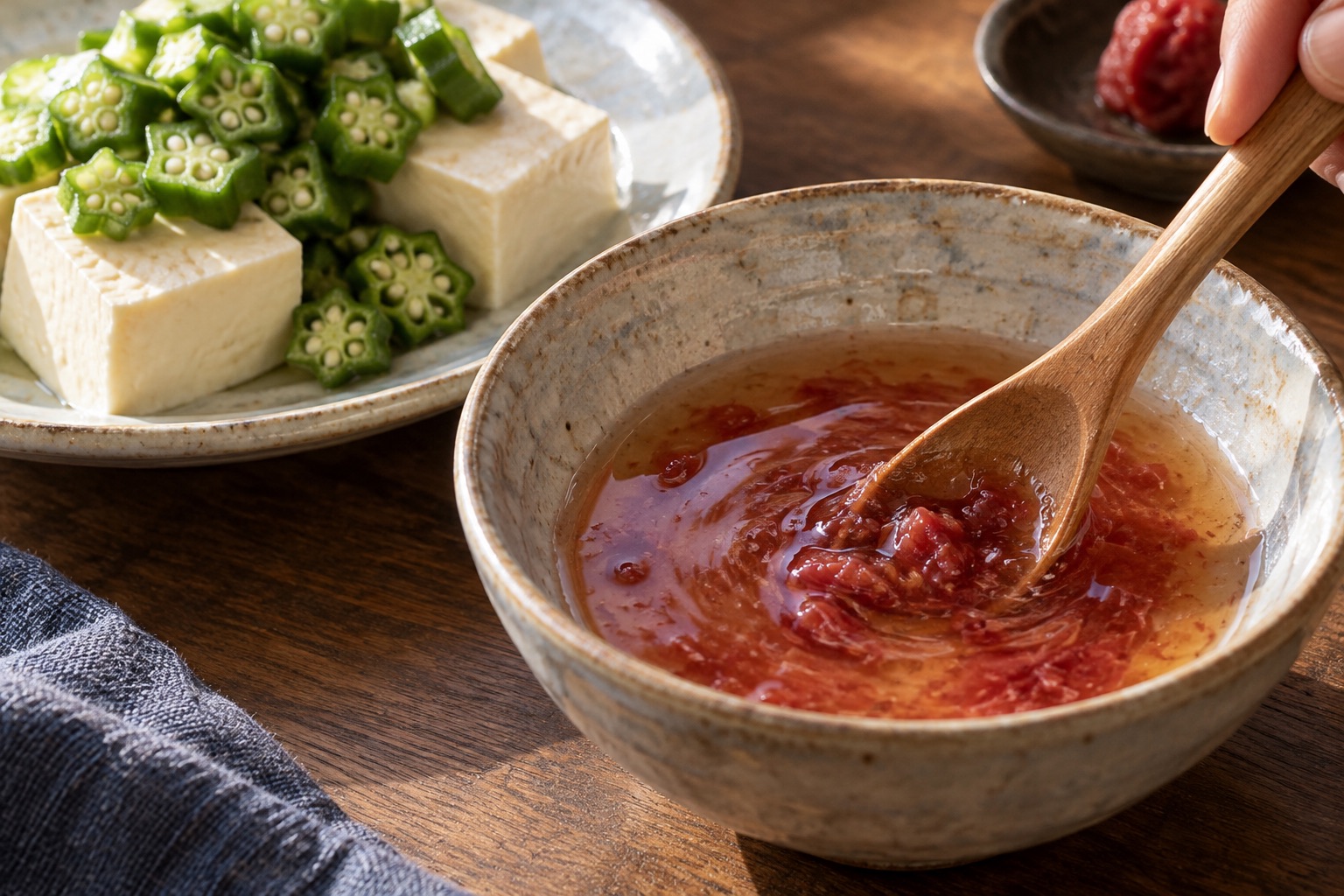
A recipe can ask for ume paste and still require several ingredients to make the sauce. This is the point at which an apparently sensible substitution often changes the dish: a cook replaces the specified paste with the same weight of a ready-made dressing, then adds all the dressing ingredients again.
Kikkoman’s nagaimo with ume sauce illustrates the distinction clearly. Its sauce combines 10g of neri ume with mirin, soy sauce, sake and bonito dashi. The resulting mixture is poured over the prepared vegetable. Ten grams is the ume component, not the weight of the finished sauce. The published combination also contains fish-derived dashi and alcohol ingredients; it should not be presented as vegetarian or alcohol-free.
Our practical conclusion is to check which stage you are buying. If the bottle already contains a dressing, look for directions for using that dressing. Do not assume it is the concentrated ingredient named in an unrelated recipe. Conversely, a paste that has not been made into a sauce may need the recipe’s liquid and other ingredients to reach the intended form.
Here is a compact way to keep those stages separate. The actions are reading and preparation checks, not universal substitution ratios.
| What you have | What is still unknown | What to check next |
|---|---|---|
| A whole umeboshi | The usable flesh after the pit is removed | Does the recipe specify a count or pitted weight? |
| Pitted flesh from your packet | How finely it should be prepared | Is it torn, minced, mashed or left in pieces? |
| A tube of ume paste | Its formulation, not merely its consistency | What salt, sweetening and other flavourings are present? |
| A prepared ume sauce | Whether it replaces a component or the whole sauce | Use its own directions before adding another recipe’s seasonings. |
Return to the tofu and okra example from the opening. The method drains the tofu and removes released liquid as needed after heating, before adding its umeboshi and shirodashi seasoning. That order matters to understanding what the sauce will meet. It is not simply “put plum into a bowl.”
The editorial lesson is to finish the preparation described for the food before judging its seasoning. If you skip a draining step and the dish seems watery, adding another spoonful of paste changes the ume quantity without correcting the skipped step. If you assess the seasoning on its own, you also miss what happens when it is eaten with the tofu or vegetables.
Try a representative bite of the finished, ready-to-eat combination when making flavour adjustments: the food, the coating and any intended topping together. A strong-tasting spoonful of concentrated paste does not establish that the dish is over-seasoned; a pleasant spoonful of sauce does not establish that enough has reached the food.
This is a different task from selecting a pickle to serve on the side. For that broader question, our Japanese pickles guide compares flavour and preparation styles. Here, the plum is helping season something else, so the combination is what you need to evaluate.
You do not need whole plums for every dish. Namiko Hirasawa Chen explicitly suggests neri ume as an alternative in her ume-shiso pasta. Her whole-plum method removes the pits and minces the flesh, then incorporates it with soy sauce and reserved pasta water before tossing with the noodles. Shiso and nori are finishing ingredients. The paste alternative saves an ingredient-preparation task; it does not remove the rest of the sauce-making sequence.
That is a useful kind of recipe to choose when you have paste: its creator has actually addressed the alternative. Follow the complete recipe and its adjustment guidance rather than lifting the plum count out of context. The source does not supply a conversion that can be applied to every tube and every plum in other dishes.
Sometimes an author does give an explicit alternative amount. Elizabeth Andoh’s plum and shiso dressing offers mashed flesh from two or three medium umeboshi or a tablespoon of neri ume within that dressing formula. That is recipe-specific guidance. It is not evidence that a tablespoon of every paste always equals the same number of whole fruits.
If you change the formulation as well as the form—for example, from a simple salted paste to a honey-seasoned plum—write that down as a second change. Otherwise, it becomes difficult to tell whether the result came from the amount used, the product’s seasoning or a different preparation method.
For the same reason, avoid making several unfamiliar substitutions on the first attempt. Changing the plum, the stock and the sauce’s sweetening at once may produce a meal you enjoy, but it will teach you less about umeboshi specifically. Start with a recipe that fits the ingredients and dietary choices you can actually use, then make deliberate adjustments.
The most useful record after trying umeboshi in a dish is short: exact product, usable amount, preparation and what you would change next time. “One plum” is enough if you are following the same recipe with the same packet and are happy with the result. “Pitted flesh, weighed before mincing” is more useful if you are comparing quantities between attempts.
For a paste, keep its exact product name with the note. For a finished sauce, record the amount of sauce used rather than pretending it was all plum. If you adjust the recipe’s soy sauce or sweetening, note that too. You are building a repeatable meal, not establishing a standard for all umeboshi.
Choose the first use accordingly. Want a concentrated accent you can portion at the table? Keep the plum separate from most of the food. Want it distributed through noodles? Choose a recipe that explains the sauce and when to add it. Want a dressing? Make sure you know whether you are starting with flesh, paste or a dressing already prepared by the maker.
The aim is not to tolerate the sourest bite. It is to prepare a useful amount so that it reaches the food as intended. Start with the recipe’s measure, account for the product’s formulation, and keep the finished sauce distinct from the plum that went into it.

AUTHOR OF THIS ARTICLE
SoJapan
SoJapan India Pvt. Ltd. is a Japanese-founded company based in Gurugram. We bring Japanese food, anime goods and apparel materials to Indian businesses, with a sister company in Kyoto that works directly with makers in Japan.