A chicken recipe asks you to coat the meat in shio koji, leave it in the refrigerator, then remove as much of the coating as possible before cooking. If you bought the seasoning for its flavour, that last instruction can feel wasteful. Why put something on only to take it off?
Because the time spent marinating and the coating exposed to heat are doing different jobs. Removing excess marinade does not erase the preceding preparation. It can help you manage the surface while you cook the food properly inside.
That sequence appears in Namiko Hirasawa Chen’s shio-koji chicken recipe hosted by Hikari Miso. It is a useful starting point for understanding the ingredient: not as a mysterious Japanese sauce that improves everything in unlimited quantities, but as a seasoning whose amount, contact time and cooking method belong together.
For readers in India exploring Japanese home cooking, three distinctions are worth keeping beside the recipe:
We are comparing published maker directions, not reporting a kitchen test or supplying a new recipe assembled from their parts. The named products illustrate techniques and formulations; they are not verified recommendations about Indian stock or prices. There is also a meat-free way to explore shio koji, discussed below, without borrowing the handling rules of a chicken marinade.
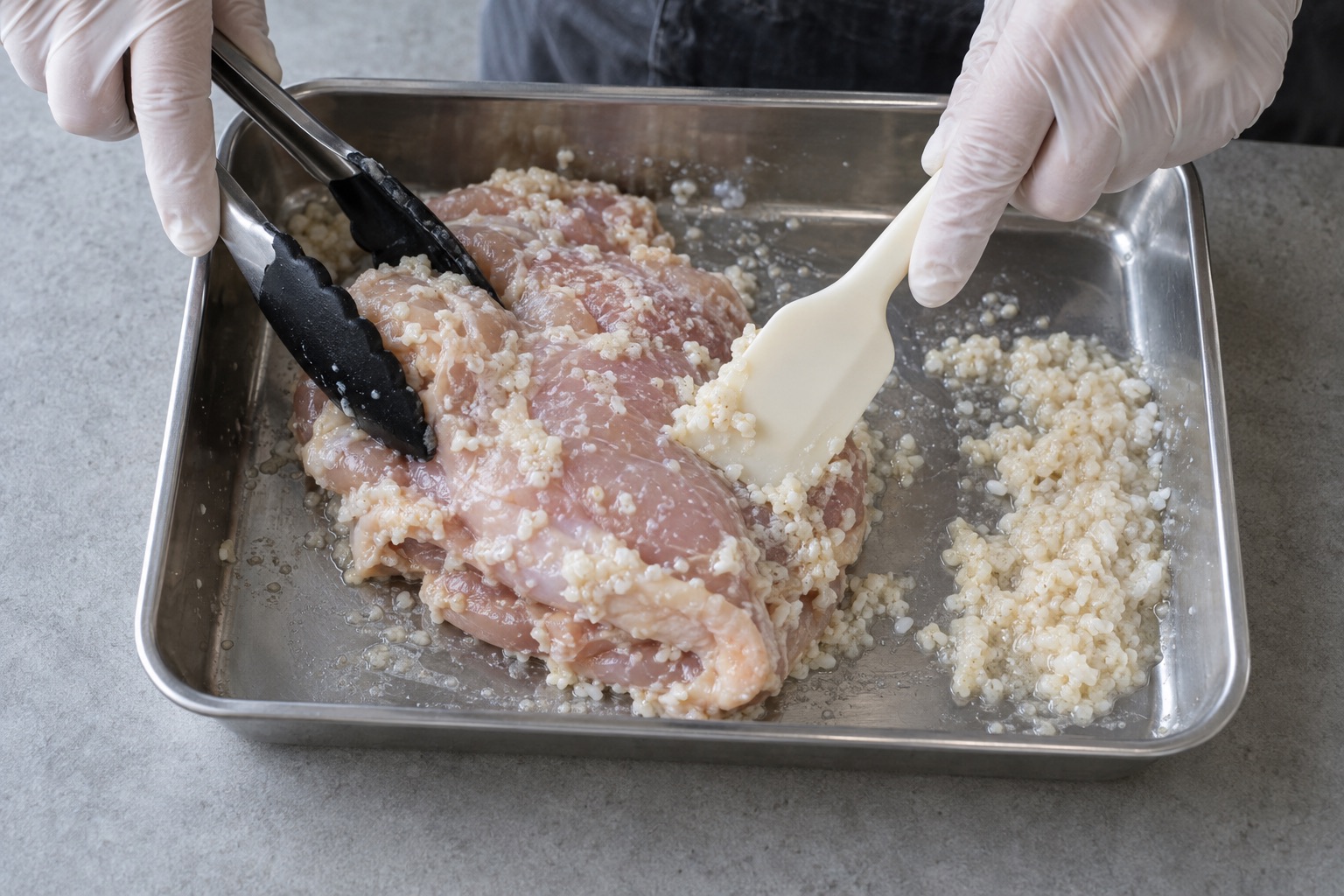
In the Hikari-hosted chicken method, the food spends a specified period in contact with the seasoning before the cook deals with its surface. The removal instruction is part of that same method. It is not an admission that the seasoning should never have been added.
Marc Matsumoto makes the reason explicit in his shio-koji black cod recipe for Hikari: the seasoning’s sugars can burn, and excess marinade should be removed before cooking. The recipe combines that surface preparation with controlled heat. Its point is to avoid scorching the outside before the food is cooked through.
The practical lesson is to stop judging the usefulness of a marinade solely by how much remains visible. A generous-looking layer may reassure you that the food is seasoned, but appearance is not a record of everything that happened during its time in the refrigerator. The recipe has already allowed for contact before asking you to change the surface.
This is where the word marinade matters. If you expected a thick sauce served on top of the finished dish, removing it would seem to remove the main attraction. Here, however, it is part of the preparation. A finishing sauce is a separate choice, with its own ingredients and handling requirements.
Think about the dish you are trying to reproduce. Is the recipe aiming for a cooked piece of chicken with its own surface, or for chicken sitting in a substantial sauce? A photograph cannot replace the method, but the method can explain why the finished food need not look heavily coated. You should not have to invent an extra sauce layer to make it resemble your idea of what “marinated” means.
Follow the linked method’s way of removing the excess. Do not silently translate a request to remove coating into a requirement to wash raw poultry under the tap. The chicken recipe has not instructed you to add that operation.
It is equally unhelpful to set an invented target such as “remove exactly half.” The amount clinging to food depends on the product and the way it has been applied. A guessed fraction creates a precision the source never supplied. Use the actual surface instruction instead.
For your first attempt, read this step before beginning the marinade. It affects how you organise the transition to cooking: have the cooking surface and the utensils you need ready, and keep the raw-food work separate from anything that will touch the finished meal. Discovering the instruction only after heating the pan makes an otherwise simple sequence unnecessarily hurried.
Shio koji is a fermented seasoning based on rice koji, salt and water. Hikari describes its bottled version as porridge-like, with partially broken-down rice material. It is not simply salt dissolved in water, nor is it another name for miso. Hikari’s product description and ingredient list identify the actual formulation.
Koji brings enzyme activity into the explanation. Hanamaruki describes enzymes produced by the koji culture breaking down proteins into amino acids as part of the seasoning’s effect on flavour and tenderness. That explains why a period of contact can matter before cooking. It does not establish an identical result for every food, bottle or duration. Read the maker’s explanation of its shio-koji range.
There are two questions inside the everyday phrase “make it better”: how do you want the food to taste, and what texture do you want it to have? They need not point towards the longest possible wait. A recipe has chosen a combination of ingredient, amount and time; extending one element is an adaptation, not an automatic improvement.
Matsumoto’s black cod explanation warns that excessive marination can leave protein unpleasantly soft. That is a reason to resist “overnight is always better,” not a reason to adopt one universal deadline for every shio-koji dish. The ingredient’s thickness and type still belong to the particular method.
For example, Nami’s chicken recipe gives a refrigerated marinating window of 30 minutes to three hours. Record that as the window for that recipe. It is not the shelf life of the bottle, the safe storage life of any raw meat, or the required wait for a salad dressing. Those are separate questions.
You may encounter nama shio koji on a product or in a Japanese recipe. Marukome explains that nama in its koji products refers to enzymes retaining activity rather than having been inactivated by heat. Its FAQ defines the term.
That is a manufacturing and ingredient-function explanation. It should not become a promise about probiotics, gut health or the safety of uncooked meat. Nor is it a reason to undercook dinner in an effort to preserve the seasoning’s enzyme activity. The preparation stage and safe final cooking have different purposes.
If your evening schedule cannot accommodate the chosen recipe’s window, select another complete preparation before starting. Do not begin a timed marinade and only later decide whether dinner is tonight or tomorrow. Planning the cooking time first is especially helpful when an unfamiliar ingredient makes it tempting to improvise the waiting period.
Some recipes give spoonfuls or millilitres. Others use a proportion of the food’s weight. Those are different ways of specifying an amount; they should not be combined casually.
Marukome’s shio-koji chicken grill specifies its Plus Koji Nama Shio Koji at 10% of the meat’s weight. The important information is not only the number ten. It is what the percentage refers to, and which product the recipe names.
Here is an illustrative calculation, not a separately tested recipe: if the meat weighed 500g, that instruction would mean 500 × 0.10 = 50g of the specified shio koji. It would not mean 50g of plain salt. It would not mean 50ml unless a valid conversion for that product had been supplied. And it would not mean that the combined meat-and-marinade mixture was 10% salt.
That last misunderstanding is worth pausing over. The seasoning is a mixture. Its mass includes more than salt, and the recipe’s ratio describes how much of that mixture to use relative to the meat. A nutrition label is answering a different question about the product’s composition.
You also cannot infer how much seasoning each person eats merely by dividing the amount initially added by the number of diners. Some marinade may be removed or remain in the preparation container. The recipe’s measured input is useful for repeating the method; it is not a direct measurement of an individual’s salt intake.
For a weight-based instruction, a kitchen scale avoids having to guess how densely a spoon has been filled. For a volume-based instruction, use the stated measuring unit.
Hanamaruki’s 300ml liquid shio-koji product is made by pressing the seasoning to produce a grain-free liquid. Hikari’s product, described earlier, retains a porridge-like character. “Liquid” on an English description therefore does not necessarily promise the same visible texture across products.
This matters if you are judging quantity by how thickly the seasoning seems to cling. Two different-looking coatings do not establish that you have applied equivalent measured amounts. Follow the identified product and measurement in your method before trying to make the food resemble a photograph of another formulation.
Hanamaruki also positions its squeezed liquid as less prone to scorching than the grain-containing form. That is the manufacturer’s comparison, not a guarantee that it cannot burn or permission to ignore the cooking instructions. A product distinction may explain why methods differ; it does not make every method interchangeable.
If the named product is unavailable to you, acknowledge that the starting ingredient has changed. A recipe written for the version you can identify gives you a clearer first attempt than guessing an equivalent thickness of coating. This is not an argument for buying more imported bottles. It is an argument for choosing a method whose quantities you can understand and reproduce.
The same restraint applies to adding other salty ingredients. A recipe may deliberately include soy sauce alongside shio koji, while another relies on the koji seasoning alone. Do not add your usual salt automatically before reading the entire ingredient list. Equally, do not delete a measured ingredient from a published recipe merely because shio koji already contains salt.
Once the food reaches the heat, you have a new task. The waiting period has ended, but cooking still needs to bring the food to an appropriate internal temperature. An attractive surface is not a substitute for that check.
Nami’s chicken method uses an oven setting of 180°C and an internal endpoint of 74°C / 165°F, with the stated cooking time treated as approximate. The oven temperature and the temperature inside the chicken describe different things. Setting the oven correctly does not, by itself, establish that the centre has reached its endpoint.
USDA’s poultry preparation guidance likewise specifies 165°F for poultry, measured with a food thermometer. It also directs cooks to keep poultry covered in the refrigerator while marinating and use suitable food-grade containers. These are food-safety requirements, separate from the flavour and texture reasons for choosing a particular waiting time.
The useful distinction is between a recipe’s planning estimate and evidence that the food is ready. If you change the cut or size, you have changed something relevant to cooking. A timer copied from a different dish cannot settle the new question, and a darkened coating cannot answer it either.
This is why “turn the heat up until it looks right” is a poor response to uncertainty. You may make the surface more conspicuous without learning anything about the centre. Return to the full recipe’s cooking method and use the appropriate temperature check instead of inventing a shortcut around it.
A bottle of seasoning and a bowl of that seasoning after contact with raw chicken no longer have the same handling history. Treat the latter accordingly. USDA says raw-poultry marinade must not be used as a sauce unless it has first been boiled to destroy bacteria.
For the examples in this guide, the simpler editorial recommendation is to discard the used marinade rather than improvise a finishing sauce from it. Make any accompanying dressing separately with clean ingredients and utensils. Do not pour a used portion back into the original bottle or taste it to decide how salty it is.
Decide which utensils will handle the cooked food before you start. Keeping a clean serving set aside is easier than trying to remember, at the end, which spoon or plate last touched raw chicken. This separation is part of preparing the meal, not an optional refinement for experienced cooks.
A manufacturer’s description of fermentation does not replace these precautions. Neither does a pleasant smell. The question is what the food and its marinade have contacted and how they have been handled, not whether the ingredient has a reassuring traditional reputation.
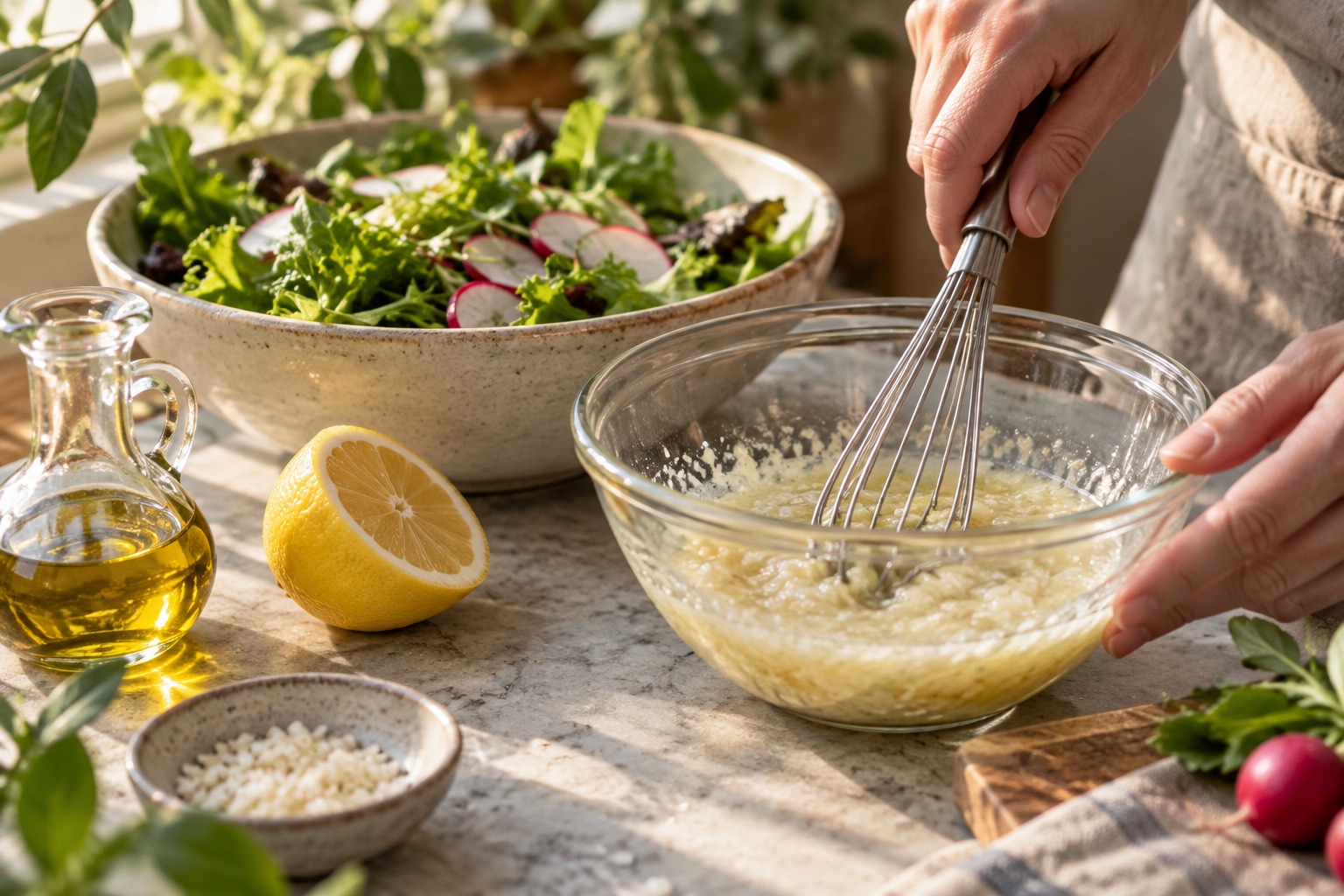
You do not have to cook chicken or fish to explore the seasoning. A fresh dressing offers another use, particularly relevant if your household prefers vegetarian food. It should begin with a suitable product straight from its properly stored container, not with leftovers from a raw-meat preparation.
In Marc Matsumoto’s shio-koji dressing for Hikari, the seasoning is combined with olive oil, lemon juice, pepper and additional salt, then blended or whisked into an emulsion. This is a mixing task rather than a long protein-marination task. Follow the linked recipe for its complete quantities.
The added salt is useful evidence against a rigid rule. “Contains salt” does not mean “a recipe must never contain any other salt.” It means the seasoning contributes to the total, which the recipe author has considered alongside the oil, acid and food being dressed. Your job on a first attempt is to understand that balance before independently changing several parts of it.
Conversely, a dressing that tastes too sharp is not automatically asking for more shio koji. Describe the issue before reaching for the bottle. Are you judging the mixture alone or with the food? Are you trying to change acidity, saltiness, texture or the amount coating each bite? These questions help you choose what to investigate rather than turning one ingredient into the answer to every disappointment.
For an informal comparison, taste a small amount of freshly prepared dressing with the same food you plan to serve. That is an editorial suggestion for judging the finished combination, not a tasting test we have conducted. A spoonful on its own and a light coating over a bowl are different eating contexts.
The product’s rice material also deserves attention here. A grain-containing preparation and a squeezed liquid should not be assumed to produce an identical dressing texture. Use a method designed for your version before deciding that a change in appearance means you have mixed it incorrectly.
Hikari’s cited shio-koji product is presented as vegan-friendly, but its ingredients explicitly include alcohol. Hanamaruki’s cited liquid product also lists alcohol. A rice-based fermented seasoning should therefore not be assumed to meet an alcohol-avoidance requirement solely because it contains no visible meat or fish.
Check the actual product you intend to use, particularly when an imported bottle differs from the market shown on a manufacturer’s website. Explain your household’s requirements precisely; vegetarian suitability, allergy requirements and alcohol avoidance are not interchangeable labels. This article does not certify a product for your diet.
If the broader question is how different Japanese sauces contribute to a meal, our soy-sauce guide to dipping, simmering and glazing follows those separate uses. Shio koji need not replace every seasoning in that cupboard. It can earn a place through one preparation you enjoy and understand.
After a first attempt, a useful note is more specific than “shio koji did not work.” Record the product, measured amount, food and cut, waiting period, removal step and cooking method. Then describe what happened without immediately assigning a cause.
If the surface scorched, investigate the coating and heat management. If the texture was softer than you wanted, examine the marinating duration and the particular food. If the flavour was too salty, review the total seasonings and your measurements. These are different lines of inquiry, not guaranteed diagnoses or instructions to compensate for one problem by creating another.
There is no need to turn dinner into a formal experiment. A single clear observation can make the next attempt more useful: you forgot the removal step; used an unmeasured quantity; changed the product; or followed the method and simply preferred a different result. That last possibility is allowed. You do not have to prefer every fermented seasoning in every dish.
Start with one complete preparation whose ingredients suit you and whose method fits the time and equipment you have. Let the marinade have its specified contact, prepare the surface as directed, and cook the food properly. Or choose the fresh-dressing route and judge it with the salad it is meant to season.
The apparent wastefulness of removing a marinade becomes easier to understand once you stop expecting every stage to leave a thicker visible layer. The goal is the food you will eat, not the maximum amount of seasoning you can keep on it.

AUTHOR OF THIS ARTICLE
SoJapan
SoJapan India Pvt. Ltd. is a Japanese-founded company based in Gurugram. We bring Japanese food, anime goods and apparel materials to Indian businesses, with a sister company in Kyoto that works directly with makers in Japan.