← JOURNAL13 Oct 2026
Konnyaku and Shirataki: Why Boiling and Dry-Frying Do Different Jobs
 By SoJapan
A shirataki recipe can ask you to boil the strands, then put them in a pan without oil. At first glance, that looks like doing something and immediately undoing it: into water, then back out to remove moisture. Why not skip one step?
Because preparing the ingredient and finishing the dish are different jobs. A preliminary treatment may address the product’s characteristic flavour. A later pan stage may remove moisture before seasoning. Neither instruction tells you everything about the other.
The packet can change the first job. Some makers explicitly permit a water rinse without an additional aku-removal treatment; others ask you to perform that preparation. There is no single boiling time that overrides those differences. But “no preliminary treatment needed” is not an instruction to discard every later cooking step.
This guide is for readers in India exploring Japanese home cooking, especially when an imported packet and an online recipe seem to disagree. The named Japanese products are examples of different directions, not a claim that they are stocked locally. We have compared published instructions, not conducted a kitchen test.
Keep three distinctions in mind:
We are discussing commercially prepared konnyaku blocks and shirataki strands. This is not a guide to making konnyaku from powder or processing a raw tuber. The Japan Konnyaku Association’s manufacturing explanation makes an important distinction: a raw konjac tuber cannot simply be boiled or baked and eaten like an ordinary potato.
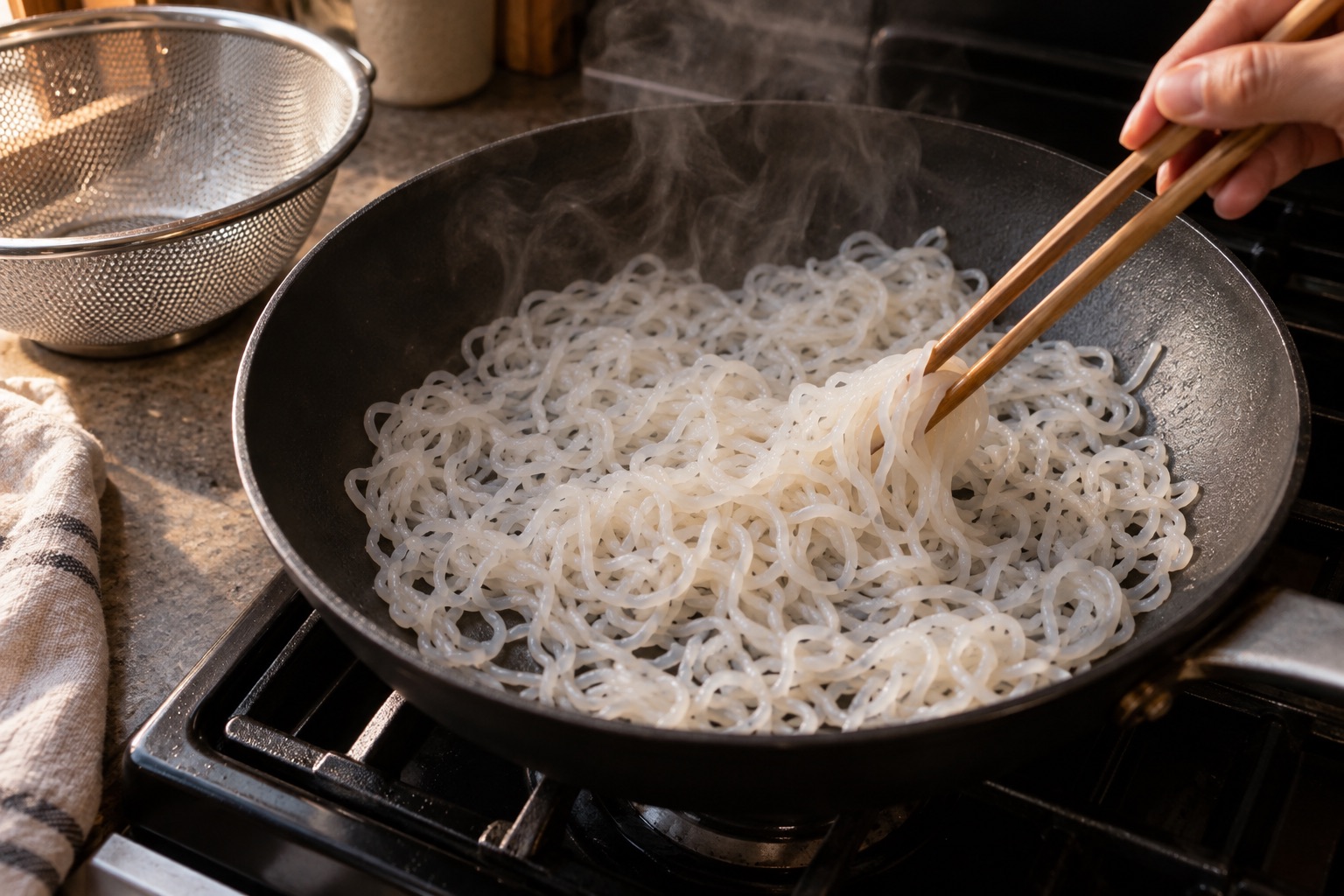
A concrete example makes the sequence easier to see. Kikkoman’s shirataki with tarako recipe starts with 200g of shirataki, cut into manageable lengths and boiled for about three minutes. Later, it puts the strands into a pan over medium heat and dry-fries them. Seasoning and the tarako mixture follow after the moisture has evaporated.
Tarako is fish roe, and this recipe also includes sake. It is an illustration of the method, not a vegetarian recommendation. Follow the linked recipe for its complete ingredient list and directions; the description here deliberately isolates the relevant stages.
Our practical reading is that the recipe has not accidentally asked for the same treatment twice. First it prepares the strands. Then it establishes the condition in which they meet their seasoning. Finally it brings them together with the rest of the dish. “It has already been heated” does not answer whether those later jobs have been done.
Think of the recipe as a sequence of actions with separate stopping points. When a step ends with a colander, you have reached an ingredient ready for its next use. When a later step ends with seasoning coating the food, you are approaching a finished dish. The first stopping point does not automatically substitute for the second.
That distinction is useful even if you never make the tarako version. When reading a new recipe, underline the action immediately before the seasonings go in. Does it ask you to drain, to dry-fry, or to heat oil? That verb tells you more about the intended next stage than the headline’s promise of a quick meal.
Lifting food from water and letting it drain is a handling step. Dry-frying involves a pan and heat. The Japan Konnyaku Association’s preparation guide describes moving konnyaku around a pan over medium heat, and associates the treatment with a firmer bite and better contact with seasoning before other ingredients are added.
The important point is not to pursue the driest possible ingredient. It is to reach the condition specified by your dish. A recipe that asks for drained pieces in a simmer is not necessarily asking for the same preparation as a recipe that asks for strands to be dry-fried before coating.
Nor should “dry-fry” become permission to leave a pan unattended while preparing everything else. The association describes stirring the food as it heats. Treat that as an active stage, not a waiting period whose length you can freely borrow from another recipe.
You may see あく抜き不要, meaning that an additional aku-removal treatment is unnecessary. In this cooking context, aku concerns unwanted harshness or characteristic flavour addressed by preparation. It is not a synonym for every kind of cooking, and “removal unnecessary” is not the same wording as “serve this entire dish without cooking.”
Kan-etsu’s general preparation guide distinguishes its rinse-only products from a conventional boiling approach. For the latter, it suggests cutting blocks or strands to a manageable size and boiling for three to five minutes. That is the maker’s general method, not a universal requirement for every packet with the word konnyaku on it.
Three actual maker instructions show why the qualification matters. The final column below is our interpretation of their scope, not a quotation from a product label.
| Named example | Maker’s preparation direction | What this does not settle |
|---|---|---|
| Kan-etsu Kokusan Kissui no Shirataki | Water rinsing is enough; no extra aku-removal treatment | Whether your chosen dish later calls for a dry pan or a simmer |
| Iwasaki’s namaimo konnyaku and shirataki family | Carry out preparation; this family has not had the aku-removal treatment | How long the other ingredients in a mixed dish need to cook |
| Ohara’s shirataki and ito-konnyaku | Rinse-only use is allowed; hot-water treatment is suggested if the flavour bothers you | Which texture or seasoning finish you personally want |
Sources: Kan-etsu’s exact product, Iwasaki’s namaimo family and Ohara’s product directions.
These examples answer three different situations: preparation already addressed by the maker, preparation still requested, and an optional flavour adjustment. None needs to be declared wrong for the others to be useful.
For a beginner, the sensible order is to identify which situation applies to the actual food in front of you. A recipe’s generic ingredient entry—“one packet of shirataki”—does not identify every manufacturer’s treatment. Conversely, a manufacturer’s rinse-only statement does not describe your recipe’s final sauce or vegetables.
If the packet is difficult to read, photograph or transcribe the preparation panel, not only the large product name. Keep the exact variety name with it when looking for the maker’s instructions. A front label can identify an ingredient while the back explains what you must do with that particular version.
The temptation is to collect several times and choose a compromise. That is not a reliable way to reconcile recipes. A time belongs to an operation: adding food to boiling water, bringing water back to a boil, simmering with seasoning or leaving a pan off the heat are not interchangeable descriptions.
For instance, one of Iwasaki’s listed pot methods brings the product and water to a boil, turns off the heat, leaves it for about ten minutes and then rinses again. Ten minutes of standing off the heat should not be rewritten as ten minutes of active boiling. The distinction is in the verbs, not merely the number.
Where your packet supplies a complete method, keep its sequence intact. Where the recipe gives only a brief reference to preliminary preparation, use the product’s own directions to understand that reference. If either is incomplete or genuinely incompatible, consult the maker’s exact product guidance instead of inventing a hybrid timing rule.
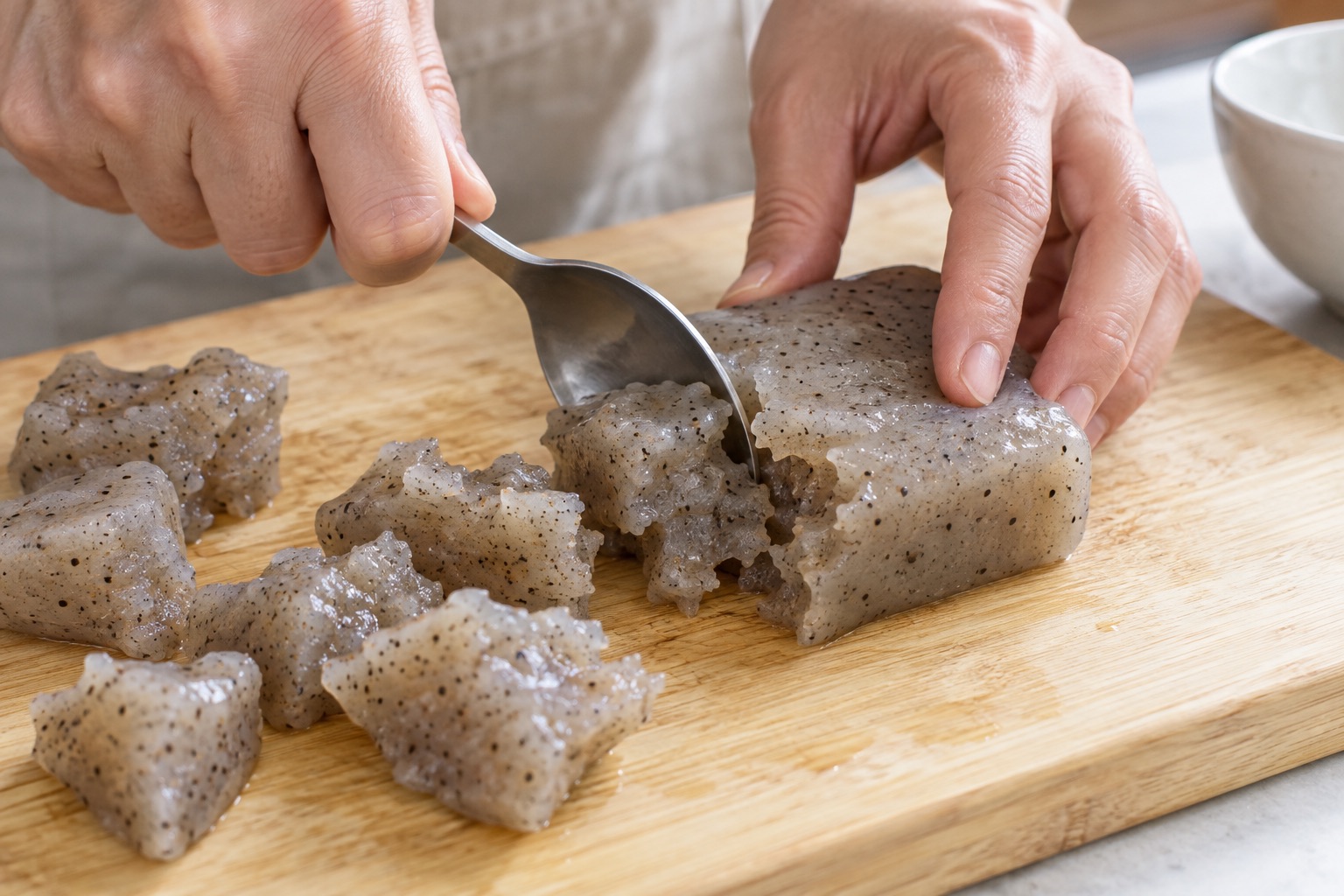
Once preparation is understood, shape becomes a more interesting question than “how long should all konnyaku boil?” A block gives you choices that a bundle of thin strands does not. You can plan defined slices, small torn pieces or a scored surface to suit the way the dish will be served.
Kikkoman’s guide with cook and food stylist Keiko Eguchi explains the use of a spoon to tear pieces rather than simply slice them. The irregular surface gives seasoning more surface to cling to, and a spoon can help keep the pieces reasonably consistent in size. This is a handling choice with a purpose, not a rule that a knife is somehow improper.
That makes tearing a useful option when you want separate, irregular bites. It does not mean every dish should look rustic, or that neat slices are a mistake. Start with the serving you want: distinct pieces picked up individually, slices arranged on a plate, or strands combined with a coating. Let that decision guide which recipe you choose.
The association also lists shallow cuts across a block’s surface among ways to help quick seasoning. Notice the word shallow: scoring a surface is a different operation from cutting a block into separate pieces. You do not have to combine every technique—tear, score, pound and salt-rub—simply because you have encountered them in separate guides.
Kikkoman’s sweet-spicy konnyaku recipe provides a contrasting example. It tears the block into small pieces, briefly boils and drains them, then fries them in sesame oil with chilli before adding the seasoning and cooking away the remaining liquid.
Here the pan is not being used in the same way as the oil-free stage discussed earlier. The oil and chilli belong to the dish’s method. Calling both actions “dry-frying” would hide an ingredient and an important difference in the instructions.
The editorial lesson is simple: look at what is already in the pan, not just whether the recipe uses the word “fry”. If oil is listed for that stage, omitting it is an adaptation. It might be an adaptation you wish to explore with another recipe, but it should not happen because an English summary blurred two techniques together.
Now consider konnyaku as one ingredient in a larger cooked dish. Kikkoman’s chikuzenni recipe uses 150g of konnyaku, tears it into larger bite-sized pieces, boils it separately for two minutes and drains it. It subsequently joins vegetables for pan-cooking and then a seasoned simmer. Chicken has its own place in the full sequence.
The separate two-minute boil is plainly not a two-minute recipe for the finished dinner. It prepares one component for the next stage. Nor would choosing a product that does not need preliminary aku-removal make the vegetables or chicken’s cooking requirements disappear.
Our reading of these examples is that the final dish provides the context for judging a shortcut. Skipping an explicitly unnecessary preliminary treatment may be consistent with the packet. Removing the simmer from a simmered dish changes the recipe itself. Those are different decisions, even though both reduce the number of minutes near a stove.
For your first attempt, select the complete recipe before cutting the block. That avoids preparing a shape suited to one dish and then trying to fit it into another halfway through. Read the ingredient list as well as the method: a recipe may use already-prepared components and therefore show less preliminary work than you expected.
If you are interested in a mixed pot, our oden ingredients and cooking-order guide explains how konnyaku sits alongside other textures. That is a separate question from whether a particular packet needs a preliminary boil. Understanding the packet helps you prepare the component; understanding the pot helps you put components together.
There is no need to turn a first attempt into a comparison experiment. Choose one appropriate product and one complete recipe, note the preparation it requests, and follow the dish through to its stated finish. Afterwards, any change you consider can address a specific preference rather than an unidentified step you accidentally omitted.
The word sashimi can introduce another misunderstanding. The Japan Konnyaku Association’s varieties guide describes sashimi konnyaku as a higher-moisture type intended to be eaten as it is, including flavoured versions and different shapes. That is a prepared product category, not raw konjac tuber served uncooked.
It is therefore possible to encounter konnyaku intended for a cold dish without concluding that every block should be handled identically. Check that the product actually is the variety your recipe calls for, and follow its rinsing or serving directions. “No aku-removal needed” and “sashimi konnyaku” are not interchangeable labels.
Names for the strands need care too. Shirataki and ito-konnyaku overlap in modern usage; the association notes regional naming and occasional distinctions by thickness. Neither name on its own settles whether a particular product has had its preliminary treatment. Use the actual directions rather than a memorised rule about one word always requiring more boiling.
A practical way to read a packet is to separate three pieces of information: what form is it, how is this product prepared, and what else is included? A block or strand answers the first. Rinse-only or a specified treatment answers the second. A flavouring or accompanying sauce raises the third.
That last question matters for dietary choices. Do not infer the ingredients of a sauce from the appearance of the konnyaku beside it. Likewise, the presence of a plant-derived main ingredient does not describe an entire recipe: the fish-roe and chicken examples above make that clear. For a broader checklist of stocks, sauces and toppings, see our Japanese vegetarian food guide.
If you want to explore the ingredient without those recipe components, choose a complete recipe compatible with your diet. Removing a named ingredient and presenting the remainder as an equivalent finished dish would be a new recipe, not something the linked source has demonstrated.
An English translation may flatten several Japanese instructions into “prepare” or “cook”. Keep the actual action visible. The following is a compact reading aid, not a new sequence that every packet must undergo:
When copying a recipe into your cooking notes, preserve the words around a timing instruction. “After it boils”, “turn off the heat” and “then drain” tell you where the number belongs. A note that retains only “ten minutes” can lose the most important part of the method.
The most useful question is “What is this step meant to accomplish here?” Ask it once for the product’s preparation and again for the finished dish. Then a rinse-only packet and a recipe with further heating need not seem contradictory. You can respect the manufacturer’s preparation directions while still giving the dish its intended surface, seasoning and final cooking.
AUTHOR OF THIS ARTICLE
SoJapan
SoJapan India Pvt. Ltd. is a Japanese-founded company based in Gurugram. We bring Japanese food, anime goods and apparel materials to Indian businesses, with a sister company in Kyoto that works directly with makers in Japan.