Three people find a baby and try to locate her parents. That sounds like a story with a clear destination. Why, then, should the encounters along the way matter as much as the destination itself?
Tokyo Godfathers makes coincidence the beginning of a relationship, not simply a shortcut to the next clue. The useful distinction is between something happening to a character and what that character does in response. Keeping both in view makes the film’s unlikely connections easier to appreciate without pretending they are ordinary everyday occurrences.
Satoshi Kon’s 2003 film follows Gin, Hana and Miyuki, three people living without stable housing in Tokyo. They discover an abandoned baby girl on Christmas Eve. As they search for her parents, encounters draw their own pasts into the journey. That is the premise established by distributor GKIDS, not a promise that every meeting will be explained like a detective’s clue.
Spoiler boundary: this guide discusses the opening situation, one rescue and wedding setup, and visual devices described by the director. It does not reveal the baby’s parentage, concealed personal histories, later reunions or the ending. The linked director interviews contain more spoilers. Interpretations and viewing suggestions below are editorial readings, distinguished from the production accounts supporting them.
The Christmas setting should not be mistaken for a children’s-film label. Violence, discriminatory language, suicide-related material and danger involving a baby are relevant viewing cautions. We return to editions and content guidance near the end.
One encounter shows how the film joins a public event to a private concern. In a 2003 interview, later revised for his website, Kon describes the protagonists helping a man trapped beneath a vehicle. The man is a yakuza boss. An invitation to his daughter’s wedding follows, and the occasion reminds Gin of his own daughter.
Our reading is that the meeting changes more than the itinerary. Assistance creates access to an unfamiliar social space; that space brings a personal association into the journey. A person introduced through an immediate predicament acquires another significance. The improbable connection is visible, but so is the act of helping. We will leave what happens at and after the wedding to the film.
There is a broader critical distinction worth making here. Probability and consequence are not the same test. Probability asks whether an event was likely to happen. Consequence asks whether its arrival changes anything that matters. A highly improbable event can have substantial consequences; a perfectly plausible scene can leave a story exactly where it was.
Neither test cancels the other. If chance keeps supplying precisely what the plot requires, a viewer may reasonably find the construction too convenient. But identifying convenience is the start of an evaluation, not necessarily its conclusion. The next question is whether the convenience removes the characters’ work or gives them something new to confront.
The search has two different kinds of progress, then: movement towards an answer about the baby, and movement towards an understanding of the people doing the searching. They need not advance at the same speed. A detour can seem inefficient as an investigation while being essential to the second kind of progress. That is the distinction to keep in mind when the film refuses to take the shortest route.

Kon’s preproduction note, written in February 2001, describes an intention to compress an extraordinary concentration of dramatic encounters into a few days. The same note treats the infant as a catalyst rather than a character with a literal set of special powers. This is an account of the project taking shape, not a technical rulebook for the finished film. Kon’s director’s note.
That distinction prevents two unhelpful expectations. One is that the film must secretly explain its coincidences through a supernatural mechanism. The other is that acknowledging deliberate design requires us to approve every result. A director can choose an approach clearly and a viewer can still find parts of it unpersuasive.
Here is a compact way to separate the questions without turning the movie into homework:
| Question | What it tests | What it does not settle |
|---|---|---|
| How did this encounter become possible? | The connection supplied by the plot. | Whether anyone responds generously or wisely. |
| What does someone choose to do? | Action within the opportunity or predicament. | Whether that action will have the intended effect. |
| What matters differently afterwards? | A consequence for the relationship or the viewer’s judgment. | Whether the original coincidence was probable. |
These are editorial questions, not three stages that Kon said every scene must follow. They are useful because they stop a single objection—“that would never happen”—from doing all the critical work. They also stop a single compliment—“it is a miracle”—from excusing everything.
Notice how different this is from treating the baby as a reward for the adults’ good behaviour. A vulnerable person is not a prize that proves somebody deserves happiness. For this guide, care matters as an action under imperfect circumstances, not as a transaction that guarantees a favourable result. That reading allows warmth without turning the film into a moral points system.
A film about finding a child’s family could keep its searchers almost anonymous. They might function as guides through a series of clues, interesting chiefly because of what they discover about somebody else. Tokyo Godfathers gives the searchers histories of their own.
Kon addressed that choice in a July 2004 interview. He described past information as a way to clarify the characters’ principles of action while their present story continues. He also credited the creation of the three protagonists to himself and co-writer Keiko Nobumoto. The interview’s detailed example discloses a personal revelation, so it is deliberately omitted here.
Here the practical viewing distinction is a person’s history versus the act of telling it. What happened earlier is one question. Why this person brings it into this conversation, with these listeners, is another. An explanation might also ask for patience or sympathy; that does not make it dishonest. Listen for what the account does between the people present, rather than filing it away as background information.
Nor should a revelation work like a switch that changes a character from bad to good. Understanding a difficulty and objecting to a response can coexist. The searchers do not have to become exemplary people before their concern for a baby counts. Conversely, concern for somebody vulnerable need not settle every disagreement between them.
In the same July interview, Kon describes the trio as having a makeshift family relationship. That helps orient the viewer, but the phrase should not finish the discussion before the search begins.
The premise contains an interesting tension: people who already have a makeshift bond are trying to find another person’s family. Those are not automatically the same problem. Knowing what a family ought to provide does not tell the searchers everything about the family they are looking for. Our reading keeps the desire to help separate from certainty about what the right answer will be.
That is why this guide leaves the baby’s history unresolved. A spoiler summary could give you the answer while flattening the experience of searching with incomplete knowledge. Let the group be uncertain. Affection does not make disagreement meaningless, and disagreement does not automatically cancel affection.
If the plot is full of conspicuous connections, where does the sense of an individual person come from? In animation, a character is not only a design plus a voice. The particular way the drawn body performs an action matters too.
In his production notes on character performance, Kon distinguishes reproducing movement from expressing a particular person. A walk is not enough merely because it reads as walking. He also points out that a still pose can act. The useful newcomer takeaway is to watch how a character occupies a moment, not only whether the next necessary action happens.
Another production entry gives a concrete example: a shot of Hana speaking for roughly 20 seconds, animated by Masashi Ando. Kon describes giving performances more time within shots and generally keeping the camera less conspicuous outside action passages. These are his production observations, not a claim that every shot is long or motionless.
Try letting one conversation run without asking when the next clue will arrive. A longer uninterrupted view makes the timing inside a performance worth noticing: where a gesture finishes, where a pause falls, how a speaker holds the frame. This is a viewing suggestion, not a list of secret signs that diagnose Hana or anyone else.
This changes what “nothing happened” can mean. Perhaps no new address was discovered and no question was answered, but a character’s manner became more distinct. Plot summary is particularly poor at preserving that kind of pleasure. A summary can report the content of a speech while losing almost everything about its delivery.
For viewers coming from an anime series built around escalating powers or mysteries, that is a useful adjustment of attention. The relevant question is not whether Tokyo Godfathers contains enough spectacle to compete. It is whether the film makes an ordinary human action interesting to watch. The emotional stakes need not become smaller because the action is speaking, listening or standing still.
There is a limit to this argument: not every extended conversation is automatically rich, and elaborate movement is not automatically better acting. The point is to give the performance a chance to register before assessing a scene solely by the information it delivers. That is especially important in a story whose plot machinery is so easy to notice.
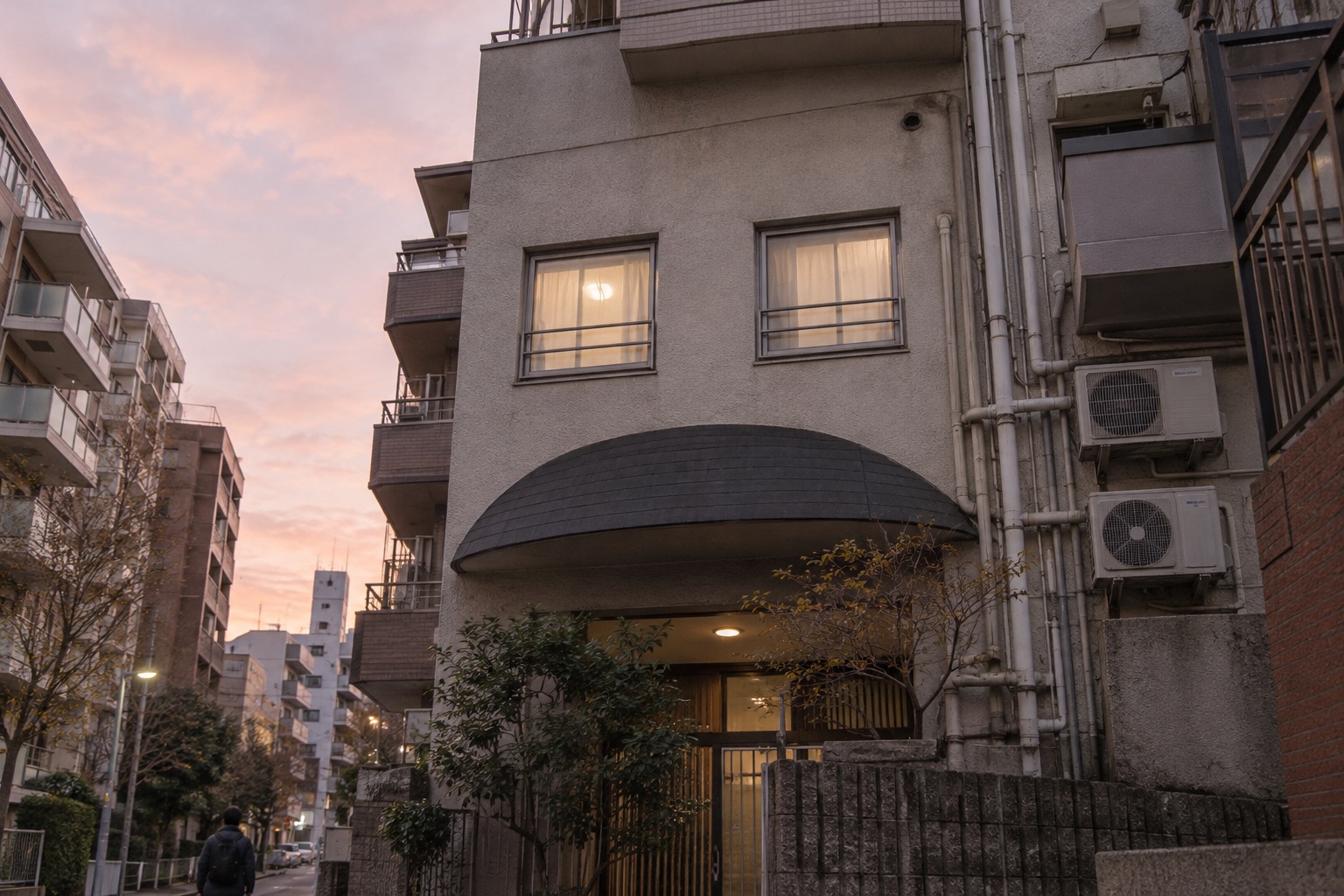
Tokyo is not only the name of the destination or an attractive background. Kon explains in the 2003 interview that the opening credits appear as signs within the city, connecting the creators’ position to a city observing the protagonists. He also discusses intentionally face-like buildings. These are specific production observations, not a claim that every building has a hidden personality. Kon on the film’s urban viewpoint.
One example is wonderfully direct. The main title appears on the side of a truck entering the frame, as the caption in Kon’s production archive explains. Information usually placed over a movie instead arrives as part of its traffic. The street is doing some of the introducing.
There is also a revealing example outside the film itself. In his notes on the teaser artwork, Kon identifies outdoor air-conditioning units as eyes and white rubbish bags as a beard. He intended a Santa-like face, though he felt the effect had not entirely succeeded. This is promotional artwork, not a scene we are claiming appears in the finished movie.
That illustration offers a small exercise in attention: the same urban objects can read first as practical things and then as a face. Neither reading requires the other to disappear. It is a helpful companion to the film’s watchful-city idea, without making a supernatural explanation compulsory. The director’s own reservation also reminds us that knowing an intention and seeing its effect are different experiences.
Back in the film, our recommendation is not to hunt for a secret message on every sign. Notice how the city remains present around the characters. A background may change the feeling of a moment without handing over an additional clue. Treating it only as beautiful decoration misses that possibility; treating it as an encrypted answer overstates it.
This also helps keep humour and distress in the same discussion. An amusing arrangement in an image does not automatically declare that a person’s predicament is trivial. Equally, a serious predicament does not require every element of the image to become solemn. Those responses can sit together instead of taking turns in neatly separated comic and tragic scenes.
There is an important boundary here. A reading of this fictional city is not evidence about contemporary housing insecurity in Japan, and it does not establish what Japanese or Indian families are generally like. Keep the attention on these characters and these images before turning them into national symbols.
The question “Is this realistic?” can mean several different things. Does the sequence seem statistically likely? Do the reactions seem recognisable? Does the place have convincing detail? These tests overlap, but none is a perfect substitute for the others.
In a June 2004 interview about his work, Kon links felt reality to the experiences and impressions that images and sound evoke in the audience. Later in the interview, he describes developing stories through successive interesting situations, then revising the structure once it emerges. His account includes revision; it is not a claim that a finished film is simply an unplanned chain of accidents.
For this article’s question, the useful consequence is modest: construction and recognition can coexist. We can see a filmmaker arranging an encounter and still recognise something in the resulting embarrassment, hesitation or longing. Seeing the arrangement does not necessarily destroy the response.
Equally, recognition is personal. An audience member who does not connect with the characters is not obliged to accept a director’s explanation as a replacement for that connection. Interviews can clarify the kind of work being attempted. They cannot compel enjoyment or prove that every intended effect succeeds.
That is why “the coincidences are intentional” is an incomplete defence of the film. Intention tells us not to mistake the device for an unnoticed accident. It leaves the more interesting critical question open: what does the device achieve in this particular story?
When discussing the film afterwards, choose one encounter rather than arguing about coincidence in the abstract. Describe what the plot supplies, what the people contribute and what remains changed. Two viewers may then disagree about the effectiveness of the same passage without talking past one another about whether chance is ever permissible in fiction.
Hana is a transgender woman. The distributor’s discussion of its 2020 release identifies her as a transgender character and describes Shakina Nayfack’s performance in the new English dub. Some historical production language is dated and reductive; this guide does not adopt it as a way of describing her.
It is possible to value a character’s place in a film while remaining uncomfortable with particular dialogue or representation. Those are not mutually exclusive responses. A newcomer should not feel required to dismiss that discomfort because a work is admired, or to settle every critical argument about it before watching.
The BBFC’s content advice for a UK release flags violence, discriminatory language, suicide-related material and danger involving a baby, along with brief breastfeeding nudity. The linked page contains specific events and outcomes, so read it with that spoiler warning in mind. It is not an Indian age classification.
The 2003 film is also distinct from a later home-video edition. Sony’s Japanese catalogue credits Kon, Nobumoto, composer Keiichi Suzuki and animation studio Madhouse, and lists approximately 92 minutes for its discs. GKIDS’ 2020 release description lists a new English dub and an updated English subtitle translation. That does not mean every copy on every service carries those same tracks.
For an Indian viewing, check the exact licensed listing available to your account: title, language tracks, subtitles and content guidance. This guide does not verify current Indian streaming availability, a Hindi dub, domestic stock or a rupee price. Japanese and American distributor links establish their own release information, not access from India.
If you want a gentler film for a shared evening, our beginner’s anime movie guide separates different viewing moods and cautions. Tokyo Godfathers need not be the right choice for every group simply because it is set at Christmas.
For the film itself, begin with a question smaller than “What does everything symbolise?” When chance changes the situation, what becomes possible—and what does someone actually do? That leaves room for surprise without surrendering judgment. It also keeps the three searchers visible while the question of the baby’s family draws them onward.
Editorial note: primary distributor information, director interviews and content guidance checked on 13 October 2026. Director comments are paraphrased and attributed; the critical questions are editorial interpretation, not personal viewing testimony or confirmation of Indian availability.

AUTHOR OF THIS ARTICLE
SoJapan
SoJapan India Pvt. Ltd. is a Japanese-founded company based in Gurugram. We bring Japanese food, anime goods and apparel materials to Indian businesses, with a sister company in Kyoto that works directly with makers in Japan.