The Medicine Seller carries a weapon that can cut down a mononoke. Why, then, does he need to ask questions?
In Mononoke, the investigation is a condition of the intervention. The being’s form, truth and reason must come together before the exorcising sword can be drawn. Having the weapon does not mean having everything required to use it. The distributor’s introduction establishes that constraint, which makes a much better starting point than a ranking of the protagonist’s powers.
This guide concerns the 2007 television anime, directed by Kenji Nakamura, not Princess Mononoke or an explanation of the later films. Its distinctive promise is that a supernatural confrontation requires attention to a human story. Finding something frightening is only the beginning of knowing what to do about it.
Spoiler boundary: the series premise and selected setups from its first two cases, Zashiki-warashi and Umibozu. No case resolutions, concealed identities or later endings. Linked episode summaries and interviews may reveal more. The viewing suggestions are our interpretation; production comments are attributed to their speakers.
This is horror, not a gentle folklore sampler. Even the opening premise involves a pregnant woman who fears for her life. That warning matters more to a first viewing than the attractiveness of the artwork.
The three Japanese terms are katachi (形), makoto (真) and kotowari (理). We use “form,” “truth” and “reason” as concise English guides, rather than claiming that every subtitle edition must use those exact words.
The licensed Japanese synopsis on Hulu distinguishes the circumstances of events from the circumstances of the heart. It also connects the taking of form to human causes and relationships. That is more informative than treating the terms as three impressive-sounding names for the same discovery.
| Term | Useful reading question | Avoid collapsing it into |
|---|---|---|
| Form — katachi | What is the being to be identified? | Merely describing a frightening outline. |
| Truth — makoto | What are the circumstances of what happened? | Accepting the first account as complete. |
| Reason — kotowari | What feelings or inner circumstances are involved? | Deciding that the resulting harm is justified. |
The last distinction is especially helpful in English. “Reason” can sound like a defence offered in an argument: someone had a reason, therefore their action was reasonable. Here, understanding the emotional circumstances is not the same as endorsing whatever follows from them. Explanation leaves room for judgment; it does not perform that judgment on the viewer’s behalf.
Likewise, “truth” should not make you expect only the discovery of a dishonest sentence. An account can omit a relationship, describe a consequence without its circumstances, or answer a narrower question than the one that needs answering. Those are different kinds of incompleteness. Do not assume in advance that every person in the series must be lying for the investigation to matter.
The table is a reference, not a timetable. It does not say that the Medicine Seller must finish one isolated task, receive a reward and move to the next. More importantly, it gives the audience a way to recognise different kinds of progress. Learning what happened may still leave its emotional significance unclear.
That is the practical value of learning the terms before watching. You can follow what remains unresolved without looking up an ending explanation. When a question persists, ask which kind of understanding is missing rather than assuming you failed to recognise a monster’s name.
The opening of Umibozu supplies a particularly clear demonstration. A merchant ship heading towards Edo leaves its route after its compass is tampered with. The passengers face supernatural danger. The Medicine Seller manages to repel an attack, yet the ship still cannot escape the troubled waters. To address the mononoke behind the situation, he investigates the passengers’ truth. That is the setup in Fuji TV’s episode-three synopsis, not the case’s solution.
The distinction is already dramatic: someone can be capable in an emergency without having resolved the cause of the emergency. A successful immediate response does not make the questions that follow unnecessary.
This gives a newcomer a useful alternative to reading every pause as a delay before the “real” action. The action has revealed a limit. Further knowledge is needed, and the investigation works on that limit. The story can therefore change its mode without abandoning its problem.
There are two different sources of suspense in that arrangement. One concerns immediate exposure to danger. The other concerns whether the situation has become sufficiently understood to end it. The first can temporarily ease while the second remains. If you measure progress only by the disappearance of an attacking presence, the story will appear to have stopped after accomplishing its task. It has actually made the remaining task easier to identify.
For viewers used to combat narratives, this is not a demand to stop enjoying the weapon or the confrontation. It changes what makes the confrontation available. More strength is not the only imaginable answer to an obstacle; the missing element may be information of a particular kind.
That difference also changes how supporting characters matter. In a fight-centred reading, the first question about someone nearby may be whether they can assist or need protection. In an investigation-centred reading, a person’s circumstances can be central even if they have no relevant fighting ability. This is our way of reading the premise, not a list of fixed roles assigned to each passenger.
You can keep the distinction visible with a simple check at a scene break: has the immediate danger changed, has the explanation changed, or have both changed? There is no need to write an answer. The check helps you avoid confusing a temporary improvement with a final solution.
The human inquiry is not an unrelated moral lesson attached to the horror, either. The series’ central condition gives it a practical consequence. What can be learned affects what can be done. The conversation and the confrontation belong to the same problem.
In a 2024 interview looking back at the original Ayakashi “Bakeneko” production, Nakamura describes building a format around supernatural events with reasons behind them. Unravelling form, truth and reason brings different people’s feelings and backgrounds into contact, with a battle concluding the movement. He presents the approach as something developed through discussion, not a spontaneous visual gimmick.
That production account helps explain why separating “the talking part” from “the supernatural part” is such an unhelpful first assumption. The format connects them. It does not, however, tell you how to solve any particular case, or require you to feel the same way about every revelation.
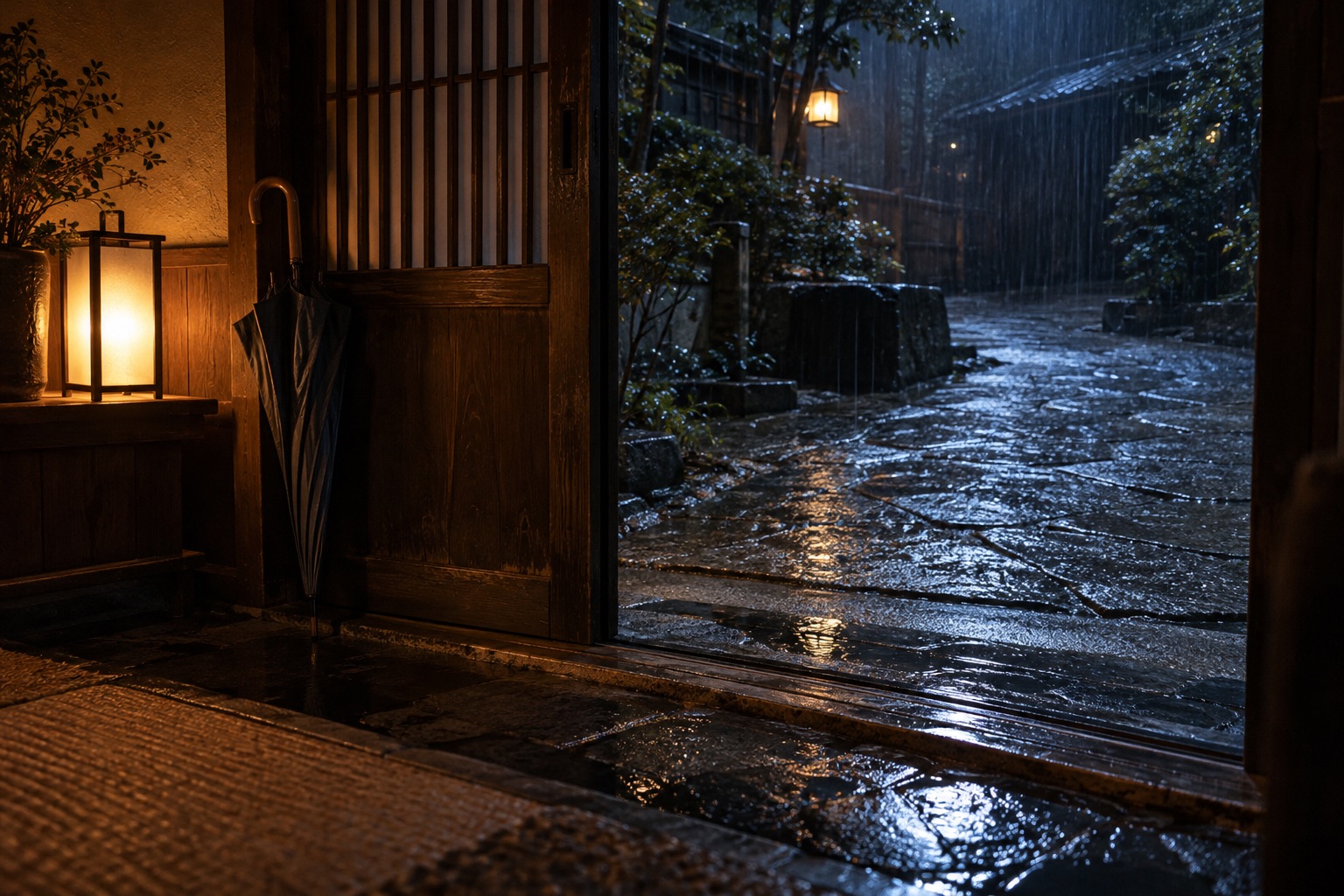
The first case begins on a smaller scale. On a rainy night, a pregnant woman named Shino asks to stay at an inn. The landlady, Hisayo, is reluctant. Shino’s urgent appeal eventually gains her access to a room not normally offered to guests. Fuji TV’s opening synopsis continues into danger; we will leave those events and the room’s history for the episodes.
Before identifying a supernatural being, a viewer already has a human predicament to follow: someone needs a place to stay, and someone else controls access. The request makes the location matter as more than an elaborate background.
Our suggestion is to begin with that immediate predicament. It is specific enough to hold onto when the larger explanation is not yet available. You do not have to know what the case title means in a folklore catalogue before understanding that refusing shelter and providing shelter are consequential choices.
There is a useful limit to that approach. Understanding an immediate need does not mean knowing every participant’s motives. Keep the two levels separate: the situation as it has been presented, and your provisional explanation of it. The latter can change without making your initial concern meaningless.
This is also why we would not begin with a list declaring what each named supernatural being “always represents.” Such a list encourages you to bring a complete explanation to an encounter before meeting the people in it. The title may orient you; it does not replace this particular story’s circumstances.
The comparison with Umibozu is not that one case is easy and the other difficult. One opening gives you a request and an unfamiliar room; the other gives you a journey that cannot proceed as expected. They organise uncertainty differently. The continuing protagonist links the cases without making their starting problems interchangeable.
Do not turn that variation into a universal rule about Japanese horror. This guide concerns a particular fictional system and the way these official premises introduce it. Japanese supernatural stories do not all use the Medicine Seller’s conditions, any more than every detective story uses the same investigative method.
If you are coming from Mushishi, the travelling specialist may be a familiar point of entry. Keep the worlds separate, though. Our Mushishi guide approaches contact with unfamiliar life. Here, the named conditions for intervention direct attention to human circumstances and feeling. A similar outline of a journey does not create the same kind of encounter.

Mononoke’s appearance can make newcomers feel that they need to decipher its imagery before they can follow its story. It is worth replacing that demand with a smaller one: recognise that presentation and explanation do different jobs.
Fuji TV’s introduction describes the earlier Bakeneko production’s combination of distinctive character design, washi-paper textures and computer processing, and the return of its team for Mononoke. That is a useful production starting point. It does not mean that every image is a traditional print, or that the animation was simply painted on sheets of paper.
Nakamura makes the process clearer in a 2024 Eiga.com interview. Discussing the move to film, he explains that the look depends on coordinated decisions across production, not a filter placed over an otherwise finished picture. Earlier overall rules were retained but reconsidered. This is a retrospective account in a film interview, not a technical breakdown of every television shot.
For viewing, the useful consequence is that you can attend to an image’s effect without assigning it a fixed translation. Feeling confined by a composition is a response to the presentation. Concluding that a character is literally unable to leave is a claim about events. Sometimes the story may connect those things; the response alone does not establish the connection.
The reverse mistake is to dismiss an image because you cannot immediately explain it. Uncertainty does not make the artwork irrelevant. A passage can affect the way a conversation feels before you understand the circumstances behind that feeling.
We would avoid a colour dictionary promising that a particular shade always means guilt, innocence or danger. This article has no evidence for such a universal key. It would give a reassuring appearance of precision while taking the episode’s own context away from the viewer.
There is also no need to make attractive artwork reassuring. The opening’s threatened person and the broadcaster’s explicit horror framing remain relevant however decorative the images become. Visual pleasure and discomfort are not mutually exclusive reasons to keep watching—or to decide that this is not the series you want tonight.
The original official site identifies twelve television episodes. They form five multi-part cases, not twelve unrelated short stories. The broadcaster’s episode archive gives the sequence:
For this guide’s purpose, we recommend beginning with the 2007 series in order and allowing the first two-part case to finish before judging its overall construction. That is an editorial entry recommendation, not a requirement imposed by the producers. Stopping after its opening instalment can tell you whether the tone suits you, but it cannot show you how that case brings its questions together.
There is an earlier route to the character: the Bakeneko story within the 2006 anthology Ayakashi. A historical official box-set page distinguishes its three episodes from the twelve Mononoke episodes, collecting fifteen in total. A fifteen-episode bundle therefore does not establish that a twelve-episode Mononoke listing is incomplete.
The repeated name is the other trap. “Bakeneko” can refer to the earlier Ayakashi story or the final case of the 2007 series. Check the series title as well as the case name when reading a listing or a review. Otherwise, a search for background to one work can deliver an explanation of another work’s ending.
If you prefer release order, the earlier Ayakashi story is a reasonable preliminary choice. If you are testing whether the 2007 series interests you, you can follow the starting route above without first absorbing a franchise timeline. Neither approach requires reading plot summaries in advance.
The later theatrical films should also be identified separately. In the Eiga.com interview cited above, Nakamura explains that the television material revealed the three elements as its stories progressed, while the film allowed him to change their timing and balance for a continuous viewing. A film explanation is therefore not automatically an explanation of how the television cases are arranged.
For India, check the exact title, episode selection and language options in the licensed service available to your account. The Japanese pages linked here verify descriptions and production history, not Indian streaming rights or a Hindi dub. Check content guidance too, especially before a shared family viewing; this article does not assign an age rating.
Once you have the right series in front of you, the most useful distinction is already simple. The Medicine Seller’s weapon is visible. The conditions that make its use possible have to be understood. Follow the space between those two facts, and the questions cease to look like an interruption of the supernatural story. They are what lets it move towards a resolution.

AUTHOR OF THIS ARTICLE
SoJapan
SoJapan India Pvt. Ltd. is a Japanese-founded company based in Gurugram. We bring Japanese food, anime goods and apparel materials to Indian businesses, with a sister company in Kyoto that works directly with makers in Japan.