Being told that other people will decide whether you belong is uncomfortable enough. Being asked to help decide which of your rivals belongs adds a different problem: what would make your judgment trustworthy?
That is a useful way into Space Brothers, also known as Uchuu Kyoudai or 宇宙兄弟. Its early astronaut-selection story is not simply a succession of difficult questions for a clever protagonist to answer. The applicants also have to work out what they can reasonably conclude about one another.
This guide concerns the 2012 television anime, directed by Ayumu Watanabe and produced by A-1 Pictures, adapting Chuya Koyama’s manga. The studio’s work catalogue identifies that version. No knowledge of the manga or real astronaut recruitment is needed for the discussion below.
Spoiler boundary: selected premises and task setups through episode 14. We do not reveal the clock task’s solution, the applicants’ eventual selections or later story developments. The linked official summaries contain more spoilers than this article. Story facts are sourced; the viewing questions and comparisons are our editorial interpretation.
For a fan choosing what to watch, the attraction here is the uncertainty between meeting a person and believing you understand them. Space equipment is not the only thing worth noticing. A conversation, a scoring method or an awkward response to an accident can be where the interesting decision happens.
Keep three distinctions in mind:
The opening places the adult story in the fictional year 2025. The Nanba brothers once promised to become astronauts. The younger, Hibito, has reached that profession; the older, Mutta, is 31 and has lost his automotive-company job after headbutting a boss who insulted his brother. His affection for Hibito coexists with the painful feeling that an older brother should be ahead. Official episode-one synopsis.
That is enough background to make his starting point legible. You do not need a catalogue of future achievements, and his disappointment does not make the workplace violence admirable. He arrives with a history, not a blank slate waiting for a grand ambition.
A sibling comparison is also a poor substitute for a selection criterion. It can make a person feel late without saying whether they are suited to the work. This is an important separation for the viewer: understanding why a character feels inadequate is different from accepting inadequacy as an established fact.
Episode three brings that confusion into the examination setting. Other applicants suspect that Hibito gives Mutta an informational advantage. Mutta, meanwhile, becomes anxious about needing to finish first at everything. Kenji offers another account: the issue is sufficiently rounded ability and psychological suitability, rather than winning every individual measurement. That is Kenji’s explanation within the story, not a statement of current JAXA recruitment rules. Official episode-three synopsis.
The useful contrast is between a requirement and the extra requirement somebody invents under pressure. “I must be better than everyone at this” sounds decisive. It may nevertheless be answering a question nobody asked.
There is a viewing habit worth trying here. Whenever an anxious character declares what they must do, ask where that obligation came from. Was it announced by an examiner, inferred from another applicant’s behaviour, or supplied by the character’s own fear? You need not decide immediately which interpretation is correct. Simply keeping the possibilities apart prevents a loud internal worry from becoming an unquestioned rule of the fictional world.
The third selection stage changes the applicants’ surroundings before they settle into the residential exercise. In episode ten, they hand over phones and watches and board a bus whose windows are blocked. Kenji notices cameras. Structured conversations with other applicants are followed by an instruction to rank suitability, including their own; the use of that ranking is not explained to them. Official episode-ten synopsis.
The order is the interesting part: meet, talk, then judge. An introduction that might otherwise seem casual now has a possible consequence. It invites the viewer to think about how rapidly a provisional impression can acquire the appearance of a settled opinion.
It would be easy to turn this into a guide to beating an assessment. That would miss the pleasure of the setup. The candidates do not have complete information about the exercise, and this article does not pretend to supply a hidden scoring sheet. Instead, the uncertainty belongs to the drama.
Consider an ordinary introduction outside the anime. Someone gives a clear, confident account of a project. You have learned something about how they describe it. You may not yet know which parts they performed, how they dealt with an error, or whether another participant would describe the collaboration similarly. Confidence is evidence of confidence; it is not automatically evidence of all those other things.
The reverse matters too. A hesitant answer need not mean an empty one. The hesitation could come from uncertainty, careful qualification, discomfort with the setting or difficulty choosing what to say. Those explanations are possibilities, not diagnoses. An observer who jumps straight to a personality label may be supplying more information than the encounter actually provides.
First impressions are inevitable. The useful question is whether yours remains open to revision when a later action conflicts with it.
That question keeps the selection story from being only a competition watched from a safe distance. You are also selecting evidence as you watch: remembering one remark, overlooking another, trusting somebody’s manner. The article’s invitation is to notice that activity, not to replace it with a list of correct character rankings.
Episode eleven establishes the closed-box arrangement: three groups of five, living separately for two weeks while completing assigned tasks. Each group is instructed to agree unanimously on two people it considers suitable on the final day. Mutta’s group includes Serika, Fukuda, Nitta and Furuya. These are the exercise’s peer-selection instructions—not a claim that those nominations automatically determine the final hires. Official episode-eleven synopsis.
Now an applicant has two positions at once: a person being considered and a person helping to consider others. Being agreeable, being impressive and giving good reasons for a choice are not interchangeable activities.
The groups do not initially settle on one common way to reach their decision. Episode twelve describes B using points, C recording daily votes for two MVPs, and A holding off while its members get to know one another better. Those are the groups’ announced approaches, not results or official instructions about the best method. Official episode-twelve synopsis.
The small comparison below separates those story facts from our questions about them. It does not rank the groups.
| Announced approach | Question for the viewer |
|---|---|
| B: points | What deserves a point, and what important behaviour might be hard to score? |
| C: daily MVP votes | Does the most memorable contribution reveal the same thing as sustained reliability? |
| A: defer the method while learning more | What new evidence would make waiting useful rather than merely postpone disagreement? |
There is no need to assume that a number is automatically cold or that a conversation is automatically fair. Numbers make some comparisons easier to inspect. Conversations can introduce context that a tally leaves out. Both still depend on decisions about relevance.
For a simple invented example, imagine choosing someone to lead a fan-club discussion. One volunteer contributes a brilliant interpretation; another consistently makes room for quieter members to speak. A count of striking comments and a judgment about facilitating discussion answer different questions. Neither observation has to be false for the choice to be difficult. This is an analogy, not an event from Space Brothers or an explanation of the anime’s hidden assessment.
The example shows why “use a fair system” is only the beginning of an answer. First decide what the system is supposed to help you notice. Otherwise, a neat record can make a poorly chosen measure look authoritative.
Agreement introduces a further distinction. People can prefer the same option for different reasons. They can also agree on a principle while disagreeing about who best meets it. A useful discussion needs more than announcing the preferred name louder. It needs some account of what evidence would change a view.
For the audience, that makes procedural talk potentially dramatic. A disagreement about how to choose is not necessarily a delay before the important character material. It can reveal what a person values, what they trust and what they fear will be overlooked.
Watch the reasoning as well as the eventual choice. A result cannot tell you everything about how it was reached.
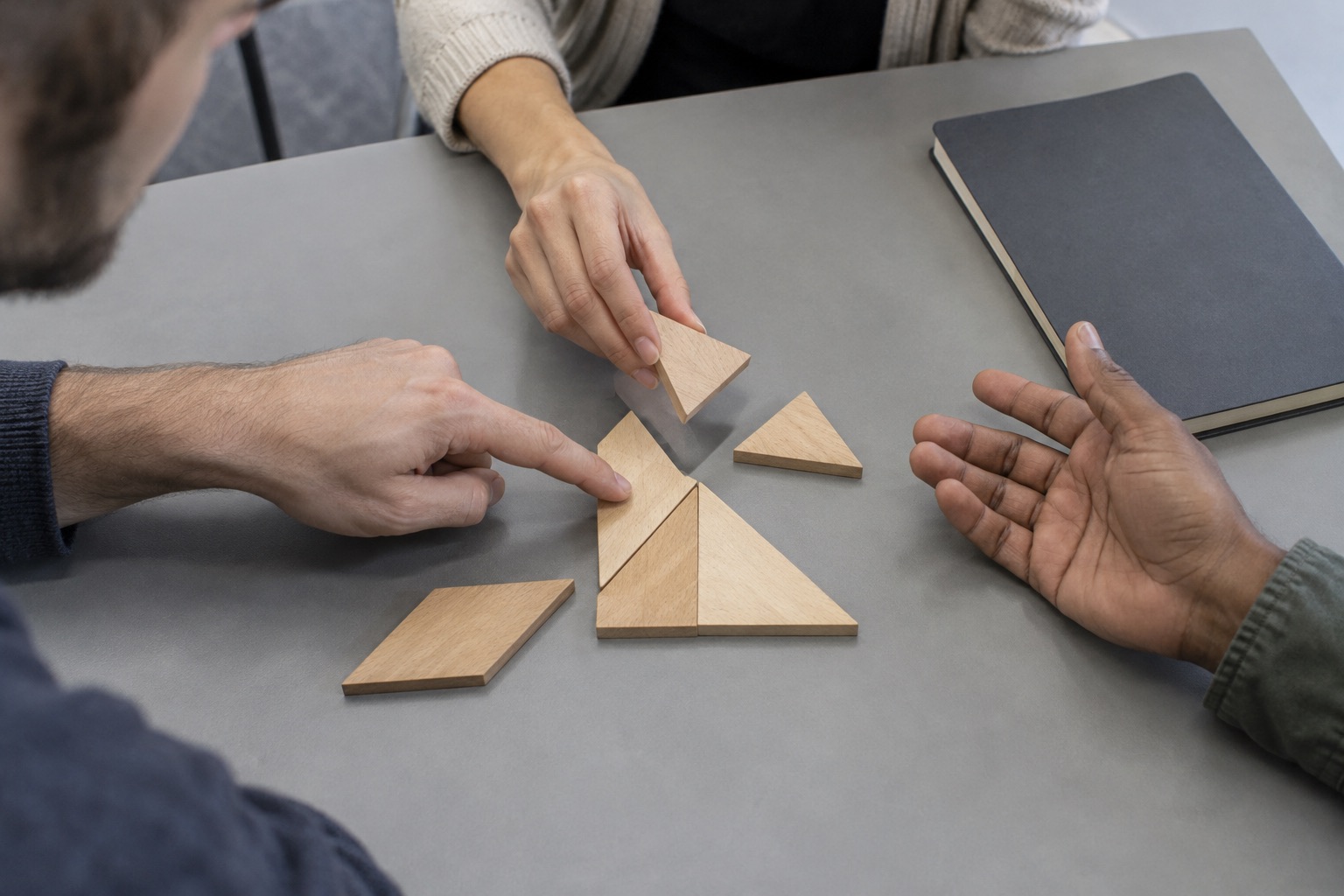
One early assignment asks the group to estimate the current time and set a clock. Mutta’s answer differs from his companions’. We will leave the solution untouched. The episode-eleven setup is enough to pose the useful question: how should a group handle a confident answer that does not match the others?
Agreement among several people can be a reason to investigate an outlying answer carefully. It does not establish that the outlier is wrong. Equally, being the lone dissenter is not a special credential. A story can make disagreement exciting without asking viewers to treat contrarianism as proof of insight.
Separate the answer, the evidence and the explanation. The answer is what someone proposes. The evidence is what they have to support it. The explanation is how they make that support available to other people. You may be able to evaluate one of these before you can evaluate the others.
This distinction is useful even in a very ordinary hypothetical: a friend says a train leaves in ten minutes. They might have checked the current departure board, remembered yesterday’s timetable or heard another traveller say so. The sentence is identical; the reasons to rely on it are not. Asking where the information came from is not the same as accusing the friend of being dishonest.
That analogy does not explain the clock solution. It distinguishes a claim from its basis without revealing who is right.
Episode thirteen widens the range of tasks. It includes calculation while running and a written response aimed at a presenter critical of spending on space development. The official synopsis supplies those premises; the responses and outcomes are left for the episode.
The contrast invites another viewing distinction. Producing an answer under competing physical demands and explaining a position to a sceptical audience are different forms of performance. Someone’s apparent strength depends partly on what the activity asks them to do. That does not make ability meaningless; it makes a single demonstration incomplete.
As a general matter, explaining something to a person who already accepts its importance is easier in one respect: the explanation can take that importance for granted. Addressing someone who questions the premise requires deciding what they need to understand first. More detail is not automatically a better answer if it answers a different concern.
For this article, none of that establishes whether any real space programme’s budget is justified. A fictional communication exercise is not a factual cost-benefit study. Its value to a viewer is that the audience for an answer becomes part of the problem.
Try carrying one question between tasks: what have I actually learned about this person from this activity? A narrow answer can be more useful than a grand one. Perhaps you have seen how they explain uncertainty, or how they respond when someone else challenges a conclusion. You need not convert each observation into a final verdict on the whole person.

A less formal event makes the evaluation problem particularly tangible. In episode fourteen, Furuya accidentally breaks Fukuda’s glasses. Fukuda plays down the effect and continues pushing through the tasks, anxious about how he compares with younger applicants. We will not reveal how the incident is resolved. Official episode-fourteen synopsis.
This is different from another scheduled challenge. Something has happened to a person’s working conditions, and their wish to appear capable may not give others a complete account of the effect. The viewer can therefore ask about the circumstances of a performance, not only its visible outcome.
There is a useful distinction between helping someone participate and deciding the contest in their favour. Restoring access to ordinary equipment is not the same action as awarding success. Collapsing those two ideas would make any assistance look like an unfair advantage before considering what the assistance actually changes.
Take a separate everyday example: a quiz participant cannot hear a question because a microphone fails. Repeating the question repairs access to the task; supplying the answer changes the task. Both could loosely be called “help”, but that label conceals the important difference. This is an original comparison, not a claim about a scene, an accommodation policy or the examiners’ intended lesson.
The incident also gives the person responsible for an accident a problem that cleverness cannot settle retrospectively. Intention and consequence need separate attention. Not meaning to cause a problem does not make the problem disappear; accepting responsibility does not require pretending the harm was deliberate.
An admission can be difficult even when the facts are clear. Watch what a person does about the damage, rather than treating discomfort itself as either an apology or proof of indifference.
The strongest reading is not that a kind gesture earns an invisible winning score. That simply turns another human interaction back into an imagined points system. Instead, keep the uncertainty: what does someone’s response make you trust, question or reconsider? The answer can matter even when you do not know how an examiner would mark it.
Begin with episode one of the television anime. The broadcaster’s episode archive is useful for checking episode numbers, but even its later titles can reveal developments. It is better as a reference after watching than as required reading beforehand.
The early material discussed here suits a viewer who enjoys adults being awkward, competitive and uncertain without needing every disagreement to become a fight. If your immediate preference is continuous action in space, understand that selection and conversation are substantial attractions in this reading—not hurdles the article promises will quickly disappear.
For viewers in India, no current streaming provider is asserted here. Check the television version, episode coverage and language options in the licensed catalogue available to your own account before subscribing. A Japanese programme archive does not establish Indian availability.
If you want another space anime with a different emphasis, our Planetes guide starts after employment: its workers disagree about the value and responsibility of the job they already have. That is a distinct question from deciding whom to trust during selection.
There is no need to pause every scene and complete an assessment sheet. Pick one person whose first impression seems clear, then stay open to the next piece of evidence. Does an unexpected contribution make you reconsider them? Does a persuasive explanation hold up when somebody asks a question? Can you recognise a useful action from a character you find irritating?
Those questions preserve more of the series’ interest than searching for the eventual successful candidates in advance. The destination of a selection story is not its only source of suspense. Learning how to judge the people in it can be part of the story too.
Source review: 12 October 2026. Limited early-TV-anime spoilers; no selection outcomes, current recruitment guidance or Indian streaming availability claims.

AUTHOR OF THIS ARTICLE
SoJapan
SoJapan India Pvt. Ltd. is a Japanese-founded company based in Gurugram. We bring Japanese food, anime goods and apparel materials to Indian businesses, with a sister company in Kyoto that works directly with makers in Japan.