If you have never watched kyudo, Japanese archery, the target gives you an obvious place to look. An arrow arrives; you can see whether it hits. The movements before that result may initially seem like an elaborate wait for the part you understand.
For Tsurune, try moving your attention back towards the person holding the bow. The useful question is not only where the arrow goes, but whether the archer can carry an action through to its release. That distinction makes the opening predicament much easier to follow without learning a rulebook first.
This guide concentrates on the first television series and its early setup. It explains a few real kyudo terms, draws on the production team’s comments, and offers an editorial way to connect them. It does not reveal later match results or prescribe how to shoot a bow.
You do not need to become a technical judge to enjoy that difference. In fact, trying to grade every animated posture is less useful for a first viewing than understanding what a character is struggling to do. Keep the vocabulary small, and let the story establish the personal stakes.
Tsurune names the sound produced when the string strikes the bow at release. The All Japan Kyudo Federation’s terminology guide locates it at that physical event. It is not another name for the noise of an arrow landing in a target.
That is a small distinction with a large effect on where you listen. One sound belongs to the archer’s action; the other belongs to the arrow’s arrival. If you treat both as a single signal of success, you can miss why a sound might interest somebody before the result has settled anything.
Nor does the word itself mean “a perfect shot.” Naming a sound is not the same as certifying correct technique. For an anime viewer, the safest starting point is to recognise what produces it, then consider what importance the story gives it. A pleasing sound should not become a shortcut for deciding that an archer has no remaining difficulties.
The original novel’s publisher glossary adds that the sound can vary with conditions and the archer’s state, even with the same person and bow. That gives useful context for the title, but not a code that lets us translate every difference in a soundtrack into a precise emotion.
Keep those two levels separate. There is a real physical phenomenon, and there is the meaning a work of fiction can build around attention to it. The first helps you identify what you are hearing. The second depends on the surrounding scene, a character’s history and the choices the story has established. An isolated sound cannot explain all of that by itself.
This also changes how to think about beauty in a sports story. Something can draw a character towards an activity without being a trophy, a ranking or proof of superiority. An attraction to the activity’s sound can matter before the character has decided what competitive success should mean. That is a useful possibility to keep open, rather than assuming that every admirable shot represents a future opponent to defeat.
For the soundtrack, listen for the relationship between the event and its surroundings rather than searching for a technical test. Is your attention on anticipation, on the release itself, or on someone’s response? Those are viewing questions, not claims that a particular sound always carries a particular message.
First-series composer Harumi Fuki describes her approach to delicate sound-making in the official countdown comments, invoking the image of the bowstring’s sound. Her comment is a production perspective, not a claim that every musical phrase was literally recorded from a bow. It is enough to suggest that listening deserves a place alongside following the plot.
The early premise makes the timing question concrete. Minato Narumiya enters Kazemai High School reluctant to return to kyudo. At a club introduction, he is asked to demonstrate as an experienced archer and misses. The opening episodes identify his difficulty as hayake, and bring him into contact with Masa-san at a night dojo. These are details from the official early-episode summaries, whose page also contains later spoilers.
In the federation’s terminology, hayake means releasing before kai, or immediately upon reaching it. Kai is the fully drawn state. For a newcomer following the anime, the essential distinction is that the release comes too early; it is not simply a failure to point towards the right place. Federation terminology
A missed target alone cannot tell you that story. If all you record is “miss,” a beginner who has not learned an action and an experienced person who cannot perform it as intended can look equivalent. Dramatically, they are different starting points. The second person brings an expectation of what should be possible, which makes the gap between knowledge and execution important.
That is the lens to bring to Minato, rather than immediately deciding whether he is talented enough. A character can know the activity, care about it and still be unable to make an intention happen. Recognising that contradiction gives the early setup more weight than a simple division between people who try and people who do not.
It also makes reluctance more complicated than disinterest. As an editorial reading, refusing an activity does not necessarily settle a character’s relationship with it. The refusal may be part of the conflict we need to understand. We do not have to excuse every reaction or predict a recovery to notice that “does he like kyudo?” and “can he return to it comfortably?” are different questions.
Avoid turning that distinction into a medical conclusion. A named problem in a sport is not, by itself, a diagnosis of an anxiety disorder. Nor does a fictional response establish a treatment for a real person. This guide uses hayake to clarify the action at stake, not to explain every possible cause or offer a remedy.
Understanding early release is not an instruction to force yourself to hold a real bow longer. Recognising the dramatic problem and correcting somebody’s shooting require very different knowledge.
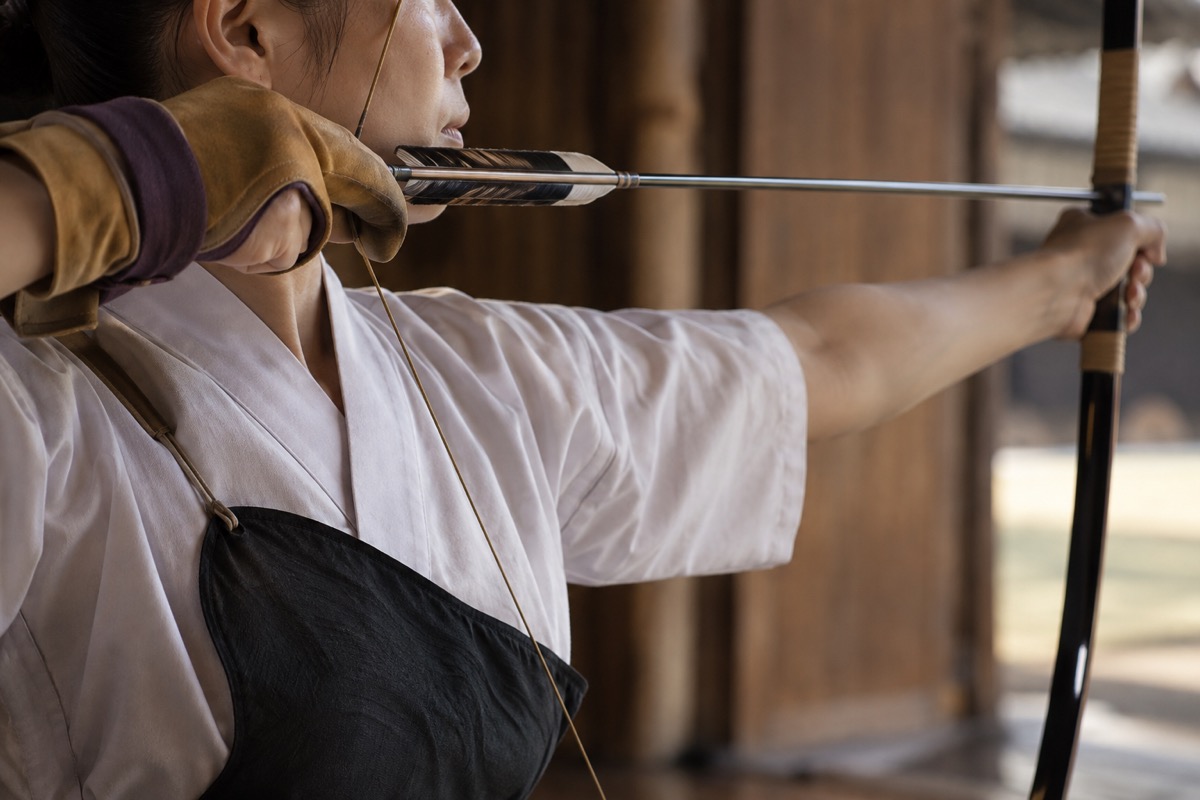
On a first viewing, you can therefore leave the technical solution unresolved. Follow how Minato responds to being asked, watched or encouraged, and allow the show to supply the context. You are not missing the point because you cannot spot a subtle mechanical error. Knowing why timing matters is already a much better foundation than treating each miss as a lack of determination.
The federation’s explanation of shaho-hassetsu, the eight aspects of shooting, explicitly treats them as a connected flow. Their names divide the action for understanding; they are not meant to make it eight disconnected events. The sequence includes hanare, release, and zanshin, the continuation of posture and attention after the arrow has left.
For watching Tsurune, that is more useful than memorising all eight names. It tells you not to assume that the important action starts when the string moves or ends when the arrow is away. Preparation and continuation belong to the same whole.
Think of this as a change in the boundaries of what you watch. If you focus only on flight and impact, the archer is mainly the person who launches an object. If you include the lead-in and continuation, the archer remains the subject. The target is still relevant, but it does not take over every question about the performance.
The following distinctions are an editorial viewing aid, not a scoring system:
| What you attend to | What it helps you follow | What it cannot establish alone |
|---|---|---|
| The lead-in to release | The action the character is trying to carry through. | A complete explanation of the character’s feelings. |
| The release and its sound | The moment the arrow leaves, distinct from its arrival. | A guaranteed hit or a verdict of perfect technique. |
| The continuation and other people’s responses | How the scene remains with the archer and the surrounding group. | The eventual outcome of the character’s story. |
This is not an argument that results do not matter. Removing competition altogether would be another way of ignoring what a sports story puts in front of us. The point is to leave room for two questions: what happened to the arrow, and what happened in the attempt? They may be related without being interchangeable.
It is also a reason not to fast-forward mentally through repeated actions. Repetition gives a viewer something recognisable against which to notice a difference. You need not label the difference correctly on first encounter. Simply noticing that your attention has moved—from the target to the release, for example—can help you understand why an apparently familiar action now feels consequential.
A practical viewing habit is to finish the scene before deciding what the shot means. Listen to what follows, and consider who has been paying attention. That gives the story a chance to qualify your first impression. It is especially helpful when you are unfamiliar with the activity and tempted to let a single obvious outcome stand in for everything else.
Director Takuya Yamamura’s account of his research offers a concrete way to understand the stillness. In a 2018 PASH! interview, he describes attending a high-school kyudo event and finding that the concentration of archers and observers helped create the quiet atmosphere. He also describes the contrast between dignified behavior on the range and the same age group’s noisy, laughing interactions outside it.
That contrast matters more than a blanket description of Tsurune as “calm.” Quiet can be something people collectively sustain in a particular situation. It does not have to mean that their personalities are quiet, that they agree with one another, or that they have stopped feeling anything difficult.
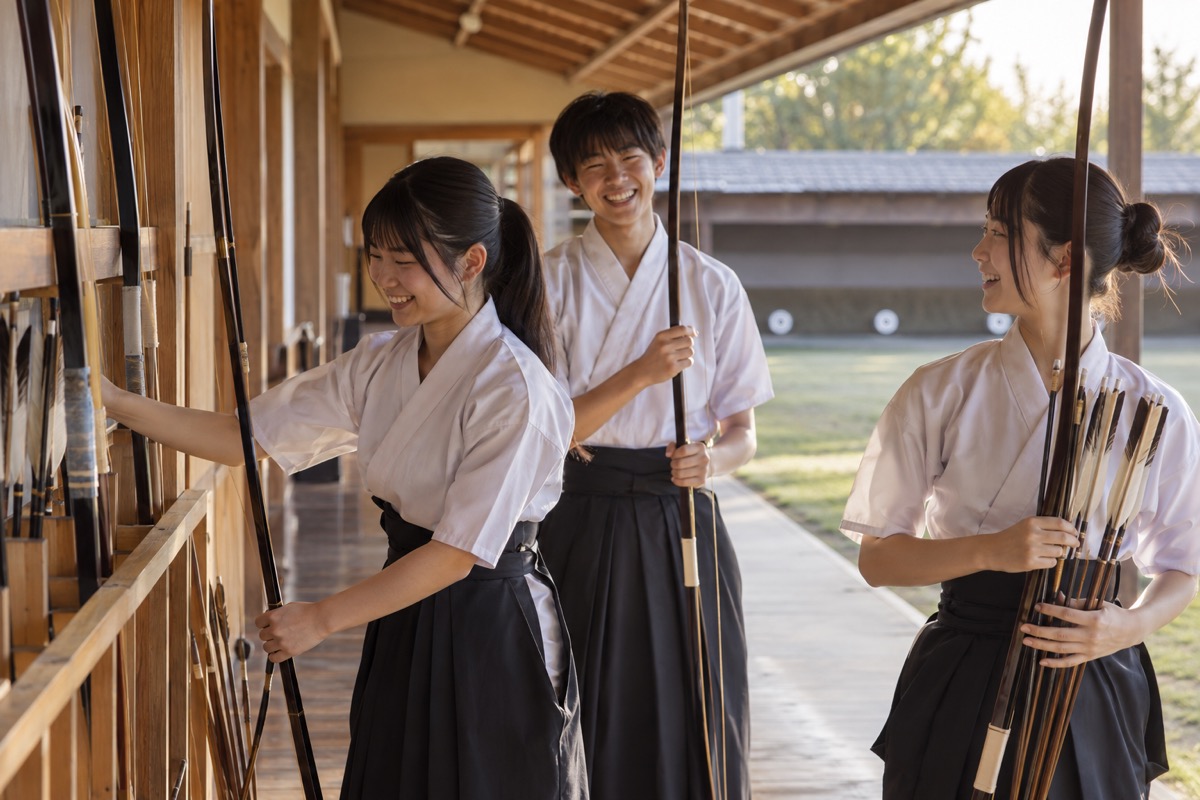
For a viewer, this leaves room for two kinds of attention. During a formal action, notice what people are attending to. Away from it, notice how they address one another. Neither setting has to cancel the other. Informal behavior is not automatically an interruption of the serious story; it can give a formal encounter its personal context.
That is also a useful guard against treating kyudo as an exotic atmosphere rather than an activity practised by people. Beautiful surroundings and measured movements may be part of the attraction, but “serene Japan” is too vague a description to explain a teenager’s hesitation or an awkward exchange. Keep returning from the general mood to the specific person and relationship.
Yamamura says he discussed the contrast with series composer Michiko Yokote, and describes an observational, telephoto-like approach to the group’s informal world. Read this as a stated creative aim, not as a demand that viewers recognise a particular camera effect in every scene. It points towards the distance between observing a group and having its members explain themselves directly to us.
Ordinary movement also deserves attention as animation. In the episode-four production comments, director Shinpei Sawa discusses detailed work on actions such as standing, walking and moving fingers. The example broadens the idea of what counts as an action scene’s preparation: a body has to remain convincing between its most conspicuous gestures.
A separate Kyoto Animation staff diary from April 2022, credited to Manmaru, recalls the challenge of in-betweening Tommy turning his head, particularly its three-dimensional form. This is one worker’s retrospective account, not a description of every animator’s process. Its value here is its specificity: a head turn, not just a flying arrow, can require close consideration.
Neither comment obliges you to admire a sequence because it was difficult to make. Instead, they offer a less obvious place to look. Does a small movement help you remain aware of the person between larger actions? That is a question about the experience of the scene, rather than an attempt to guess the number of drawings or hours behind it.
An individual action can still have a shared emotional setting. A useful perspective comes from ChouCho, who performs the first series’ ending song and practised kyudo at high school. In a 2018 interview, she recalls the tension of team competition and the encouragement that another member’s successful shot could give. This is her recollection, not a guarantee that every team experiences the same effect.
It suggests a distinction worth taking into the anime: other people can change what a moment means without being able to perform it on your behalf. Support is not the same thing as physical substitution. Whatever encouragement exists around the archer, the release remains the archer’s action.
That makes “teamwork” a less complete explanation than it initially sounds. If we say only that friends help, we skip the interesting questions. What form does that help take? Is the character ready to receive it? Does being watched feel reassuring in this situation, or does it make the attempt harder to face? These are questions to follow, not outcomes this guide will answer for you.
The early official setup already makes company significant: Minato’s return is not welcomed in exactly the same way by everyone. Kaito questions his change of mind. That is enough to avoid imagining the club as a single voice of encouragement. Official episode-three introduction
You do not need to decide immediately which person has the correct response. From a viewing perspective, the disagreement itself is useful. One person’s invitation and another person’s doubt can place different demands on the same decision. Following those demands is more precise than treating the whole group as either helpful friends or obstacles to the protagonist.
If you have read our Run with the Wind guide, the contrast is useful. There, the viewing question centres on people sharing a home and negotiating a collective commitment. Here, keep the focus closer to the particular action: what can company change, and what must the archer still carry through personally?
That focus avoids making the team a cure that explains everything. A relationship can matter without erasing an individual problem, and an individual difficulty can matter without making the surrounding group irrelevant. Leaving both possibilities open is more rewarding than trying to reduce the opening episodes to a moral about self-reliance or friendship.
For this guide’s setup, begin with the 2018 first television series, identified on the official first-series site. That keeps the introduction to Minato and his return to kyudo in order. This is an entry recommendation, not a claim about which services currently carry it in India; check your own region’s licensed catalogue and the exact series listing.
You can begin with just three ideas: the title names a bowstring sound, hayake concerns early release, and a shot includes more than its impact. There is no need to pause every unfamiliar term. The names become useful when they clarify a difficulty or an action you are already trying to understand.
On the evidence and creative intentions discussed here, Tsurune is a promising choice if you enjoy stories that ask you to attend to the lead-in to an event, not only its climax. If your immediate preference is for constant overt confrontation or rapidly changing spectacle, that emphasis may not be what you want tonight. Neither response requires declaring the series universally soothing or universally slow.
For a different kind of listening in a sports anime, our Chihayafuru viewing guide explores how recognition and response make competitive karuta readable. Tsurune asks for a different adjustment: stay with the person completing the action, rather than waiting only for the result that is easiest to recognise.
When you start, try one question: where did the difficulty begin before the arrow left? You may not have an answer immediately. That uncertainty is a useful reason to keep watching the character, rather than a gap you need a technical manual to fill.

AUTHOR OF THIS ARTICLE
SoJapan
SoJapan India Pvt. Ltd. is a Japanese-founded company based in Gurugram. We bring Japanese food, anime goods and apparel materials to Indian businesses, with a sister company in Kyoto that works directly with makers in Japan.