You can care deeply about a picture and still struggle to explain why. Making a picture of your own adds another difficulty: the person looking at it cannot borrow your memories or intentions. They have what you put in front of them.
That gap is a useful way into Blue Period. Rather than watching only for signs that its protagonist is becoming talented, watch for the choices that make a private response visible to somebody else. A colour, an arrangement or a criticism can then become a turning point, not merely information between the dramatic scenes.
The television anime follows Yatora Yaguchi, a high-school student whose strong grades and social adaptability coexist with a sense of emptiness. An encounter with a painting opens an unfamiliar ambition: studying art at Tokyo University of the Arts. The adaptation is based on Tsubasa Yamaguchi’s manga, with animation by Seven Arcs. Official introduction and story archive, staff credits.
This is a guide to that early creative problem, not an art lesson or an admissions guide. It discusses the premise and selected setups through episode four, without revealing examination results or the ending. Linked story archives and interviews can contain later spoilers. The viewing questions and comparisons below are our editorial interpretation; factual story and production details have sources beside them.
Three distinctions will help you decide how closely to follow the art itself:
Yamaguchi gives a revealing account of this premise in an interview hosted by Tokyo University of the Arts. The author wanted an effort-driven art story, reversing the familiar idea of someone who can do little except create brilliant art. Yatora was conceived as a logical, broadly capable person attempting something he could not already do. Creator interview.
That changes the question a newcomer brings to the series. It is not simply whether a hidden gift will finally be recognised. It is whether familiar ways of achieving a good result will still work when the task demands a personal choice.
There is a difference between understanding what people expect and deciding what you want them to see. The first can be useful: attention to others is not a defect, and discipline does not suddenly become worthless in an art room. But neither supplies the answer to the second question automatically. This is where Yatora’s starting position becomes more interesting than a simple opposition between a sensible student and a reckless artist.
For viewers accustomed to school stories organised around marks, the shift can feel disorienting. A mark appears to settle the immediate comparison. A picture invites a further question: what exactly did the maker attempt? Without that question, every discussion of art risks becoming a scoreboard with the numbers removed.
Try keeping two forms of progress separate as you watch. One is becoming more capable of doing something. The other is becoming clearer about why that particular thing matters. A character might advance in one while remaining confused about the other. That possibility gives learning a less predictable shape than a steady climb from bad drawings to good ones.
It also keeps effort from becoming a moral guarantee. Wanting something badly does not oblige the world to reward it, and working hard does not make every decision effective. An effort-centred story can be compelling precisely because effort leaves the outcome open. You can be invested in a choice without needing the anime to certify that everyone should make the same choice in real life.
Our Barakamon guide offers a useful contrast. Handa begins with a developed craft and has to negotiate the people around it. Here, the useful starting question is how someone acquires a way of expressing something in the first place. The two series can appeal to the same viewer without offering interchangeable versions of artistic frustration.

The opening episode connects Yatora’s response to Shibuya with expressing the city in blue. That is a small enough premise to discuss without following his later achievements, and a concrete place to begin looking at his decisions. Official episode-one synopsis.
Instead of asking whether blue is the objectively correct colour for the place, ask what the choice brings forward. Does it give another person access to a quality that a more literal description might leave unspoken? That is an interpretive question, not an instruction to assign blue a single emotional meaning.
Colour need not be a code that an audience deciphers into one approved answer. If every choice could be replaced with a label, there would be little reason to make the image. The useful tension is between something open enough to invite a response and something specific enough to feel chosen.
This gives viewers without painting experience a manageable point of entry. Start with what holds your attention. Then consider what makes it hold: a contrast, the amount of space given to something, or the relationship between elements. You do not need to identify a historical movement before you are allowed to notice an emphasis.
Nor do you have to like every picture that a character admires. There are at least two different questions available: whether you personally respond to the result, and whether you understand why this person responds to it. A drama can succeed at the second without persuading you of the first. Letting those answers differ makes room for curiosity rather than a test of your taste.
The distinction between admiring and making is important here. As an audience member, you can move towards what interests you. As a maker, you must decide what will remain in the work and what will not. Admiration may provide a direction, but it does not make those selections on your behalf.
For a first viewing, there is no need to pause every image and analyse it. Choose one artistic decision that the story brings to your attention and follow what happens to the character’s understanding of it. That is often more revealing than collecting terms. The vocabulary is useful when it gives you a better question, not when it makes watching feel like revision for another exam.
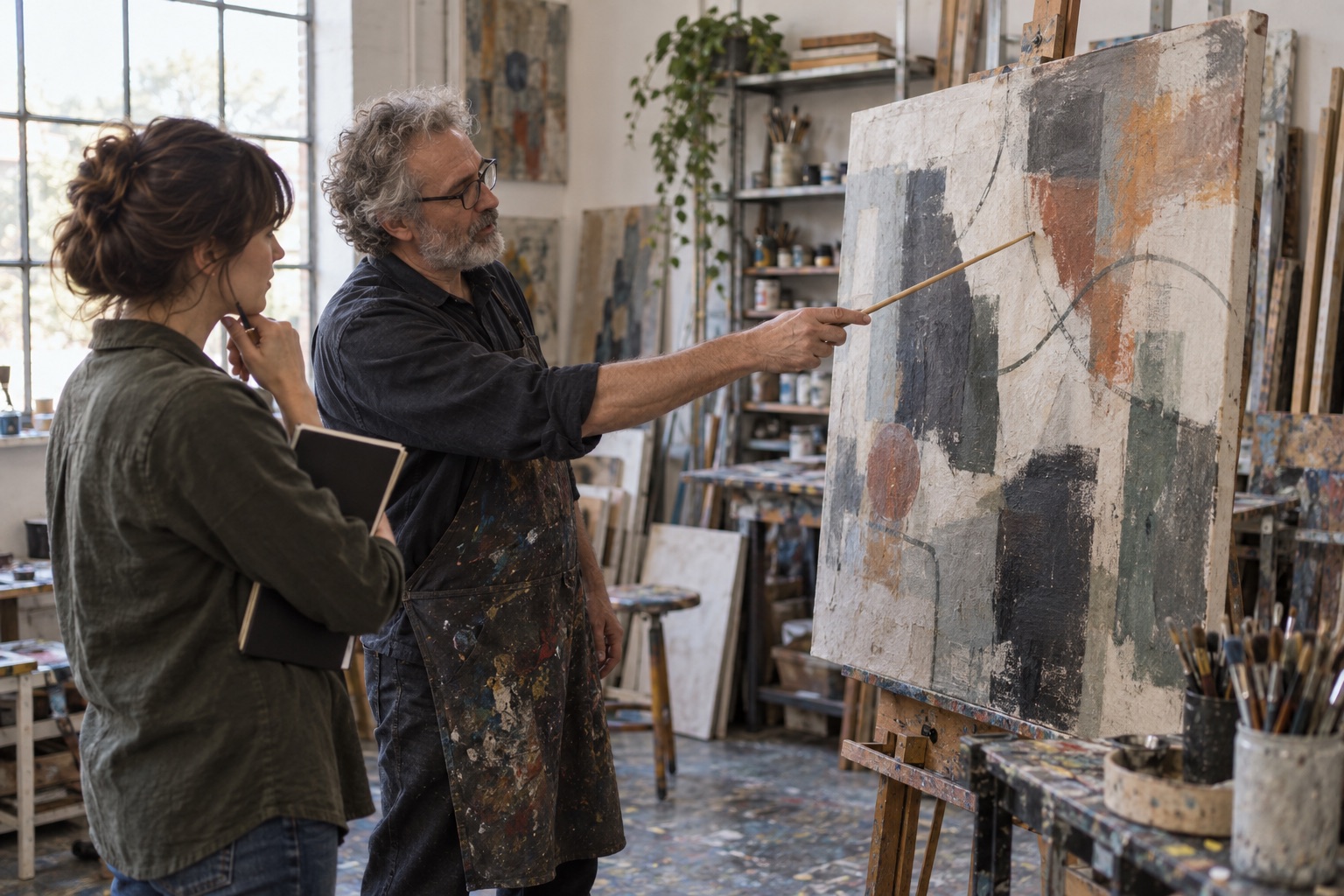
After entering an art preparatory school, Yatora is pushed to discover his own preferences. Episode four supplies a sharp problem: he is criticised for assembling appealing elements from admired work, and teacher Mayu Oba explains composition and guiding the viewer’s eye. Being told something is insufficient and finding a specific way to think about it are different steps. Official episode-three and episode-four synopses.
The dramatic interest is not exhausted by how harsh the criticism sounds. A cutting remark can produce an immediate reaction while leaving the maker with no usable next step. A quieter explanation can alter the entire problem by giving the person something to examine.
Here is a compact way to separate those possibilities. These are editorial categories for following the drama, not quotations from the anime or a universal method of teaching art.
| Kind of response | What it tells you | What to look for next |
|---|---|---|
| Verdict | Whether someone approves of the result. | Does the character receive any reason they can examine? |
| Diagnosis | Which relationship or choice may be causing a problem. | Can the character recognise it in the work? |
| Revision | What the maker changes in response. | Does the change serve the intended picture, or merely seek approval? |
A simple hypothetical distinction helps: being told that a picture is confusing does not identify where the confusion begins. Being asked which part should attract attention first points towards an inspectable choice. It still does not dictate the answer. That difference is the point of the example, not a claim that all pictures require one obvious focal point.
This is also why learning a technical term need not oppose personal expression. A term can identify a relationship that was previously difficult to discuss. It becomes restrictive only if it is treated as a ready-made verdict on every possible work. The useful question for this story is what a character can now notice or change, rather than whether technique has defeated feeling.
There is another trap: assuming that a hurtful delivery proves a criticism is insightful. Tone and usefulness are separate matters. A response may contain a worthwhile observation without making every part of the exchange admirable. Watching that distinction leaves room to understand a character’s reaction without automatically endorsing either the critic or the recipient.
Likewise, disagreement is not evidence that a person has learned nothing. Consider what they disagree with. Rejecting a whole response to escape discomfort is different from understanding its premise and choosing another direction. You do not have to determine which character is permanently right; you can follow the reasoning available at that moment.
Under an assessment goal, approval has practical consequences, so it would be too easy to dismiss it as irrelevant. But if approval becomes the only explanation for a decision, the question of personal expression disappears. Holding both concerns in view is a more productive way to follow Yatora than dividing every choice into pure art and cynical exam strategy.
An art-school setting makes comparison tempting. Another person’s work is visible; the route by which they made it may not be. If a viewer treats the supporting cast only as evidence of how far the protagonist has to climb, the comparison becomes narrower than the people involved.
Yotasuke Takahashi is introduced as someone with striking ability and difficulty communicating with others. Ryuji Ayukawa, also called Yuka, has a distinct artistic direction: Japanese painting, rather than Yatora’s oil-painting goal. Even these brief profiles caution against imagining that everyone occupies a different rung on one identical ladder. Official character profiles.
The cast’s own comments offer a second perspective. In the official 2021 interview, Daiki Yamashita discusses looking beyond Yotasuke’s apparent giftedness to the person underneath. Yumiri Hanamori talks about Yuka’s wish to be understood and the difficulty of sustaining personal preferences against other people’s expectations. These are the performers’ readings of their roles, not diagnoses of the characters. Official cast interview.
A useful viewing question follows: whose experience is available in a particular exchange? Looking at somebody from outside can make their ability seem effortless. Being invited to consider their own priorities changes the comparison. It does not erase a difference in skill; it makes that difference less adequate as a complete description of a person.
Yuka especially should not be reduced to a device that introduces the hero to art. You can notice what matters to Yuka without requiring every concern to become a lesson for Yatora. This is a small shift in attention, but it changes how a conversation reads: another person’s preferences are not simply clues to the protagonist’s next stage of development.
That does not mean the story must make every disagreement comfortable. The point of this lens is to preserve competing interests, not smooth them into a message that everybody is secretly the same. When people care about different things, a single measure of progress will leave something out. Watching for what it leaves out can make the quieter exchanges as important as an assessment of a finished picture.
There is a practical reason to give the television version your ears as well as your eyes. In a January 2022 interview with with, Yatora’s voice actor Hiromu Mineta said painting and environmental sounds had been recorded at a school, and drew attention to details including breathing and the sounds of working. His account suggests a specific listening focus beyond dialogue and music. Mineta interview, second page.
Take that as an invitation to attend, not a promise that every sound is a documentary recording. The useful question is what work sounds like when it is happening, before a completed picture can be judged. A finished surface presents a result; breath and activity can direct attention towards the person producing it. The two offer different kinds of information.
The manga raises a different material question. In PIGMENT’s May 2022 studio interview, Yamaguchi describes scanning ink textures and combining them with digital tones, seeking variation and a better fit between the manga’s surfaces and the artworks within it. This is a description of making manga pages, not the anime’s animation technique. PIGMENT creator interview.
That is a good reason not to think of a monochrome edition simply as the television image with colour removed. A page has its own ways of distinguishing surfaces and emphasis. If the story makes you curious about how an image communicates, its source format can become part of that curiosity rather than merely a place to find what happens next.
There is research behind the original manga’s art discussions, too. In the university interview, Yamaguchi describes consulting multiple books for technical material, speaking with others rather than relying only on older personal memories, and using contributed artworks with permission. The account helps distinguish informed fiction from a supposedly unmediated record of the author’s life. Yamaguchi on research and artworks.
It does not turn every statement in a fictional classroom into comprehensive instruction. Nor does it make the story a current map of admission requirements. Research and dramatic selection can coexist: a creator chooses what a reader needs for this scene, which is a different responsibility from preparing somebody for an actual application.
If the making of moving images interests you more than the evaluation of paintings, Keep Your Hands Off Eizouken! offers a contrasting question: how do different creative priorities become a film that can be finished? That comparison is more useful than treating both titles as interchangeable encouragement to draw. One can prompt curiosity about personal expression under assessment; the other about negotiating a shared production.
Start the television anime with episode one. The changing relationship between responding to art and trying to make it is the reason to follow the beginning, not an obstacle to skip before the supposedly important examination material. You do not need an art-history primer or familiarity with another franchise.
If you would rather read, Kodansha publishes the English manga, with volume one providing the starting point. Its product page labels that edition 16+; that is a manga publisher’s rating, not a universal age classification for every anime release. Check the actual edition or platform’s guidance for the version you choose. Kodansha’s English volume one.
For viewers in India, confirm a current authorised listing in your region before paying for a subscription or edition. Check the exact title, episode access and audio/subtitle languages you need. A historical interview’s streaming reference or a US publisher’s retailer links do not establish today’s Indian availability. This guide does not claim a locally available service or price.
The premise is a stronger fit if you enjoy people trying to put uncertain thoughts into a form others can respond to. It also gives you something to follow if you like school drama but want more than a straightforward ranking of achievements. An interest in painting helps, but curiosity about choices and criticism is enough to begin.
Approach it differently if you mainly want a soothing craft demonstration. An examination goal and concern about evaluation are built into the setup; learning here is not simply a succession of relaxing projects. Equally, do not choose it as a substitute for painting instruction. Enjoying the way a drama makes an idea intelligible and learning to apply that idea yourself are different activities.
For a first viewing, one question is enough: what is this person trying to make another person see? It gives you a way to notice the art without needing to announce a verdict on it. As the answer becomes more specific, a discussion of a picture can become a discussion of a choice—and that is where this art-school premise has room to become drama.

AUTHOR OF THIS ARTICLE
SoJapan
SoJapan India Pvt. Ltd. is a Japanese-founded company based in Gurugram. We bring Japanese food, anime goods and apparel materials to Indian businesses, with a sister company in Kyoto that works directly with makers in Japan.