Antarctica is an impressive destination to put in an anime premise. A convenience-store job is a less obvious attraction. In A Place Further Than the Universe, the connection between the two is a good reason to pay attention.
The opening does not treat wanting an adventure as the same thing as being able to join one. It gives the ambition smaller, less glamorous problems: earning money, finding a route into an expedition, contacting somebody and learning what participation requires. Those problems give the characters opportunities to be funny, hesitant and unexpectedly serious before a distant landscape can do the work for them.
This guide is for viewers curious about the series beyond its beautiful destination. It discusses the premise and selected developments from episodes 1–4, without revealing later confrontations, the expedition’s eventual outcomes or personal resolutions. The premise includes a mother who has not returned from Antarctica; expect difficult family feelings alongside the comedy. Some linked interviews contain much later spoilers, as flagged below.
Three distinctions make the opening easier to follow:
The reading offered here is editorial interpretation, grounded in the official early-episode descriptions and attributed production interviews. It is not a travel guide or a claim that the fictional arrangements can be reproduced in real life.
Mari Tamaki, nicknamed Kimari, has reached her second year of high school without taking the step she hoped would make life feel different. Shirase Kobuchizawa already has a much more definite ambition: Antarctica. The opening brings Kimari into contact with somebody who refuses to abandon that goal simply because other people dismiss it. Official episode-one introduction.
That contrast is more useful than immediately sorting them into a cheerful character and a serious character. One person wants to begin; the other has named what she is trying to do. Neither position, by itself, supplies a complete plan.
Our reading is that the meeting changes the scale of Kimari’s uncertainty. Instead of wondering what sort of life might be exciting, she has something specific to investigate. That does not mean she has suddenly become knowledgeable or fearless. It means her next hesitation can concern an actual action rather than an indefinite future.
Shirase should not be mistaken for the complete solution. Her mother’s absence gives the destination a personal weight, identified in Kana Hanazawa’s account of the character. It is not merely an unusual place selected to impress classmates. But a powerful reason to go cannot answer every question about how. Hanazawa and Inori Minase’s early cast interview.
You can therefore follow two questions without expecting them to produce identical answers: why does this destination matter, and what would make the next step possible? The first concerns attachment. The second concerns circumstances. Keeping both in view prevents the story from becoming either a motivational slogan or a transport puzzle.
For a newcomer, there is no need to learn Antarctic geography before pressing play. The initial uncertainty is part of the point of entry. Start by noticing when somebody’s grand statement becomes a smaller request, a decision or a task that another person can respond to.

Episode two makes money concrete. In the expedition arrangement described there, participants will board at Fremantle, Australia. Kimari needs the airfare to get there, so she starts working at a convenience store. Her co-worker Hinata Miyake wants to join the adventure as well. Official episode-two synopsis.
This is a detail about the story’s route, not a current statement about how all Antarctic journeys operate. Its dramatic use is easier to understand: the enormous destination creates an ordinary reason to turn up for work.
The job matters because it gives intention a form that lasts longer than a declaration. A person can be sincere during one exciting conversation. A wage-paying task introduces repetition, time and a contribution that can be accumulated. It also creates a setting in which another person can encounter the project without already belonging to a school club devoted to it.
Then the problem changes. In episode three, the girls search on their phones for a way for high-school students to take part. They discover that Yuzuki Shiraishi, a student and actress, is due to accompany a reporting team. Shirase wants her agency contacted, and the phone is pushed between the girls. Official episode-three synopsis.
The phone is a particularly good object around which to read this stage of the story. Holding information is not the same as being willing to act on it. Searching lets you remain an observer; making contact means that somebody else can answer, ask questions or refuse.
That is a different difficulty from earning airfare. More savings would not automatically tell you whom to contact or make an awkward conversation less awkward. Equally, a promising contact would not make every other practical requirement disappear. The opening gives the ambition more than one kind of resistance.
Notice the comic possibility in that arrangement. Somebody can be the most insistent person in the room while still not being the person best equipped to handle the next interaction. Passing a phone around can reveal this without a formal speech about anyone’s weaknesses.
It also changes how to watch the arrival of a new character. Rather than asking only which personality type will complete the group, ask what the opportunity means to each person involved. Access to a journey and a desire to make that journey are separate things. A professional arrangement, in particular, should not be read as a complete statement of somebody’s private feelings.
Leave the meeting’s resolution for the episode. The useful preparation for watching is simply to recognise that the story has moved from “we need a means” to “we need to deal with people outside this room.” That is progress, but it also makes the plan vulnerable in a new way.
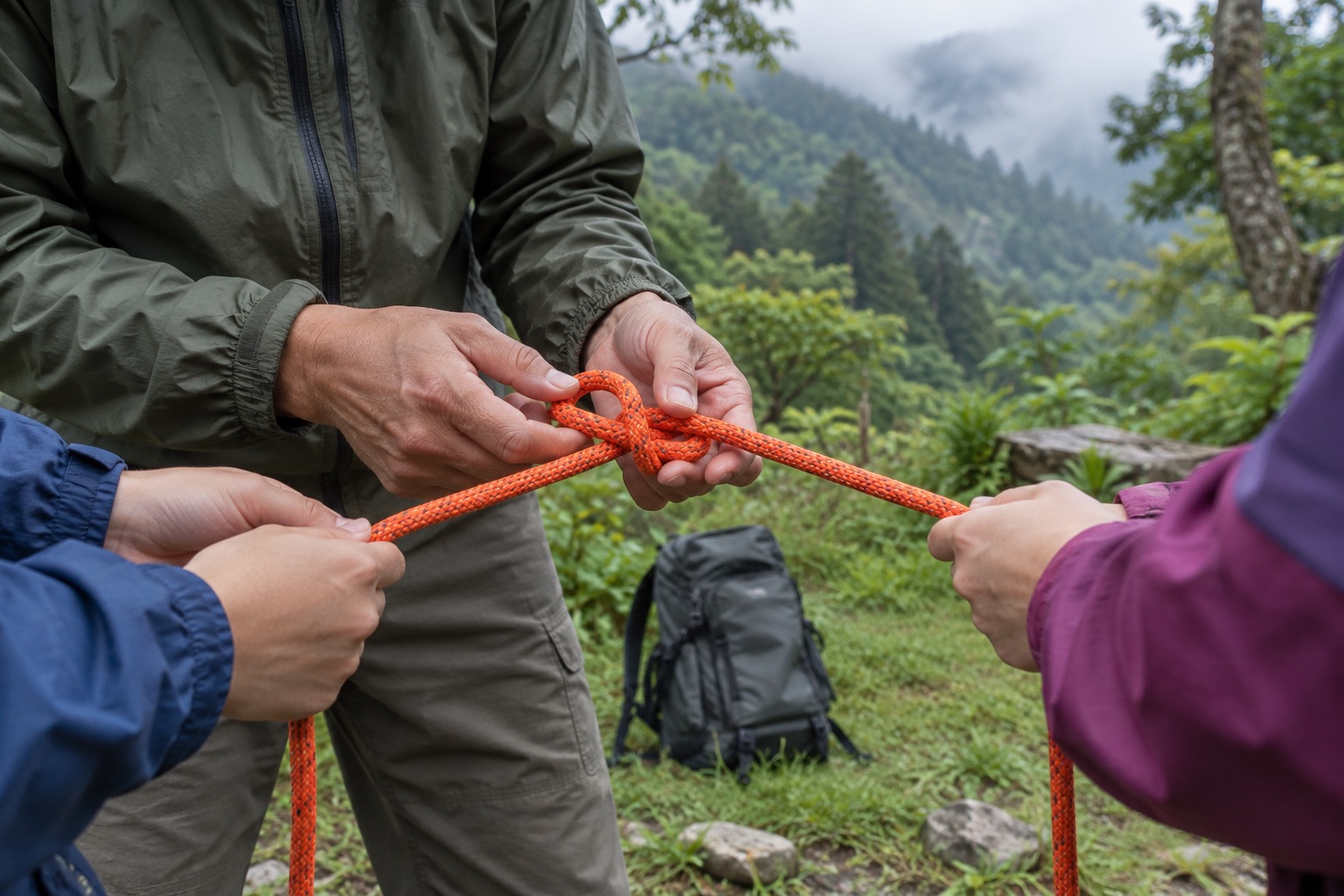
By episode four, the girls have secured an opportunity to go and face summer training. The official description includes both classroom learning and fieldwork, under the expedition’s adults. Gin Todo, the expedition leader, enters this stage of their preparation. Official episode-four synopsis.
This shifts the question again. The story is no longer concerned only with making someone listen to the proposal. Participation asks the girls to acquire knowledge and skills. Getting through one barrier reveals another responsibility rather than turning them immediately into experts.
There is an important viewing distinction here: training is not necessarily a pause before the adventure. It can be where the adventure first stops belonging entirely to the person imagining it. An organised undertaking has procedures, other participants and people responsible for more than the newcomers’ excitement.
That does not make the adults an uninteresting administrative layer. Their presence changes whose judgment matters. Within a small group, enthusiasm can circulate and reinforce itself. A training setting introduces tasks that cannot be settled only by agreeing that the ambition is worthwhile.
Watch for the difference between being keen to arrive somewhere and being willing to learn what the journey demands. They may coexist, but they need not appear at exactly the same speed. This is an interpretive question to bring to the episode, not a claim that every character’s response can be reduced to a single lesson.
None of this establishes that the anime is comprehensive instruction. Fiction selects the parts of preparation that serve its story. It cannot tell a real traveller that all relevant permissions, training, equipment or safety decisions have been represented. Here the value of the sequence is dramatic: an accepted ambition begins to acquire obligations.
For a different treatment of commitment, our Run with the Wind guide begins with housemates who have not all chosen the same athletic project. The contrast helps: finding people, agreeing on a destination and preparing to take part are not interchangeable story problems.
The cast’s early production discussion offers a useful corrective to reading Shirase as an unchanging emblem of resolve. Kana Hanazawa, her Japanese voice actor, discusses the gap between the character’s striking appearance, forceful ambition and awkward reactions. Inori Minase, who plays Kimari, describes an openness that is not calculated, alongside the character’s difficulty taking a first step. Their performances were not being built around effortless confidence. Minase and Hanazawa’s interview.
Our interpretation is that this makes embarrassment part of the adventure rather than evidence against it. A character does not have to look admirable in every moment for a desire to matter. If awkwardness automatically disqualified the girls, the story would have very little room to let them attempt anything unfamiliar.
For viewers, that can be more interesting than a perfectly delivered inspirational speech. A speech tells you how a person would like a moment to sound. A hesitation or an excessive reaction may reveal something the person cannot package so neatly. You get a reason to care about the attempt without being required to endorse every tactic.
When watching a group exchange, give the reactions some attention too. You do not need to classify the whole cast in advance. Ask who is proposing an action, who is responding to the proposal and who is reacting to the way it was made. Those roles can move around inside a conversation.
The comedy therefore need not be treated as a distraction from the serious premise. It can make the people attached to that premise less abstract. A viewer might understand the importance of a destination intellectually, but a badly handled interaction supplies a more particular person to follow there.
This is also a reason not to sell the series only as encouragement. Its appeal can include affection for people who are not behaving ideally. That leaves room for disagreement, vulnerability and uncomfortable feelings, rather than promising a steady sequence of uplifting affirmations.
Director Atsuko Ishizuka connects the credibility of the distant setting to the credibility of life before departure. In her official interview, she points to location research for schools and streets, including the early Shinjuku setting. She also describes changing colour design between Japan and overseas to convey a different atmosphere. Ishizuka’s official production interview.
That suggests a productive way to look at an adventure anime: the familiar environment is not disposable material placed before the impressive one. It establishes what ordinary movement, light and social space feel like for the characters. Difference needs a starting point.
A background can help answer questions that dialogue need not explain. Is this a place where the characters know how to behave? Do they have space to gather privately, or are they negotiating a public setting? Does the environment make the proposed action seem manageable or exposing? Those are viewing prompts, not claims about an unverified sequence of shots.
Ishizuka also describes the limits of the production’s firsthand research. The team received cooperation from the National Institute of Polar Research and the Maritime Self-Defense Force and boarded the ship Shirase, but did not visit Antarctica. Visual records and conversations with former expedition members helped fill out daily-life details. The director’s account of the research.
That boundary is worth preserving. “Researched” does not mean every artist personally experienced every place being represented. Nor does working from photographs mean the production only copied scenery. Asking how people wash, rest or spend ordinary time can reveal details a dramatic landscape photograph does not supply.
The editorial point is that plausibility often depends on the apparently minor question. A destination can look spectacular and still feel uninhabitable as a story setting if nobody seems to have an ordinary day there. Conversely, a small routine can make an unfamiliar environment imaginable without making it familiar in every respect.
Our Laid-Back Camp guide considers places through separate trips and shared views. Here, the more useful emphasis is change: how does an established everyday world give a journey somewhere else its sense of distance? Similar attractive scenery does not require an identical reading of the two shows.
In a later direct interview, Ishizuka describes an approach to technical exposition: let Jukki Hanada’s conversations keep moving, and supply necessary information visually. She also values small conversational detours for what they reveal about relationships. The director’s Tokyo University Newspaper interview contains major later-episode spoilers; save the source for after viewing if needed.
This is a more precise production clue than calling the dialogue “natural.” It describes a division of work. Spoken exchanges do not have to carry the entire explanation of a setting while simultaneously revealing personality, moving the plan forward and landing a joke.
For your own viewing, try separating two questions. What information does the exchange provide about the journey? What does the manner of the exchange provide about the people? The answers can differ. A practical conversation can fail to settle its practical problem and still tell you something valuable about who takes initiative or avoids exposure.
Look at the image before assuming an explanation is missing. Where the participants are, what they are handling and how they respond may already make part of the situation legible. This does not require pausing to inspect every frame. It means giving the visual arrangement a chance to communicate alongside the subtitles or voices.
The same interview describes care for each episode’s individual shape and for the feeling around its ending. That offers another useful habit: let an episode finish before immediately replacing its last impression with a plot summary. An ending can change the weight of the action that preceded it without adding another spoken explanation.
You can enjoy the series without knowing any of these staff names. If the craft interests you, the official credits identify Ishizuka as director, Hanada for series composition and screenplay, and Takahiro Yoshimatsu for character design and chief animation direction. The discussion above concerns particular responsibilities and choices, not a claim that one person made the whole work alone.
A Place Further Than the Universe is an original television anime, animated by MADHOUSE, rather than a manga or novel adaptation. Its original broadcast began in 2018. The official box listing identifies the complete television run as 13 episodes. Official introduction, studio interview, episode-count listing.
Start with episode one. If you like having an early checkpoint, the first four episodes cover the different kinds of preparation discussed here. That is our suggested viewing interval, not an official arc designation or a demand to continue something you do not enjoy.
The series is a promising choice if you want an adventure in which arranging to leave can be as revealing as arriving. The comedy, practical obstacles and personal reasons for participating give you several ways into the story. If your main interest is uninterrupted polar exploration or a technical documentary about research work, the early relationship drama may not be what you are looking for.
Likewise, a cute-looking group and an unusual destination should not be mistaken for a guarantee of emotionally undemanding viewing. The missing-parent premise is enough to signal that not every important question is about transport. You can make that suitability decision without reading how the story eventually addresses it.
For viewers in India, this article does not promise a currently available streaming platform. Check the licensed service accessible to your account, its episode list and language options before paying. A Japanese broadcast archive or disc listing does not establish regional streaming access.
In the studio interview, Ishizuka emphasises the experiences and relationships formed through the journey over merely reaching Antarctica. That is a useful final adjustment to expectations. The destination gives the characters direction, but reaching the next stage is not the only thing a scene can accomplish.
Begin with the small actions. Notice when a wish acquires a cost, when information asks for a conversation and when an opportunity asks for preparation. You do not need to know what awaits at the end to see why those moments belong to the adventure.

AUTHOR OF THIS ARTICLE
SoJapan
SoJapan India Pvt. Ltd. is a Japanese-founded company based in Gurugram. We bring Japanese food, anime goods and apparel materials to Indian businesses, with a sister company in Kyoto that works directly with makers in Japan.