The most revealing moment in making takoyaki comes before it looks like takoyaki. Batter spreads across a pan full of small hollows. Pieces of octopus disappear into it. Only after the cook divides and turns the mixture do the familiar round snacks emerge.
That transformation explains more than the label “octopus balls”. Takoyaki is not normally a solid ball of dough with a filling pushed into the middle. Its tender interior and rounded exterior develop together as a fluid batter cooks in a shaped pan. Sauce is the finish, not the explanation.
For an anime fan in India encountering the dish through a festival scene, a menu or a home-cooking video, three distinctions help: the batter is separate from the octopus, the topping is separate from both, and a soft texture is not an instruction to leave flour or egg uncooked. This guide follows those distinctions from the first pour to the first order.
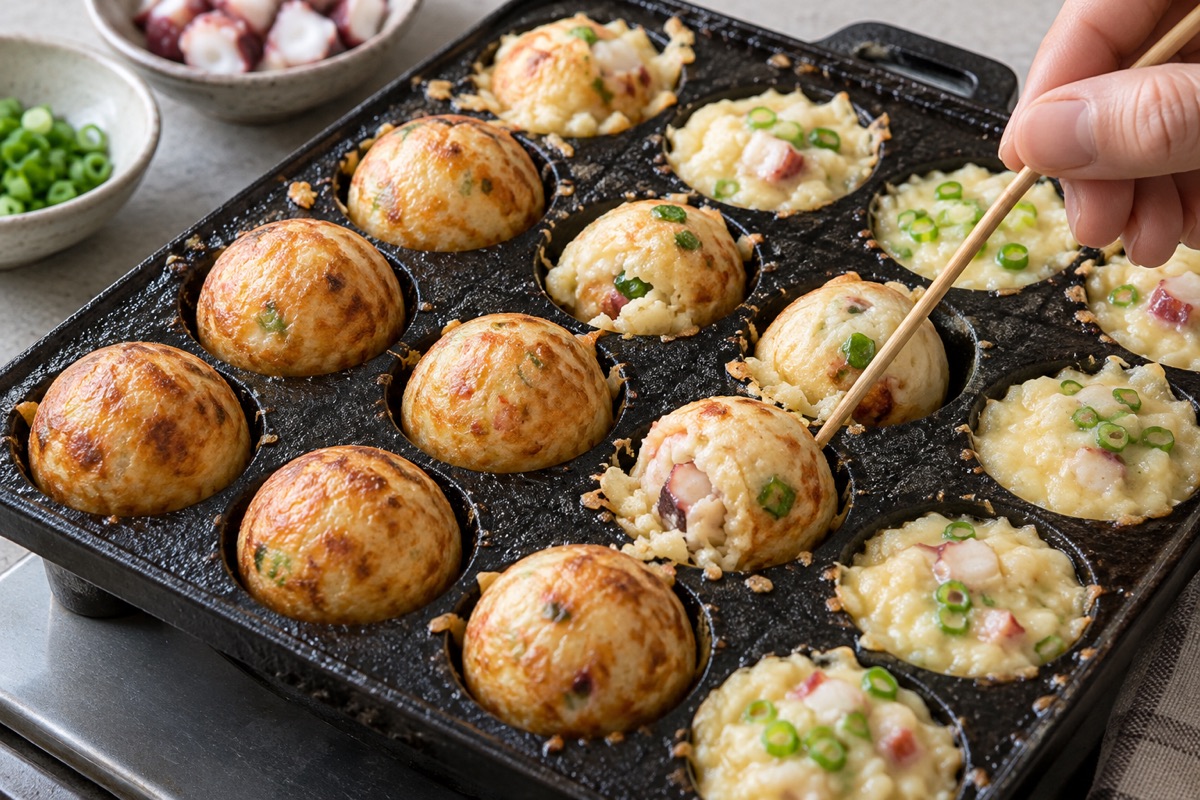
A hollow supports only the lower surface. Turning brings another side against that curve: it forms the snack rather than merely colouring an existing sphere.
Otafuku’s Takoyaki Kodawari Set guide shows batter, fillings and an overflowing second pour. The connected layer is divided as it sets. A lightly firm rim signals the first turn, before the whole portion solidifies.
The apparently untidy overflow belongs to the portions in this method. Follow its quantities and equipment guidance; the demonstration is not permission to overfill any appliance.
The maker’s separate rounding guide advises placing the unfinished or open part down against the hollow, with the rounded dome above. It also warns that impatiently handling the pieces too much makes shaping harder.
Those two points belong together. “Keep turning” does not mean “keep moving everything from the moment you pour”. The useful question is which part needs contact with the pan now. A smooth dome does not need the same correction as an open seam.
If you are watching a cooking demonstration, follow one piece through several turns rather than trying to copy the cook’s overall speed. Notice when it first holds together, which side is placed down and how its shape changes. This is a suggested way of learning from a demonstration, not a claim that a particular number of turns guarantees success.
For a beginner, an uneven ball can also be more informative than a perfect-looking one hidden under sauce. It lets you identify the stage that was difficult: separating adjacent portions, making the first turn or closing the remaining opening. “I need to flip faster” is too vague to solve all three.
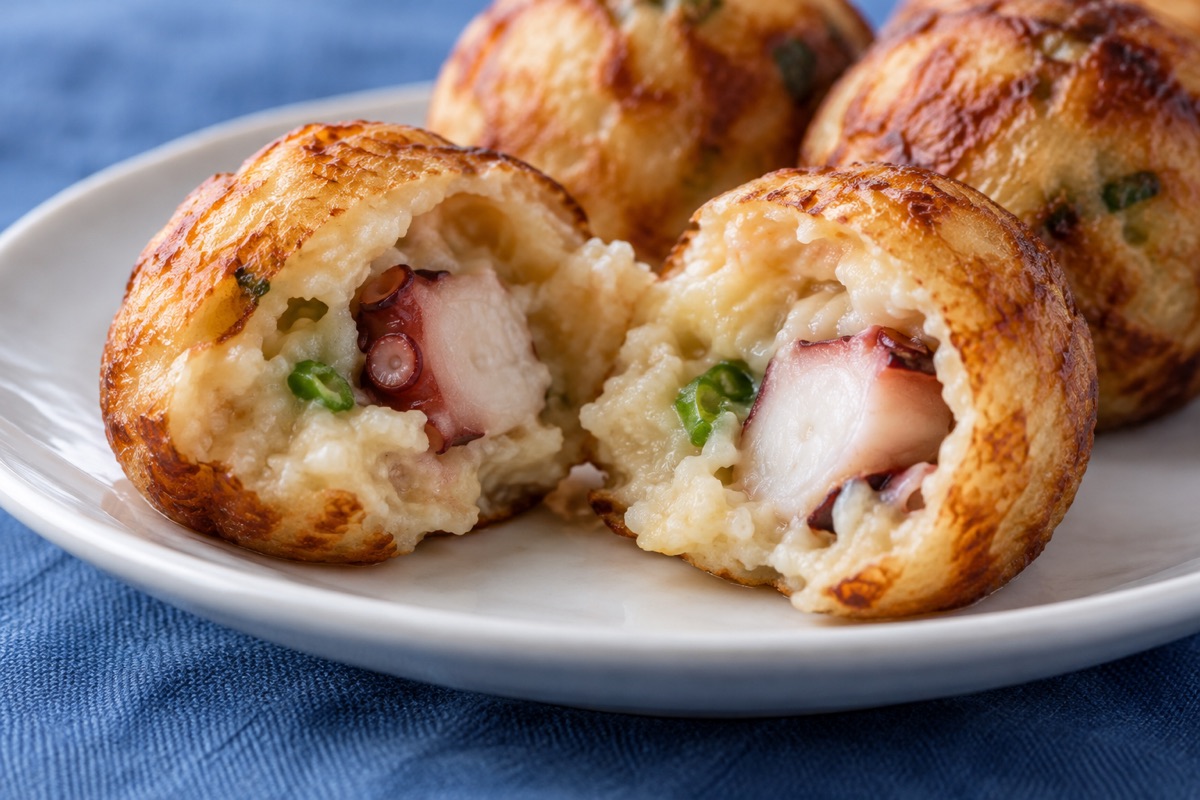
Osaka’s official tourism guide describes the contrast between a browned, crisp exterior and a soft interior, while also noting that batter, seasoning and cooking affect the result. That is a useful introduction, not a promise that every shop will produce an identical crust. Read Osaka’s takoyaki overview.
Inside, distinguish the tender batter from the piece of octopus. They are different components with different textures. Expecting the whole ball to behave like a firm fried snack can make the batter seem surprising even when the dish was deliberately made that way.
Otafuku’s explanation of batter hydration connects a softer interior with a larger proportion of liquid relative to flour. It also describes the trade-off: a wetter mixture is harder to shape because its surface is slower to become firm enough to handle. The appealing centre and the cook’s turning task are linked.
This does not make “add more water” a complete improvement strategy. You might obtain a mixture that is harder to manage before you have learned the original recipe. Start with the specified proportions and method. A restaurant’s result is not necessarily reproduced by changing one ingredient quantity in a household recipe.
Otafuku’s from-flour version lists 200 g of low-protein wheat flour with 600 ml of water or stock, plus three eggs and 20 ml of milk. These are selected quantities from one complete recipe, not a replacement recipe here. They make the important point that the mixture contains substantial liquid before the filling enters the pan.
Do not turn those figures into a universal flour-to-water rule for every packet. A seasoned premix has its own formulation. The set recipe and the from-flour recipe are different starting points, even when both are intended to produce takoyaki.
For the same reason, “creamy” describes a texture rather than a reliable ingredient declaration. The from-flour example does use milk, but the word itself cannot tell you whether another kitchen does. Ask about dairy directly if it matters to you.
Do not deliberately undercook batter to imitate a soft centre. The US Food and Drug Administration explains that flour is usually a raw food and advises against eating or tasting uncooked flour, dough or batter. Its guidance is to follow the cooking directions on flour-containing products and to keep raw ingredients separate from ready-to-eat food. See the FDA’s flour-handling guidance.
Neither “it feels soft” nor “the outside is brown” establishes that a particular portion was cooked correctly. Texture vocabulary is not a substitute for a suitable recipe, equipment instructions and proper cooking. If a served portion concerns you, ask the kitchen rather than relying on an online description to declare it safe.
A heavy finish can make the whole dish look like one sauce-covered object. Separating the components makes both ordering and home preparation easier.
| Part of the portion | What to identify | What a photograph cannot settle |
|---|---|---|
| Batter | Flour or premix, added liquid, egg and any other additions | Whether fish seasoning or dairy is already mixed in |
| Filling and small additions | Octopus, spring onion, ginger and crumbs in the chosen recipe | Whether a substituted centre changes the rest of the mixture |
| Finish | Sauce, mayonnaise, seaweed and fish flakes, where used | The formulation of each condiment or which toppings are optional |
Otafuku’s English cooking tips identify octopus, green onion, pickled red ginger and tenkasu, then list sauce, mayonnaise, aonori and bonito flakes as a finish. Here, tenkasu means tempura crumbs, aonori is the seaweed garnish, and bonito flakes are fish, not another form of seaweed.
Knowing those names changes the request you can make. “No bonito flakes, please” concerns the final garnish. It does not ask for a different stock or flour mixture. “No mayonnaise” is another separate request. A server can answer more accurately when you name the component rather than asking to remove “the Japanese topping”.
Our suggestion for a first portion is to avoid adding extra condiments automatically. Notice the interior and the existing finish before deciding you want more. That is a preference-based recommendation, not a claim that any particular restaurant has used the right amount for you.
For readers who do not eat seafood, the octopus is the obvious issue. The less visible issue is whether the kitchen can make a suitable base at all. A mushroom substitution, for example, changes the centre; it does not reach ingredients already dissolved or mixed into the batter.
Two products from the same manufacturer show why blanket statements about takoyaki flour are unhelpful. Otafuku’s Japanese Takoyaki Kodawari Set lists bonito powder and egg-white powder in its flour component; its included crumbs contain squid ingredients. By contrast, the manufacturer’s 180 g Okonomiyaki Takoyaki Flour listing states that the product has no animal ingredients and lists wheat and soy under “Contains”.
These are exact-product examples checked in October 2026. They are not a claim that either packet is currently stocked in your Indian city. Nor does the second packet’s formulation make every completed dish made with it vegetarian: added stock, egg, filling and condiments remain separate decisions.
The sauce deserves its own question. Otafuku’s Japanese 300 g Takoyaki Sauce includes oyster, meat, fish and scallop extracts in its ingredient list. That is evidence about that bottle, not every takoyaki sauce sold worldwide. A fruit-and-vegetable description on the front does not replace the complete ingredient list.
A practical request might be: “I do not eat fish or seafood. Does the batter or premix contain fish seasoning, and do the crumbs or sauce contain seafood?” If you also avoid eggs, say that explicitly and include the mayonnaise. If you avoid dairy, ask about the mixture as well as a cheese filling.
This order matters because some changes can be made when serving, while others require a separately prepared mixture. Omitting a garnish may be straightforward. Removing an ingredient from a bowl that has already been mixed is not the same operation.
If the answer is only “we can leave out the octopus”, the batter question remains unanswered. You do not need to argue over whether the menu’s label is correct. Ask whether the kitchen can check the packet and condiments; if it cannot establish what is in them, choose something you can verify.
For an allergy, also ask about handling and shared equipment rather than treating a substitution as an allergen-free guarantee. Vegetarian preferences, egg avoidance and allergy requirements are not interchangeable categories. Our Japanese vegetarian food guide for Indian readers provides broader stock and seasoning vocabulary; the immediate task here is to identify the actual batter, additions and finish.
An adapted snack can still be worth making. Describe what changed instead of claiming a non-octopus version is identical to the original. That gives people a fair expectation of what they are about to eat.
Another tray of pale, round octopus snacks may come with a bowl of broth. It is worth checking the name before deciding that the sauce has been forgotten.
Akashiyaki, locally called tamagoyaki in Akashi, is a related regional dish. The Akashi Tourism Association describes a mixture containing egg, wheat flour and jin-ko, a refined wheat starch, with octopus inside. The pieces are served on a board and dipped in broth. See the association’s Akashiyaki guide.
Japan’s Ministry of Agriculture, Forestry and Fisheries also distinguishes the higher proportion of egg compared with takoyaki and the soft result. Read MAFF’s regional-food account.
The distinction is in the mixture and serving approach, not just a bottle withheld at the end. Pouring broth beside your ordinary takoyaki does not establish that you have made the Akashi dish. Conversely, its gentler presentation is not an incomplete version of a sauce-heavy snack.
For a diner, this gives a useful choice of emphasis: do you want to explore a sauce-topped portion, or the combination of a soft egg-rich piece and dipping broth? Neither has to win. If egg or seafood is outside your diet, however, the pale appearance does not make Akashiyaki a suitable alternative by default.
The name also needs context. If you know tamagoyaki as a rolled omelette, ask what the menu means here; Akashi’s local use refers to this particular dish. Food names are often easier to understand when attached to a place and a preparation rather than translated in isolation.
Before deciding you need a new pan, choose the experience you want to try. Learning the round shape is a different goal from exploring the batter and octopus combination in a simpler form. Both are reasonable, but they lead to different methods.
For the round version, read a complete recipe alongside the instructions for the cookware you actually have. A pan with similar-looking hollows is not automatically identical in size, coating, heat-source compatibility or operating method. This matters if you already own an appe or paniyaram pan: use the manufacturer’s guidance rather than assuming the shared general shape guarantees identical results.
The Otafuku set guide’s approximate 32-piece yield uses hollows 43 mm across and 24 mm deep. Treat that as a qualified example, not a promise about every moulded pan.
The practical consequence is to plan by batches as well as by pieces. In a hypothetical example, a pan with 12 hollows would require at least three rounds to cook 32 pieces, assuming that recipe actually produces 32 in those hollows. The arithmetic is 12 + 12 + 8; it is not a predicted cooking time or a verified yield for your equipment.
That distinction can prevent an awkward first meal. A recipe’s total quantity may be manageable while its entire output cannot appear on the table at once. Decide whether people will eat successive batches or whether a different cooking project better suits the occasion.
Do not assemble one method from isolated tips. The Japanese set guide preheats its cooking surface, while the separate Otafuku Foods tips describe adding the initial batter and fillings before switching on the heat. Those are different sequences. Their existence is a reason to follow one coherent set of instructions, not a reason to alternate between the two halfway through.
Likewise, a temperature on an electric appliance is not a position on every gas hob’s control knob. Follow the selected recipe’s equipment qualifications and the appliance’s own instructions. Use turning tools compatible with the cooking surface; a video showing a metal pick does not establish that the same tool is appropriate for your coated pan.
For a first attempt, prepare the specified additions before starting the cooking sequence. Keep the chosen recipe open at the turning stage, where the timing and appearance cues matter. If the result needs improvement, note the exact mix, equipment and stage that caused difficulty. Changing the liquid quantity, filling size and heat setting together makes the next batch harder to compare.
Otafuku also publishes kakutako, a square adaptation made in a rectangular omelette pan: batter and fillings are folded and turned rather than formed into individual spheres. Its introduction to kakutako offers a route for someone without a takoyaki maker.
That is a better starting point than pretending any ordinary frying pan will reproduce the round method unchanged. Follow a complete recipe written for the alternative shape. You can explore the flavour combination now and decide later whether mastering the small hollows is a project you want to take on.
Once the ingredients suit you, let curiosity replace the search for a perfect specimen. Notice how the outside gives way, how the batter differs from the centre filling and whether the sauce complements or overwhelms what you enjoy. Those observations will help you choose your next portion more than a verdict that the dish is simply “good” or “strange”.
If you are comparing it with okonomiyaki, the difference is not just size. Our Osaka and Hiroshima okonomiyaki guide follows mixed and layered pancake constructions. Here, the distinctive task is shaping a fluid mixture through a succession of turns in a hollow.
You do not have to love every texture to appreciate how it is made. Prefer a firmer centre? Say so when asking what a shop’s version is like. Interested mainly in the dipping broth? Explore Akashiyaki on its own terms. Avoid seafood? Begin with a fully checked adaptation, not just a changed filling.
The little round shape is memorable, but it is the least complete description of the food. Understand what enters the pan, what the turning achieves and what gets added afterwards, and takoyaki becomes much easier to choose—and much more interesting to watch.

AUTHOR OF THIS ARTICLE
SoJapan
SoJapan India Pvt. Ltd. is a Japanese-founded company based in Gurugram. We bring Japanese food, anime goods and apparel materials to Indian businesses, with a sister company in Kyoto that works directly with makers in Japan.