← JOURNAL29 Sep 2026
SPY×FAMILY Explained: Why the Forgers’ Secrets Make the Family So Funny
 By SoJapan
A spy needs a convincing family. An assassin needs an ordinary-looking life. A child who can read minds knows more than either adult expects. Put them in the same household, and even a school interview becomes complicated.
That is the pleasure of SPY×FAMILY: the audience is often allowed to understand the situation before the people inside it do. The secret identities are not simply a twist being saved for the ending. Knowing them makes the ordinary conversations funnier, because a sensible answer for one person can mean something completely different to another.
Tatsuya Endo’s series is introduced by its English publisher as an action comedy about a fabricated family containing a spy, an assassin and a telepath. But that neat description leaves an interesting question unanswered: why should these exceptionally capable people be entertaining when they are trying to do something as unexceptional as spend a day together? VIZ’s official series introduction.
The answer involves three gaps: what each person knows, what each person wants, and what each person can actually do. This guide explores those gaps for Indian anime fans who want more than a list of character names.
Spoiler boundary: we discuss the opening identities and selected situations from the first twelve television episodes, including an early school disagreement. We leave their resolutions, later family additions and subsequent story arcs for you to discover. The linked official episode summaries can reveal more than this article does. Story facts come from those official sources; the discussion of humour and relationships is our interpretation.
The opening assignment belongs to Twilight, a spy working for WISE. Under the identity of psychiatrist Loid Forger, he takes in Anya and seeks to enrol her at Eden Academy, where he hopes to gain access to his target, Donovan Desmond. Anya’s ability to read minds is hidden from him. That is the starting situation described in the anime’s first episode. Official MISSION:1 synopsis.
The broader introduction puts a one-week deadline on forming the family. This compressed timescale is useful dramatically: there is little room to grow gradually into comfortable roles before the performance is required. Official anime story introduction.
Yor enters the arrangement with a different problem. Her public job is at city hall, while her hidden occupation is assassination. In the story’s suspicious social environment, being an unmarried woman can attract unwanted attention. Loid, meanwhile, needs someone to play Anya’s mother for the school interview. Official MISSION:2 synopsis.
Notice what this arrangement does not provide: a shared briefing. It would be a very different series if three specialists sat down, disclosed their abilities and agreed on a plan. Instead, they can cooperate on the visible task while understanding its purpose differently.
That distinction helps explain the title’s balance. The spy plot supplies a reason for the household to exist. The household then generates problems that cannot be reduced to the spy plot. A child has to live through school, not merely function as an access card to an adult’s target.
For a newcomer, the essential names are therefore few: Loid, Yor, Anya, Eden and Desmond. You do not need to memorise every organisation or later relative before starting. First understand why these people occupy the same rooms; the wider cast becomes easier to follow from there.
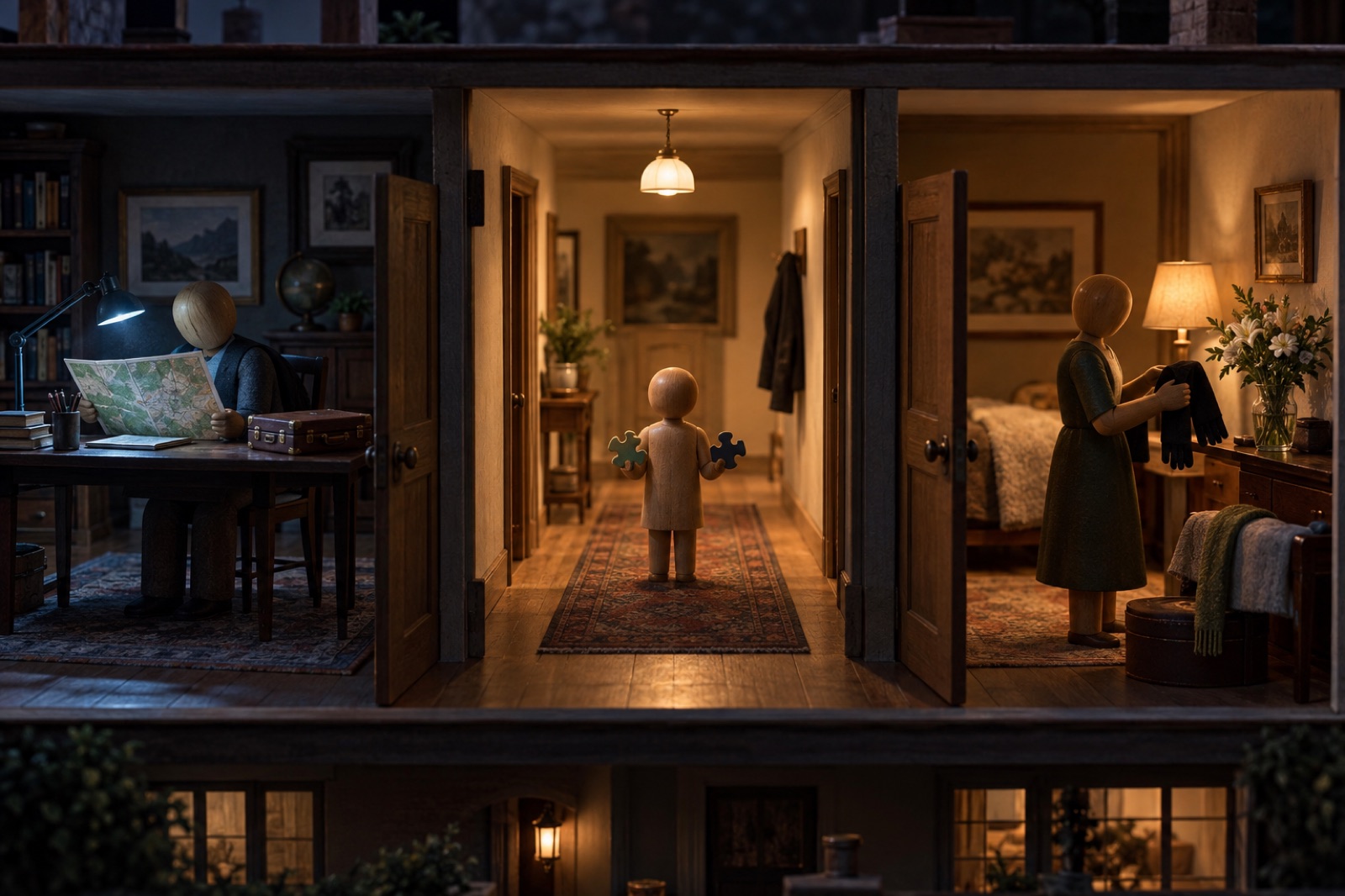
The family’s central joke depends on unequal knowledge. In the opening arrangement, Anya can recognise the adults’ hidden occupations while keeping her own ability secret. The adults do not begin with an equivalent view of one another. The official character descriptions make this asymmetry explicit. Official character guide.
Here is the useful beginner’s map—not a claim about every development later in the series:
| Person | Identity presented at home | Hidden element | What to watch for |
|---|---|---|---|
| Loid | Father and psychiatrist | The spy Twilight and his assignment | Mission reasoning behind ordinary family decisions |
| Yor | Mother and city-hall employee | Her work as an assassin | The effort required to appear ordinary |
| Anya | Daughter entering school | Her ability to read other people’s minds | Information she has but cannot openly explain |
| The viewer | Outside the household | No need to maintain the family’s cover | The difference between a spoken explanation and a private motive |
The storytelling term is dramatic irony: the audience knows something that a character does not. You do not need to remember the term to enjoy the effect. Watch for the moment when a harmless remark becomes funny because you understand an extra layer.
There are several possible pleasures here. You may anticipate a misunderstanding before it happens. You may understand why a person gives a strangely careful answer. Or you may enjoy a reaction that another character interprets incorrectly. The reveal is not always new information for you; sometimes it is the visible consequence of information you already possess.
This also explains why an isolated reaction image cannot carry the whole joke. A startled face is amusing on its own, but the surrounding scene tells you whose thought triggered it and why saying that thought aloud would create another problem.
On a first viewing, follow the conversation. On a rewatch, try following the knowledge instead. At each turn, ask who has heard a spoken sentence and who has access to something unspoken. The same scene can feel more carefully constructed when you notice that those are not identical groups.
Mind-reading sounds like an unbeatable advantage until you separate receiving information from using it. Knowing an adult’s immediate concern is not the same as possessing the adult’s experience, judgement or ability to carry out a plan.
The second episode offers a compact example. At a boutique, Anya discovers Yor’s hidden occupation through her thoughts and encourages Loid to bring her into their arrangement. The adults are discussing a practical family role, while Anya has access to an additional layer. The official synopsis presents the meeting from these different perspectives without requiring the audience to wait for a later revelation.
What makes this interesting is not a simple claim that the youngest person is secretly the most competent. Anya’s information advantage and her position as a child coexist. She can know something startling while still having to persuade an adult through an ordinary child’s words.
Consider an invented comparison, not a scene from the series. A child learns that a parent is worried about arriving late. That information does not give the child permission to drive, knowledge of every route or the ability to control traffic. Even a correct reading of the worry leaves practical choices unresolved.
Anya’s premise invites a similar distinction. The thought she hears is a piece of information; deciding how to respond is another task. It is worth watching for the gap between a complicated adult objective and the smaller action that seems available to her.
A thought also belongs to a perspective. A person’s immediate fear, suspicion or plan need not be an accurate description of everyone else’s motives. Even in fiction with telepathy, it is useful to distinguish “this person thinks it” from “the story has established it as fact.”
This is a reading principle, not an additional supernatural rule being invented for Anya. You can apply it to any scene containing internal monologue. Ask whether you are being shown evidence about the world or evidence about the thinker.
That distinction keeps Anya from becoming merely a device for delivering answers. Her reactions can reveal both the information she receives and the meaning she gives it. The comedy has room to continue because knowing more does not make every decision easy.
MISSION:3 turns family preparation into an outing. With Yor now living with Loid and Anya, he tries to build the shared knowledge and manners that an interview will require. Visits to a theatre and an art museum do not produce the response he hopes for. Official MISSION:3 synopsis.
The choice of activity is revealing. Loid approaches the family as something that can be prepared for a particular audience. If they acquire the right experiences and understand the expected behaviour, perhaps they can present a convincing picture.
Our reading is that the humour comes from a mismatch between planning and participation. Scheduling a cultural outing is straightforward compared with making someone interested in it. A plan may specify where three people should go; it cannot automatically determine what each of them notices or enjoys there.
That is a more generous interpretation than simply calling Loid foolish whenever his plan fails. His competence is real within the premise, but competence has a context. A technique for managing an assignment may become awkward when the “assignment” contains people with their own preferences.
For the viewer, this creates a useful double response. You can understand why he makes a decision and still see why that decision is insufficient. The character need not become unintelligent for the scene to be funny. The problem can be bigger than the particular skill he brings to it.
The next episode sharpens the pressure. At Eden, the prospective families are being observed and assessed before the formal interview has even begun. Housemaster Henderson pays attention to the Forgers’ conduct and subjects them to further tests. Official MISSION:4 synopsis.
Here, school manners and the feeling of being watched occupy the same scene. An ordinary admissions visit acquires the tension of a performance under scrutiny. The question becomes not just whether the family has prepared answers, but how its members respond when preparation is interrupted.
Watch this section for the difference between looking united and acting together. The first can be arranged as an image. The second has to happen in response to an event. The series gains much of its energy from putting pressure on that distinction.
Yor’s premise reverses a familiar assumption: the difficult task should be the spectacular one. Her hidden occupation is extraordinary, yet fitting into everyday expectations can be the uncomfortable part.
It is easy to flatten that contrast into a two-word description such as “strong but awkward.” A more useful question is: who gets to define what counts as capable in this particular room? A school, workplace and household do not ask for identical performances.
This is why it matters that Yor has her own reason to join the arrangement. She is not simply an accessory assigned to Loid’s mission. The same public role answers different needs for the two adults, giving their cooperation an unstable but understandable foundation.
There is also a difference between observing a fictional social pressure and endorsing it. The suspicion directed at an unmarried woman in the opening story is part of its world. It is not a lesson that marriage makes someone respectable, nor a reliable description of contemporary Japan or India.
For viewers who recognise the anxiety of being judged through a narrow social role, that tension may be relatable. It does not require a claim that every family or culture experiences the same pressure. The specific story gives you enough to understand Yor without forcing a national comparison onto her.
Keep that perspective when a scene places her abilities beside an ordinary task. The interesting contrast is often not strength versus weakness, but a mismatch between the ability someone possesses and the ability the situation appears to demand.
That makes room for a more affectionate kind of comedy. You can laugh at an excessive response without concluding that the person making it has nothing valuable to offer. The household becomes compelling partly because the roles are imperfect fits, not because everybody instantly performs them flawlessly.
School is not merely a backdrop between spy sequences. It creates a place where Loid’s objective must pass through relationships he cannot personally conduct on Anya’s behalf.
MISSION:7 begins after Anya has hit Damian Desmond and received a disciplinary mark, a Tonitrus Bolt. She struggles to apologise, while her friendship with Becky makes school less lonely. Loid, disguised as school personnel, tries to encourage reconciliation for the sake of his mission. Official MISSION:7 synopsis.
That situation contains several different measures of success. An operative wants a damaged route to a target repaired. A child needs to say something difficult to another child. A friendship can make an unpleasant day bearable without necessarily advancing the adult’s plan at all.
If you watch only for progress towards Desmond, you may overlook why Becky matters. Her friendship offers Anya something different from successful contact with a target’s family: a reason to enjoy being at school that day.
The disagreement also gives Anya a kind of difficulty that information alone cannot remove. An apology has a social risk: you must approach someone, choose words and accept that you cannot dictate the response. Hearing thoughts does not make another person a button you can press to obtain friendship.
An exaggerated premise still leaves recognisable awkwardness intact: the strategic instruction is simple, while the conversation needed to carry it out is not.
In MISSION:10, a rumour spreads that students who excel in the upcoming physical-education class will receive a Stella Star. Anya trains with Yor before the dodgeball match. The source calls it a rumour: it should not be converted into a guaranteed school reward in a beginner’s explanation. Official MISSION:10 synopsis.
That small qualification changes how you read the situation. The characters can invest enormous effort in something they expect to happen, while the viewer should still distinguish expectation from confirmation.
The episode premise also moves Yor’s involvement into Anya’s school life. The activity is ordinary; the surrounding ambitions make it feel much larger. Keep the basic distinction clear: a Stella is a desired distinction, while a Tonitrus marks misconduct. These incentives help explain the children’s urgency, but they do not tell you whether a rumoured reward is real.
A useful viewing question is whether a scene’s apparent importance comes from an established rule, a character’s hope or a rumour. Those three sources of urgency can lead to very different jokes.

MISSION:12 begins with an exhausted Loid hearing neighbours suggest that he neglects his family. Worried about the effect of suspicion on his assignment, he plans an aquarium visit to present a harmonious household. A new WISE task then intrudes on the outing. Official MISSION:12 synopsis.
This is a particularly clear way to understand the series’ genre mixture. The family excursion is not simply a pause before the espionage resumes. The two activities compete for the same person’s attention in the same stretch of time.
As an interpretation, think of this as a collision between two clocks. One measures whether the assignment can be completed. The other measures whether the day still feels like time spent together. Satisfying the first does not automatically satisfy the second.
That distinction is more interesting than asking whether a domestic episode is “filler.” A story can develop the household’s habits, expectations or strains even when the central investigation does not move a conspicuous distance forward. Conversely, a busy action sequence need not tell you much about a relationship simply because many things happen.
Instead of counting only plot milestones, ask what the situation makes someone choose. Whose attention is divided? Who believes the day is going according to plan? What is being protected: the cover story, the mission, another person’s experience, or several things at once?
Those questions help you see why an ordinary setting is useful. An aquarium visit offers a recognisable expectation of leisure. Placing a hidden assignment inside it makes the competing obligations easy to grasp without a long explanation of international politics.
There is a limit to this reading: it does not make every deceptive action admirable. The affection of the household and the manipulation built into its origin can coexist as sources of tension. You do not have to erase one to enjoy the other.
“Fake family” describes the arrangement’s origin. It should not end the discussion of every action performed within it.
One way to watch the Forgers is to distinguish a role, a motive and an action. The role is the identity someone presents. The motive is why they believe they are doing something. The action is what another person actually receives: time, attention, help, pressure or disappointment.
These categories can overlap without being identical. Preparing for an interview may serve a mission and still require patient attention. Helping with a school problem may have strategic value while also changing how supported a child feels. You can examine that possibility without declaring a precise moment when a character’s entire inner life has permanently changed.
This approach also leaves room for disagreement among fans. One viewer may find an action caring; another may emphasise the concealment around it. A better conversation points to the action and its context instead of claiming access to an unstated definitive motive.
If you discuss the series with friends, try separating three kinds of statement: what the scene explicitly shows, what you infer from it, and what you hope will happen later. Predictions can be part of the fun, but they should not be presented to a newcomer as established events.
For another kind of relationship comedy, our Ninja Hattori guide examines what happens when extraordinary abilities meet everyday difficulties. The comparison is useful precisely because the mechanisms differ: the Forgers’ shared home is structured around secrets that are not equally shared.
Start with the opening television episodes in order. They establish the household before asking you to enjoy variations on its problems. A compilation of Anya’s expressions can introduce the character’s appeal, but it removes the information that makes many of those reactions specific.
Give the series room to show more than one setting. The early family formation, interview preparation and school scenes demonstrate different parts of its appeal. If you enjoy only tightly advancing espionage, the domestic rhythm may feel slower than you want. If you like character comedy with action mixed in, that changing scale may be the attraction.
The presence of a child protagonist is not a guarantee of suitability for every young viewer. The opening premise includes assassination, espionage and threats of violence. For family viewing, check the age rating and content information on the service you actually use, and preview according to the viewer’s needs.
For access from India, verify the exact season, available audio and subtitles in your local catalogue. The Japanese official site’s streaming list is not evidence that those same services carry the same episodes in India. Our guide to watching anime legally in India explains that verification process; this article does not promise a particular subscription’s current catalogue.
You do not need to analyse every exchange while watching. Keep one simple question in mind when a scene catches your attention: what does this moment mean to each person in it?
An interview can be an operation, a test of belonging and a frightening adult ritual at once. An apology can be a strategic necessity and a child’s difficult conversation. An outing can be a public performance and an opportunity to spend time together. SPY×FAMILY becomes richer when you let those meanings sit beside one another—and funnier when they refuse to line up neatly.
AUTHOR OF THIS ARTICLE
SoJapan
SoJapan India Pvt. Ltd. is a Japanese-founded company based in Gurugram. We bring Japanese food, anime goods and apparel materials to Indian businesses, with a sister company in Kyoto that works directly with makers in Japan.