Recognising Dark Magician does not prepare you for a card covered in punctuation, an opponent asking for a response, or a monster with a Link Rating instead of a Level. That gap can make Yu-Gi-Oh! look like a hobby you were supposed to start years ago.
You were not. The useful starting point is smaller than the entire card catalogue: learn how one turn works, how two effects interact, and what your chosen deck is trying to assemble. The anime gives you a reason to care about the monsters. Those three skills give you a way to play with them.
For a fan exploring Yu-Gi-Oh! in India, there is also a practical question before buying physical cards: which version are your prospective opponents playing? An English-language card, a Japanese import and a digital deck are not automatically interchangeable.
This guide follows that journey from recognition to understanding. It is not a competitive tier list or a promise that a particular deck is in stock locally. Rules and official resources were checked on 29 September 2026; the worked scenarios below are teaching examples, not reports of real matches.
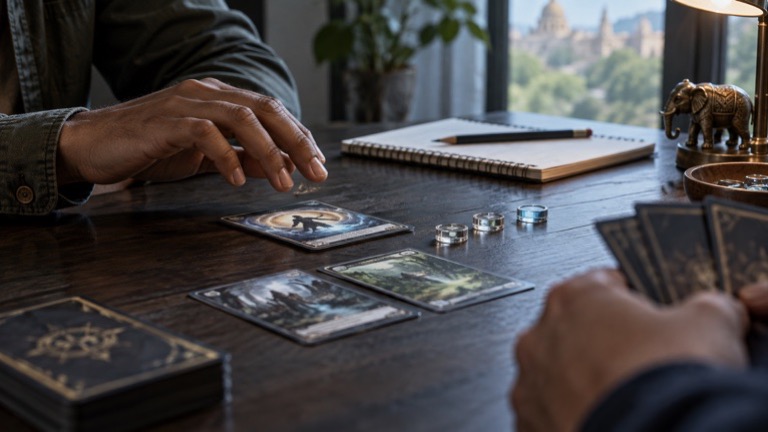
A dramatic comeback is a good reason to love a series. It is a poor rules reference. In a real Duel, the current card text and applicable rules decide what happens, not how convincing the play would look on screen.
That distinction actually makes learning easier. You do not need to remember every televised interaction or watch every sequel before sitting down with a friend. You need to explain the cards in front of you. If someone says a monster can do something because it did it in the anime, open its official database entry together.
Konami itself uses anime scenes in its beginner teaching videos, but separates the basic flow of a Duel from advanced lessons on Chains and summoning. Follow that separation. Trying to learn every monster category during your first hand makes ordinary decisions harder to see.
The first habit to change is evaluating a monster only by its ATK. Ask instead: how does it reach the field, what does it do there, and what remains if the opponent removes it? A spectacular monster you cannot summon is currently a card occupying your hand. A modest monster that enables your next play may be doing more useful work.
That is an editorial way of thinking about the game, not a rule that low-ATK monsters are always better. The interesting part is the relationship between cards. If you are still choosing between franchises, our TCG guide for Indian beginners compares the broader starting experiences.
Konami distinguishes the Yu-Gi-Oh! TRADING CARD GAME, or TCG, from the OFFICIAL CARD GAME, or OCG. Its card-legality guidance excludes Japanese, Korean, Chinese and Asian-English OCG cards from ordinary TCG tournament use. An English translation is therefore not enough to establish compatibility. Product edition matters too.
For an Indian player, the sensible next question is specific: “Which rules and card editions does this group accept?” Do not infer an official tournament territory from geography, or assume a community gathering follows every policy of a championship abroad. Check an event’s own published rules for any special exceptions.
Two friends can agree a casual environment, but that agreement does not establish eligibility for another organiser’s tournament. Keep a photograph or exact product identifier when asking about a purchase. “English Yu-Gi-Oh! cards” is less helpful than the actual edition you intend to bring.
Yu-Gi-Oh! Master Duel includes Solo Mode tutorials and Duel Strategy lessons covering summoning methods. It can give you a structured place to repeat a sequence and see which actions the software permits.
Use that feedback actively. If a button is missing, check the card’s conditions, your earlier actions and the game state before deciding the app is wrong. After a lesson, try explaining the sequence without the prompts. Being able to repeat clicks is different from understanding why those clicks were legal.
Before installing or spending, check the official destination for your actual Indian store account and device. This article does not promise availability on every platform or identical access in every region. Also verify restrictions inside the game: do not turn a digital deck screenshot into a physical purchase without checking the intended tabletop format.
“I play Duel Links” still needs a follow-up: Speed Duel or Rush Duel? Konami lists them as separate World Championship categories, alongside Master Duel and the TCG. Treat a guide’s mode label as essential context, not a minor detail beneath the title.
There is also Genesys, a physical TCG format with no Link or Pendulum Monsters. It uses a points system instead of the standard Forbidden & Limited List; the usual three-copy maximum remains. Its standard cap is 100 points, although an event can choose another cap. Check the current point list and the organiser’s chosen limit.
This is why “a beginner deck” is not a complete description. Ask for a deck for a named game and format, against a known kind of opponent. Fewer permitted mechanics might suit your learning preferences, but that alone does not guarantee a gentle match.
For the ordinary physical TCG, start with this compact reference. Your Main Deck contains 40–60 cards; the Extra Deck and Side Deck can each contain up to 15. The normal maximum is three copies of a card across all three combined, subject to restrictions. Players start with 8,000 LP and five cards. The first player does not draw for the opening turn or conduct its Battle Phase. The ordinary Normal Summon/Set allowance is one per turn, not one of each. See the official rulebook.
Reducing the opponent’s LP to zero is the usual win condition. The turn sequence is Draw, Standby, Main Phase 1, Battle, Main Phase 2 and End. If you skip the Battle Phase, you also skip Main Phase 2. Use the Main Phases to organise your plays; check effects relevant to each phase.
Do not try to make those numbers into a strategy on their own. The question in your opening hand is which action enables the next one.
Consider a deliberately simplified practice situation. You have a low-Level monster you can Normal Summon, a Trap you can Set, and another card you would rather save. Your aim is to make a legal turn you can explain, not imitate a long competitive combination.
First, identify what the summoned monster accomplishes. Does it give you a useful effect, establish material for a later summon, or simply leave something on the field? Second, read when the Trap can actually be activated. Third, ask whether the last card improves this position now or merely reduces your choices later.
The official beginner guide explains the basic distinction: a Trap is ordinarily Set before being activated on a later turn. Quick-Play Spells have their own timing rules; they are not simply Normal Spells with a different picture. Card text can create exceptions, so check the particular card rather than extending this short teaching example to every interaction.
There is no prize for using every available action. In an open-handed teaching game, say why you kept the last card. Your friend can then challenge the reason, rather than only telling you that a different play was “better”. That conversation is much more useful than replaying a memorised sequence with no explanation.
“I activate this” does not usually mean “its entire effect has already happened”. The pause between activation and resolution is where much of Yu-Gi-Oh!’s interaction lives.
Konami’s Fast Effect Timing guide explains opportunities to respond and to act before the game moves to another phase. Do not race through those opportunities. Naming your action, identifying any target and checking for a response makes the game easier to follow for both players.
Imagine Player A activates Raigeki, and Player B responds with Mystical Space Typhoon, which B Set on an earlier turn, targeting Raigeki. Assume both activations are legal, no other effects apply, and neither player adds another response.
| Moment | What happens |
|---|---|
| Chain Link 1 is activated | Player A activates Raigeki. Its effect has not resolved yet. |
| Chain Link 2 is activated | Player B activates Mystical Space Typhoon and targets Raigeki. |
| Chain Link 2 resolves first | Mystical Space Typhoon destroys Raigeki. |
| Chain Link 1 resolves next | Raigeki still destroys Player B’s monsters, under these assumptions. |
Why? Mystical Space Typhoon’s official text describes destruction, not negation. Removing this Normal Spell does not, by itself, cancel the effect already activated. Raigeki’s database entry gives the effect being resolved. The reverse resolution order comes from the rulebook’s Chain rules.
The lesson is not “destroying a Spell never matters”. Continuous cards and effects that require a card to remain face-up need separate treatment. The lesson is to identify the verb and the particular card involved. Destroy, banish and negate are not interchangeable ways of saying “stop that”.
For practice, reconstruct the example with two written labels. Point to the link being resolved, then describe the changed field. This externalises the order instead of asking a new player to keep the whole interaction in their head. Once that feels natural, add another legal response—not ten new mechanics at once.

Long effect text becomes more approachable when you stop treating it as one uninterrupted paragraph. Konami’s Problem-Solving Card Text explanation distinguishes conditions before a colon, activation procedures before a semicolon, and what happens when the effect resolves afterward. Not every effect needs every part.
Importantly, “before the semicolon” does not mean “everything here is a cost”. It can also include selecting targets. Spell and Trap Card activations can start a Chain even when their text contains neither punctuation mark; do not turn a shortcut for reading monster effects into a universal test.
Try three passes through an unfamiliar effect:
Then read the final sentence. A once-per-turn restriction or a limitation on later summons may be the part that changes your whole plan. Do not stop reading as soon as you find the exciting benefit.
Konami’s further card-text clues explain that activation costs are paid when activating. This matters to decision-making: you are committing something before knowing whether the eventual result will help you. Separate the cost from the hoped-for outcome when evaluating a play.
If you and a friend disagree, preserve the exact situation. Write the card names, whose turn it is, the phase, the target and the order of activations. “Can this beat that?” is often missing the information needed for a ruling. At an organised event, use the judge or organiser’s stated process rather than settling a disputed interaction through an unrelated video comment.
You do not need an encyclopaedia of summoning methods on day one. Pick the method your practice deck actually uses, then learn a contrasting one. The distinction becomes easier to remember when each method answers a different question.
Junk Synchron is a Level 3 Tuner. On its Normal Summon, its effect can bring back a qualifying Level 2-or-lower monster from your Graveyard in Defense Position, with its effects negated. That is already a useful reading exercise: the summon condition, target and result are separate pieces.
In a simplified legal setup, use face-up Junk Synchron and a face-up Level 2 non-Tuner you control to make the Level 5 Junk Warrior. The Level arithmetic is 3 + 2 = 5, and Junk Warrior specifically requires Junk Synchron plus non-Tuner material. Merely reaching five with arbitrary monsters is not enough.
Here is a revealing follow-up: Junk Warrior gains ATK from Level 2-or-lower monsters you currently control when its effect resolves. If your only such monster was just used as material, it is no longer waiting on your field to contribute. Summoning the boss and maximising its effect are different tasks.
The original Number 39: Utopia requires two Level 4 monsters and has Rank 4—not Level 8. The materials sit underneath it; its attack-negating effect uses a material by detaching it.
That creates a different planning question from the Synchro example. You are assembling a matching pair and then managing attached resources. Utopia also has an effect that destroys it if it is targeted for an attack while it has no material. Spending the last material is therefore not an invisible bookkeeping change.
Use the exact card entry when learning. A newer card with a longer name containing “Utopia” is not automatically the same card. Familiar artwork and names can hide meaningfully different instructions.
Decode Talker is Link-3 and requires at least two Effect Monsters. Its printed material line does not mean any two Effect Monsters automatically suffice. The Link Rating must also be satisfied: three suitable face-up non-Link Effect Monsters you control are one straightforward teaching setup. A suitable Link-2 Effect Monster counted as two, plus one other suitable Effect Monster counted as one, can also satisfy it. Assume no other summon restrictions apply.
Its arrows matter after the summon too. Decode Talker gains ATK for monsters it points to, and its response effect requires a monster you control that it points to as a Tribute. The practical question is not only whether you can produce it, but what will be around it afterward. A field can meet a summon requirement without supporting everything the summoned monster could do.
The Link-era beginner guide covers the material procedure. Read its placement diagrams alongside the subsequent update below, not as a replacement for that update.
Konami’s Solfachord teaching manual offers a clear numerical example: Scales 1 and 8 allow Pendulum Summons of Levels 2 through 7. The boundary numbers are not included. Pendulum Summons from the hand and from the face-up Extra Deck also have different destination constraints.
Do not rush to learn every Pendulum interaction because the cards look unfamiliar. Start by identifying the two scales and which text belongs to the monster effect or Pendulum effect. Then explain where each intended summon is coming from. Those questions expose a misunderstanding sooner than simply announcing several monsters at once.
Konami’s 2021 rules update clarifies that Fusion, Synchro and Xyz Monsters can first be summoned from the Extra Deck into your Main Monster Zones without requiring a Link arrow. Link Monsters and Pendulum Monsters summoned from the Extra Deck retain the Extra Monster Zone/linked-zone requirement.
An older official PDF can therefore contain a diagram that is no longer the whole answer. This is especially relevant when someone learns from an old product insert. Keep the rulebook and its updates together.
Fusion and Ritual lessons are also available in the official beginner video series. You can defer them until your chosen cards use them. Learning one deck well is a legitimate beginning, not an incomplete way to enjoy the franchise.
Take Dark Magician. One productive question is not “How many famous monsters can I fit beside it?” but “What useful thing happens when I get Dark Magician onto the field?”
Dark Magical Circle provides a concrete answer: its effect can target and banish an opponent’s card when Dark Magician is Normal or Special Summoned to your field, outside the Damage Step. Its separate activation effect looks at the top three cards and may add a qualifying card. Each effect has a once-per-turn limit.
That suggests a teaching exercise, not a tournament-ready deck recommendation. Trace how your proposed deck finds the pieces, produces the summon and benefits from it. What does an opening hand do if it has only the payoff? What happens if the opponent stops the enabling play? A support card is useful because it addresses one of those questions, not just because the illustration matches.
Here is a hypothetical consistency calculation. Assume a uniformly shuffled deck, exactly three copies of one desired card, a five-card opening hand, and no searching, extra draws or other effects.
The probability of opening at least one copy is about 33.8% in 40 cards, versus 23.3% in 60 cards. The calculation is one minus the probability that all five drawn cards come from the other cards: 1 − C(N−3, 5) / C(N, 5), where N is deck size and C(n, k) counts ways to choose k cards from n without regard to order.
This is not a win-rate claim, a universal instruction to use 40 cards, or a claim that three copies are legal for every card. It isolates one trade-off: extra cards can dilute access to a particular piece. Adding a favourite should be a conscious choice about the deck’s purpose, not an assumption that more options always mean more consistency.
For your first experiments, change one small package at a time and record what problem it was supposed to solve. “I could not start my plan” and “I started but had no answer to the opponent” are different problems. They should not automatically produce the same shopping list.
Before travelling to a gathering, ask for a beginner practice partner rather than simply an opponent. Share the named format and your experience level. Ask whether someone can explain responses slowly or lend a suitable practice deck; do not assume a venue provides either service.
Our anime events and communities guide for India can help you think about community discovery, but an anime gathering is not evidence of a Yu-Gi-Oh! tournament. Confirm the card activity, date and organiser directly. This guide is not asserting a current official event in any particular Indian city.
For two people learning together, Konami’s 2-Player Starter Set is a relevant product to investigate. The official contents are two 40-card Main Decks, two four-card Extra Decks and a 64-page comic guiding a scripted Duel. The appeal is the structured lesson; this is not a claim about Indian stock or a guarantee of competitive strength.
Whichever route you use, make the first session measurable in understanding rather than wins. Can you explain one activation completely? Can you reconstruct the last Chain? Can you identify why a summon was legal? If yes, you have learned something that transfers to unfamiliar cards.
Before organised Advanced-format play, recheck Konami’s current deck-construction page. At this article’s review, the linked list was effective 21 September 2026, with two specified changes delayed until 28 September. Do not use a saved deck video as your legality check, and do not apply that list automatically to Genesys or a digital mode.
If you run an Indian card shop or organise hobby events, SOJPN’s business enquiry channel is available for discussing Japanese products. State whether the enquiry concerns collecting or a specified play format; this is separate from the publisher’s authority over tournament eligibility.
The important change is being able to say why. Perhaps you spent a resource too early, misunderstood a response window, or assembled materials that did not meet the monster’s requirements. Each is a concrete question you can investigate and practise.
Choose one compatible way to play, one deck with a plan you can describe, and one partner or tutorial that gives you room to think. Keep the favourite monster that brought you here. Build the understanding around it.

AUTHOR OF THIS ARTICLE
SoJapan
SoJapan India Pvt. Ltd. is a Japanese-founded company based in Gurugram. We bring Japanese food, anime goods and apparel materials to Indian businesses, with a sister company in Kyoto that works directly with makers in Japan.