For one person, staying can mean refusing to lose something. For another, it can mean finally finding somewhere to stop.
That difference is a useful way into The Aquatope on White Sand. Kukuru Misakino is trying to keep Gama Gama Aquarium going. Fuuka Miyazawa arrives in Okinawa after leaving her idol career. They can work in the same place without the place answering the same need for each of them. The official premise brings their meeting together with the aquarium’s threatened closure; the contrast between their attachments is the reading this guide follows. DMM Pictures’ series introduction
There is a further complication: the aquarium is not empty space in which two people can sort themselves out. Animals need care, colleagues have responsibilities, and visitors need someone able to guide them. A refuge for a newcomer is already somebody else’s workplace.
This is a spoiler-light guide to the setup and selected situations in the first four episodes, not a summary of the whole series. It does not reveal the aquarium’s eventual fate or either lead’s later career. Where a linked creator interview contains later spoilers, that is marked beside the link.
Kukuru is not simply a visitor who loves the aquarium. The first episode introduces her as a high-school student serving as its acting director, working through the summer holidays against the prospect of closure. Fuuka reaches Gama Gama with help from the tourism association’s Karin Kudaka. Their starting positions are therefore unequal: Kukuru has an existing role, while Fuuka is entering a place she does not yet know. Official episode 1 synopsis
That distinction changes what an encouraging offer of help might mean. To the person arriving, work can offer structure: a reason to get up, someone to ask, a task with an end. To the person already responsible, another worker also brings questions about instruction and reliability. The same arrangement can be welcome and demanding.
Notice who knows what needs doing before a task starts, and whose attention is freed—or occupied—when someone new joins in. That is one way to follow their changing relationship without waiting for an argument to announce it.
The acting-director role also helps explain why affection for Gama Gama cannot remain a private feeling. Wanting a place to survive means dealing with work that other people can observe. Enthusiasm may explain Kukuru’s commitment; it cannot, by itself, tell a newcomer how to do a job.
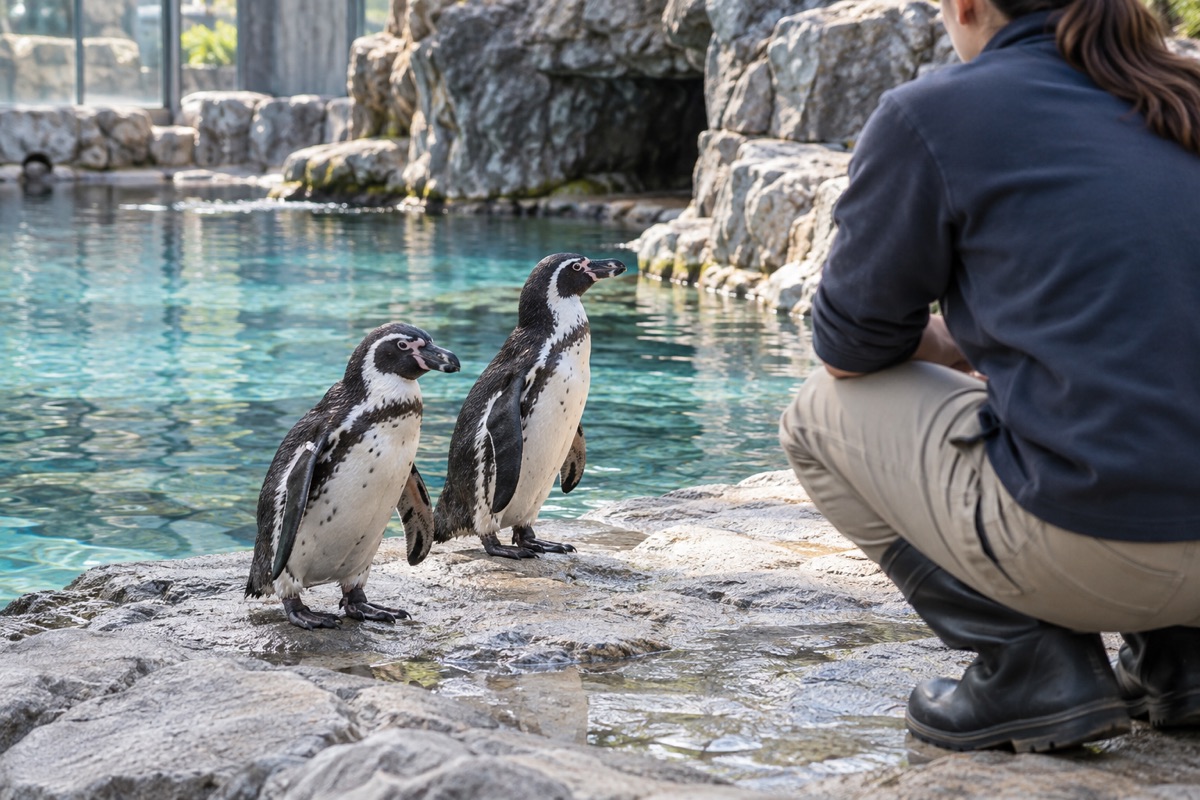
In episode 2, Fuuka begins working at the aquarium and stays at the Misakino family home. Kukuru teaches her how demanding the work can be, including a penguin-feeding show. The next episode’s synopsis explicitly recalls Fuuka’s feeding failure while describing her more capable handling of subsequent work. Official episode 2 synopsis, official episode 3 synopsis
There is a satisfying progression available here, but “she gets better” is only part of it. A public feeding show and routine work do not ask exactly the same thing of a newcomer. One puts an activity before an audience. Another can make progress visible through a less conspicuous task. The comparison gives you a way to recognise learning without treating every scene as an audition for a permanent future.
The third episode also places Kukuru under a different kind of pressure. With her grandfather away, she and Fuuka weigh the penguins. Kukuru notices something abnormal in one bird and, worried about responsibility for its life, seeks help from veterinarian Takeshita, who is on maternity leave. Official episode 3 synopsis
Here, the important distinction is between performing a task and deciding what an observation requires. An animal’s condition introduces a need that does not depend on whether the work is going well for the humans. Reading the scene that way makes the aquarium more than a convenient setting for personal development.
Urgency can be real without making someone else’s circumstances disappear. Watch how concern, responsibility and the availability of other people meet; determination alone does not settle the question. This is a reading of the drama, not animal-care advice.
Director Toshiya Shinohara has described a practical writing constraint: aquarium staff are responsible for lives. Repeatedly giving them serious, life-threatening failures would make the institution itself look like a bad aquarium. Creating drama within that limit was difficult. Official director Q&A — the linked page contains major later-series spoilers
That is a useful check on expectations. Our reading is to pay attention to what the work makes a person notice, not only to what goes wrong. The animals are not merely devices for teaching the leads a lesson, and the aquarium need not become a training manual for its responsibilities to matter.
The fourth episode turns towards a touch-pool attraction for the summer visitors. Kukuru directs preparations, while Fuuka is assigned a guiding role. Despite working diligently on her preparation, Fuuka is anxious about appearing in front of people. Official episode 4 synopsis
The apparent contradiction is worth keeping, rather than explaining away: a person with a performance background can still find this particular public role difficult. “Has stood before an audience” is a description of past experience, not a guarantee about every future encounter with one.
There are two questions a viewer might accidentally merge here. Can Fuuka prepare what she needs to say? And what does it feel like for her to become visible again? The synopsis places preparation beside unease rather than making one cancel the other. A neatly learned explanation is not necessarily the same thing as feeling ready to deliver it.
Her previous occupation matters without supplying an automatic solution. Allow her more than a résumé.
Rikako Aida, who voices Fuuka, describes more than fragility in her early comments: kindness towards others sits alongside surprising boldness and humour. That is a helpful counterweight to approaching Fuuka only as the girl whose earlier ambition ended. Aida’s official cast comment — the page also includes later-series characters
A character who is struggling need not be equally hesitant in every situation. Nor does a humorous or impulsive moment prove that an earlier difficulty was not serious. For a first viewing, leave room for those changes of register. Otherwise, you can mistake a person showing another side of herself for the story abandoning its premise.
This is also where the guide’s two-person focus matters. Kukuru has a reason to want an attraction staffed and ready. Fuuka has to inhabit the role she is given. Neither perspective is fully captured by asking whether the event is a good idea. One concerns making a shared undertaking happen; the other concerns being the person who must stand there.
If you enjoyed the question of earned responsibility in our Deaimon guide, this is a different variation. Nagomu returns to his family’s shop, where other people already know what he used to be like. Fuuka enters an unfamiliar workplace after leaving another life. Familiarity and a fresh start create different pressures; neither guarantees that a new role will feel natural.

An aquarium premise, Okinawan scenery and appealing animals can suggest an uncomplicated comfort watch. It is worth adjusting that expectation before you start. The closure threat and Fuuka’s departure from her previous career are already part of the opening, not late complications added to an otherwise carefree setup.
Shinohara’s explanation of sea imagery makes the distinction concrete. He describes how a wide view of the sea at dusk can become sad as well as beautiful when combined with Fuuka’s restrained crying. Image and sound create the emotional effect together. Director’s discussion of imagery — the linked Q&A contains major later spoilers
During a landscape passage, listen as well as look. A frame can offer space without offering relief; calling it pretty may leave half the experience undescribed.
Yohei Azakami, the voice of Kuya, recalls finding stretches without characters or dialogue in the script and wondering how they would appear on screen. His comment singles out the finished scenery and animation. Azakami’s official cast comment
That account is a reason to give such passages your eyes, rather than treating every gap in conversation as time to look away. It is not a promise that every viewer will enjoy the pace. If you prefer constant verbal exchanges, the amount of attention requested by an unhurried visual passage may itself be part of deciding whether this is the evening for this anime.
Try a small distinction when you feel that an episode has slowed down: has the immediate problem disappeared, or has the dialogue stopped explaining it? Those are not equivalent. You need not invent a hidden symbol for every wave to remain engaged with an unresolved feeling.
The first episode’s official description includes Fuuka having an unusual experience before a tank, followed by Kukuru asking whether she saw it too. We will leave the contents and explanation of that moment to the anime. The point for a new viewer is that the opening is not framed solely as an ordinary workplace account. Official episode 1 description
You can hold that uncertainty alongside the practical work without rushing to choose a single category. The presence of something strange does not make feeding and observation irrelevant; those tasks do not require every other part of the story to behave like a procedural explanation.
There is no need to decide on a theory immediately. Let the series establish its balance of daily activity and the fantastic before expecting a particular kind of explanation.
This guide concerns the 2021 television anime, an original project credited to project Tingarla, with animation by P.A.WORKS and direction by Toshiya Shinohara. DMM Pictures’ work record and credits
You do not need previous idol-anime knowledge or specialist knowledge of marine life to follow the opening question. The useful information is relational: who has arrived, who already belongs, and what each hopes staying will make possible. The jobs give those hopes something concrete to encounter.
The series is a promising choice if you like watching a relationship develop through shared responsibilities, with room for quiet images between conversations. It is a less obvious choice if you want only cheerful animal encounters, a brisk professional success story, or practical instructions for entering aquarium work. The early situations described here contain uncertainty and pressure; a beautiful setting does not remove them.
Our SHIROBAKO article follows a different workplace question: what happens when creative requests and information travel between people? That can be a useful next read if the coordination interests you most. Aquatope’s opening has its own centre of attention, though: a living collection that must be cared for while two young people approach it from different directions.
For readers in India, the Japanese official and distributor pages linked here verify the work and the episode premises. They do not establish Indian streaming availability. Before paying for access, check the exact television title, your region and the subtitles offered by the licensed service you are considering. No current local platform, subscription price or stock claim is made here.
Start with episode one rather than a later character profile: the official site now includes material from beyond the opening covered here. After the first few episodes, you can return to one distinction without making the viewing into homework. Is the aquarium important in this scene because of what someone needs from it, or because of what its inhabitants need from that person?
Both can be true. That is what makes the two reasons to stay worth following. Kukuru’s wish to preserve a place and Fuuka’s arrival after a departure meet in tasks that cannot be completed through affection alone. Gama Gama can matter deeply to them without becoming the same answer for each.

AUTHOR OF THIS ARTICLE
SoJapan
SoJapan India Pvt. Ltd. is a Japanese-founded company based in Gurugram. We bring Japanese food, anime goods and apparel materials to Indian businesses, with a sister company in Kyoto that works directly with makers in Japan.